


Some error occured while loading the Quick View. Please close the Quick View and try reloading the page.
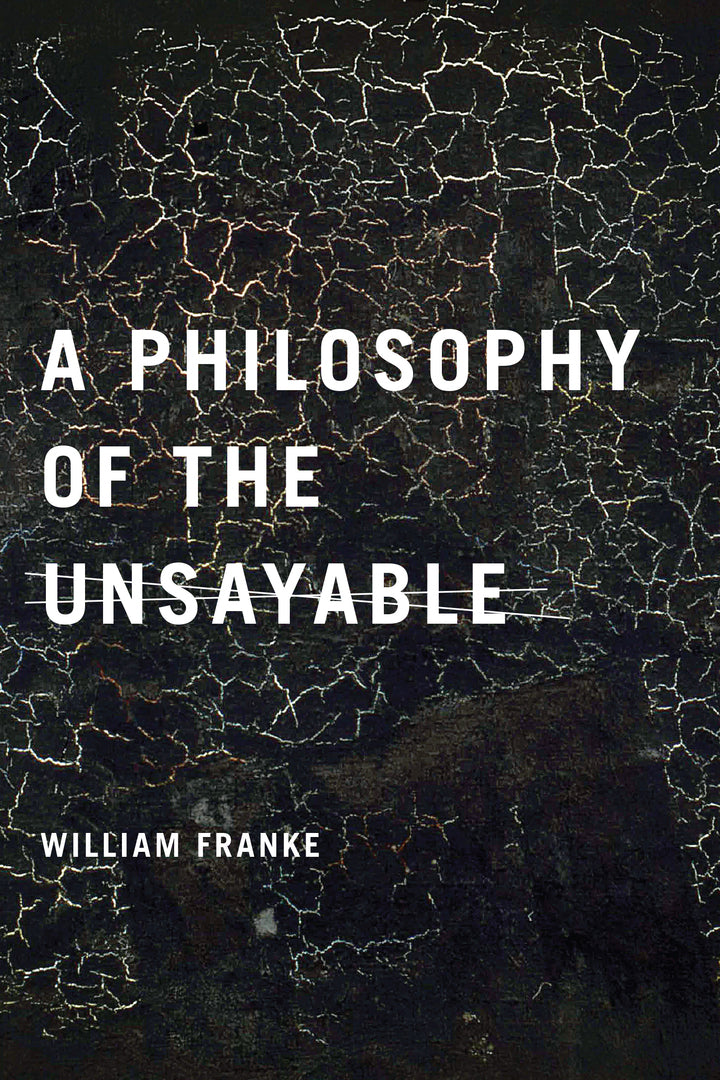
In A Philosophy of the Unsayable, William Franke argues that the encounter with what exceeds speech has become the crucial philosophical issue of our time. He proposes an original philosophy pivoting on analysis of the limits of language. The book also offers readings of literary texts as poetically performing the philosophical principles it expounds. Franke engages with philosophical theologies and philosophies of religion in the debate over negative theology and shows how apophaticism infiltrates the thinking even of those who attempt to deny or delimit it.
In six cohesive essays, Franke explores fundamental aspects of unsayability. In the first and third essays, his philosophical argument is carried through with acute attention to modes of unsayability that are revealed best by literary works, particularly by negativities of poetic language in the oeuvres of Paul Celan and Edmond Jabès. Franke engages in critical discussion of apophatic currents of philosophy both ancient and modern, focusing on Hegel and French post-Hegelianism in his second essay and on Neoplatonism in his fourth essay. He treats Neoplatonic apophatics especially as found in Damascius and as illuminated by postmodern thought, particularly Jean-Luc Nancy’s deconstruction of Christianity. In the last two essays, Franke treats the tension between two contemporary approaches to philosophy of religion—Radical Orthodoxy and radically secular or Death-of-God theologies. A Philosophy of the Unsayable will interest scholars and students of philosophy, literature, religion, and the humanities. This book develops Franke's explicit theory of unsayability, which is informed by his long-standing engagement with major representatives of apophatic thought in the Western tradition.

"William Franke has emerged as our foremost purveyor of what cannot be said. . . . We should be grateful for this extended articulation, since it also informs us why the unsayable must be said. . . . Given its breadth—the range of thinkers and thought that is covered—and its challenge—to keep open ‘conscious human reflection that refuses to be cut off from the mystery of its ground’—this is a remarkable text, and deserves close attention at every level." —Literature & Theology
William Franke is professor of comparative literature and religious studies at Vanderbilt University and past professor of philosophy and religions at the University of Macao (2013–16). He is a research fellow of the Alexander von Humboldt-Stiftung and has been Fulbright-University of Salzburg Distinguished Chair in Intercultural Theology and Study of Religions. He is the author of A Philosophy of the Unsayable (University of Notre Dame Press, 2014).
Preface
Part 1. Philosophy and Literature
1. On e Invitatory: Varieties and Valences of Unsayability in Literature
2. In the Hollow of Pan’s Pipe: Unsayability and the Experience of Truth and Totality
3. The Writing of Silence in the Post-Holocaust Poetry of Edmond Jabès and Paul Celan
Part 2. Philosophy and Theology
4. Apophasis and the Predicament of Philosophy of Religion Today: From Neoplatonic Negative Theology to Postmodern Negations of Theology
5. Radical Orthodoxy’s Critique of Transcendental Philosophy and Its Mistaken Mistrust of Negative Theology
6. Apophatic Thought as the Missing Mean between Radically Secular and Radically Orthodox Theology
In conclusion
Notes
Index