


Some error occured while loading the Quick View. Please close the Quick View and try reloading the page.
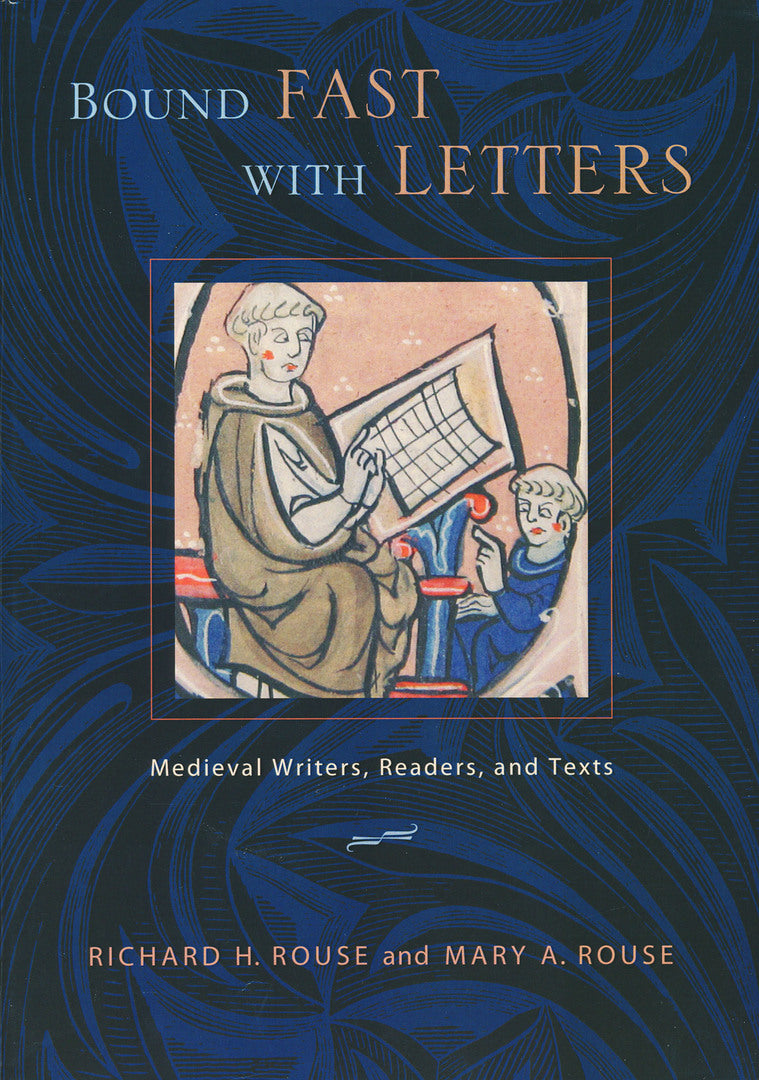
Bound Fast with Letters brings together in one volume many of the significant contributions that Richard H. Rouse and Mary A. Rouse have made over the past forty years to the study of medieval manuscripts through the prism of textual transmission and manuscript production. The eighteen essays collected here address medieval authors, craftsmen, book producers, and patrons of manuscripts from different epochs in the Middle Ages, extending from late antiquity to the early Renaissance, and ranging from North Africa to northern England. Their investigations reveal valuable information about the history of texts and their transmission, and their careful scrutiny of texts and of the physical manuscripts that convey them illuminate the societies that created, read, and preserved these objects.
The book begins in Part I with articles on writers from the patristic era through the twelfth century who experimented with, and mastered, various physical forms of presenting ideas in writing. Part II contains essays on patronage and patrons, including Richard de Fournival, Jean de Brienne, Watriquet de Couvin, Pope Clement V, the Counts of Saint-Pol, and Christine de Pizan. Part III, on manuscript producers, discusses the questions, for whom? and by whom? were manuscripts made. The four essays in this section each reflect on a different part of the process of book-making. Throughout, Bound Fast with Letters focuses on the close ties between the physical remains of literate culture—from the wax tablets of the patristic era to the vernacular literature of the wealthy laity of the late Middle Ages—and their social and economic context.

“Over four decades the Rouses’ prolific work on medieval manuscripts has continuously advanced knowledge in this field by providing convincing answers to and unique examples of the way books were conceived, constructed, copied, illuminated, commissioned, sold, and used. . . . The result is a breathtaking stretch of work ranging from writing practices in fifth-century Northern Africa to fifteenth-century commercial book-making in France and Italy.” —Manuscripta
Richard H. Rouse is professor of history emeritus at University of California, Los Angeles.
Mary A. Rouse is former managing editor of Viator. They are coauthors of a number of books, including Manuscripts and Their Makers: Commercial Book Producers in Medieval Paris, 1200–1500.
Foreword by Robert Somerville
Acknowledgments
List of Abbreviations
Introduction
Part I. Writing It Down: Practicalities and Imagery, 500–1220
1. The Vocabulary of Wax Tablets
2. Donatist Aids to Bible Study: North African Literary Production in the Fifth Century by Charles McNelis
3. Two Carolingian Bifolia: Haimo of Auxerre and Carolingian Liturgical Texts
4. From Flax to Parchment: A Monastic Sermon from Twelfth-Century Durham
5. The Schools and the Waldensians: A New Work by Durand of Huesca
Part II. Patrons and the Use of Books, 1250–1400
6. Manuscripts Belonging to Richard de Fournival
7. Early Manuscripts of Jean de Meun’s Translation of Vegetius
8. Publishing Watriquet’s Dits
9. Context and Reception: A Crusading Collection for Charles IV
of France
10. The Goldsmith and the Peacocks: Jean de le Mote in the Household of Simon de Lille, 1340
11. French Literature and the Counts of Saint-Pol, ca. 1178–1377
12. Prudence, Mother of Virtues: The Chapelet des vertus and Christine de Pizan
Part III. Commercial Book-Makers, French and Italian, 1290–1410
13. Wandering Scribes and Traveling Artists: Raulinus of Fremington and His Bolognese Bible
14. Thomas of Wymondswold and the Making of a Glossed Decretum
15. Jean Marlais and Bonne, His Wife: Last Wills from the Medieval Paris Book Trade
16. Pierre le Portier and the Makers of the Antiphonals of St-Jacques
17. St. Antoninus of Florence on Manuscript Production
Part IV. Epilogue
18. Archives in the Service of Manuscript Study: The Well-Known by Nicolas Flamel
Index of Manuscripts and Documents Cited
General Index