Skip to product information
1 of 1

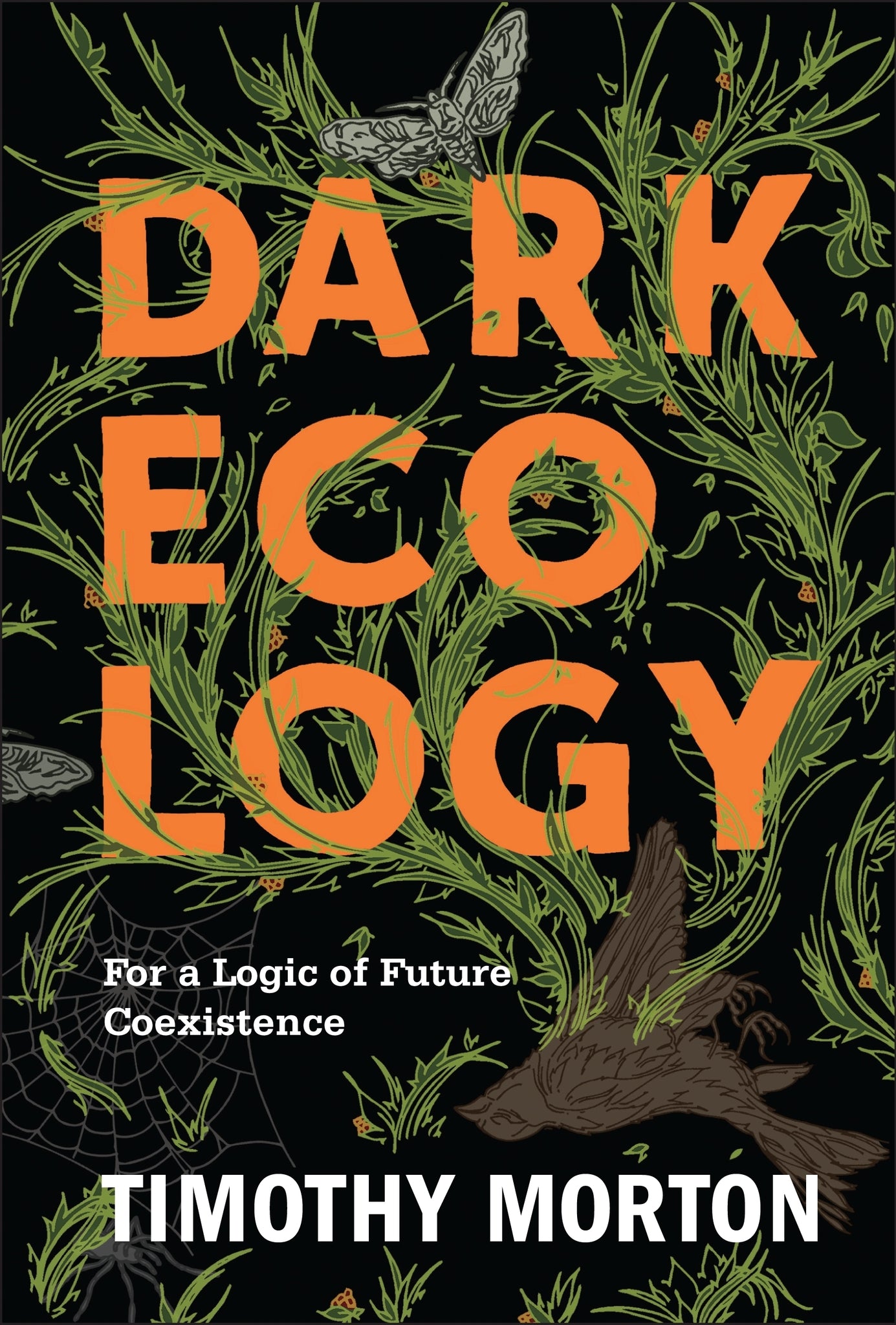
Dark Ecology

Regular price $25.00
Sale price $25.00 Regular price $25.00
Sale Sold out
Timothy Morton explores the foundations of the ecological crisis to reestablish our ties to nonhuman beings and rediscover playfulness and joy. Dark ecology puts us in an uncanny position of radica...
Read More
  • Format:
  • 12 June 2018
View Product Details

Timothy Morton argues that ecological awareness in the present Anthropocene era takes the form of a strange loop or Möbius strip, twisted to have only one side. Deckard travels this oedipal path in Blade Runner (1982) when he learns that he might be the enemy he has been ordered to pursue. Ecological awareness takes this shape because ecological phenomena have a loop form that is also fundamental to the structure of how things are.

The logistics of agricultural society resulted in global warming and hardwired dangerous ideas about life-forms into the human mind. Dark ecology puts us in an uncanny position of radical self-knowledge, illuminating our place in the biosphere and our belonging to a species in a sense that is far less obvious than we like to think. Morton explores the logical foundations of the ecological crisis, which is suffused with the melancholy and negativity of coexistence yet evolving, as we explore its loop form, into something playful, anarchic, and comedic. His work is a skilled fusion of humanities and scientific scholarship, incorporating the theories and findings of philosophy, anthropology, literature, ecology, biology, and physics. Morton hopes to reestablish our ties to nonhuman beings and to help us rediscover the playfulness and joy that can brighten the dark, strange loop we traverse.

files/i.png Icon
Price: $25.00
Pages: 208
Publisher: Columbia University Press
Imprint: Columbia University Press
Publication Date: 12 June 2018
Trim Size: 8.25 X 5.50 in
ISBN: 9780231177535
Format: Paperback
BISACs:

PHILOSOPHY / Movements / Critical Theory, PHILOSOPHY / Ethics & Moral Philosophy, LITERARY CRITICISM / Semiotics & Theory, SCIENCE / Global Warming & Climate Change, NATURE / Environmental Conservation & Protection

In often witty and humorous language, Timothy Morton provides a kind of affective atlas for the human era. The book calls for scholars to recognize the structures of entwinement between (the human) species and ecological phenomena and to develop modes of thought for accommodating them.
Timothy Morton is Rita Shea Guffey Chair in English at Rice University. His books include Ecology Without Nature (2007); The Ecological Thought (2010); Hyperobjects: Philosophy and Ecology After the End of the World (2013); and Realist Magic: Objects, Ontology, Causality (2013); and he has published more than 150 essays on ecology, philosophy, art, literature, music, architecture, and food. He has collaborated with several artists, including Björk, Jennifer Walshe, Olafur Eliasson, Haim Steinbach, Emilija Škarnulytė, and Pharrell Williams, and blogs regularly at ecologywithoutnature.blogspot.com.

Acknowledgments
Beginning After the End
The First Thread
The Second Thread
The Third Thread
Ending Before the Beginning
Notes
Index