


Some error occured while loading the Quick View. Please close the Quick View and try reloading the page.
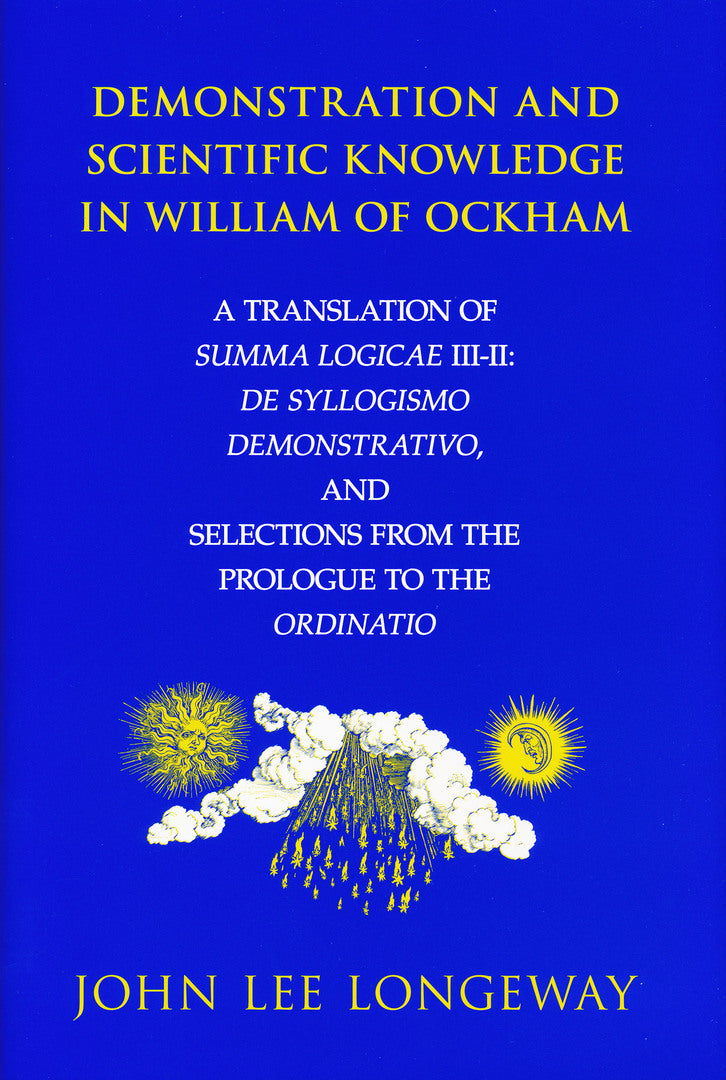
This book makes available for the first time an English translation of William Ockham's work on Aristotle's Posterior Analytics, which contains his theory of scientific demonstration and philosophy of science. John Lee Longeway also includes an extensive commentary and a detailed history of the intellectual background to Ockham's work in the Latin Middle Ages.
Longeway puts Ockham into context by providing a scholarly account of the reception and study of the Posterior Analytics in the Latin Middle Ages, with a detailed discussion of Robert Grosseteste, Albert the Great, Thomas Aquinas, Duns Scotus, and Giles of Rome. In a series of appendices, Longeway includes shorter translations of some important related work by Giles of Rome and John of Cornwall.
In his introductory discussion, Longeway examines the exact character of the highest sort of demonstration (demonstratio potissima), the relations of the empirical sciences to mathematics, natural causation and the manner in which natural laws come to be known, the possibility of natural knowledge, our knowledge of God, and the relation of theology to the other sciences. Longeway discusses the way in which scientific epistemology and theory of demonstration corresponds to the metaphysical position of its interpreter, in particular to the Neoplatonism of Grosseteste, the radical Aristotelianism of Giles of Rome and Albert the Great, the more moderate Aristotelianism of Aquinas, and the nominalistic empiricism of Ockham. Throughout the book, Longeway makes a case for Ockham's importance as the founder of Empiricism in the West.
Demonstration and Scientific Knowledge in William of Ockham will interest philosophers and historians of science and logic, as well as those who study medieval philosophy or early modern philosophy.

“Like much else in medieval philosophy, medieval theories of demonstrative knowledge are historically important, philosophically interesting, and little understood. There are a few extensive studies into medieval discussions of demonstration and even fewer translations of these important discussions. Longeway's translation of Ockham in Demonstration and Scientific Knowledge in William of Ockham is among the few English translations of medieval commentaries on posterior analytics we have and in this way is an important contribution to the field. Longeway's lengthy introductory survey both introduces readers to the development of medieval discussion of Posterior analytics prior to Ockham and situates (historically and philosophically) Ockham's discussion within that development. These translations will be of value to scholars working on a variety of areas on Ockham's thought as well as to scholars interested more generally in medieval theories of demonstration, science, and epistemology.” —Susan Brower-Toland, Saint Louis University
John Lee Longeway is associate professor at University of Wisconsin, Parkside. He is the author of William Heytesbury: On Maxima and Minima.