


Some error occured while loading the Quick View. Please close the Quick View and try reloading the page.
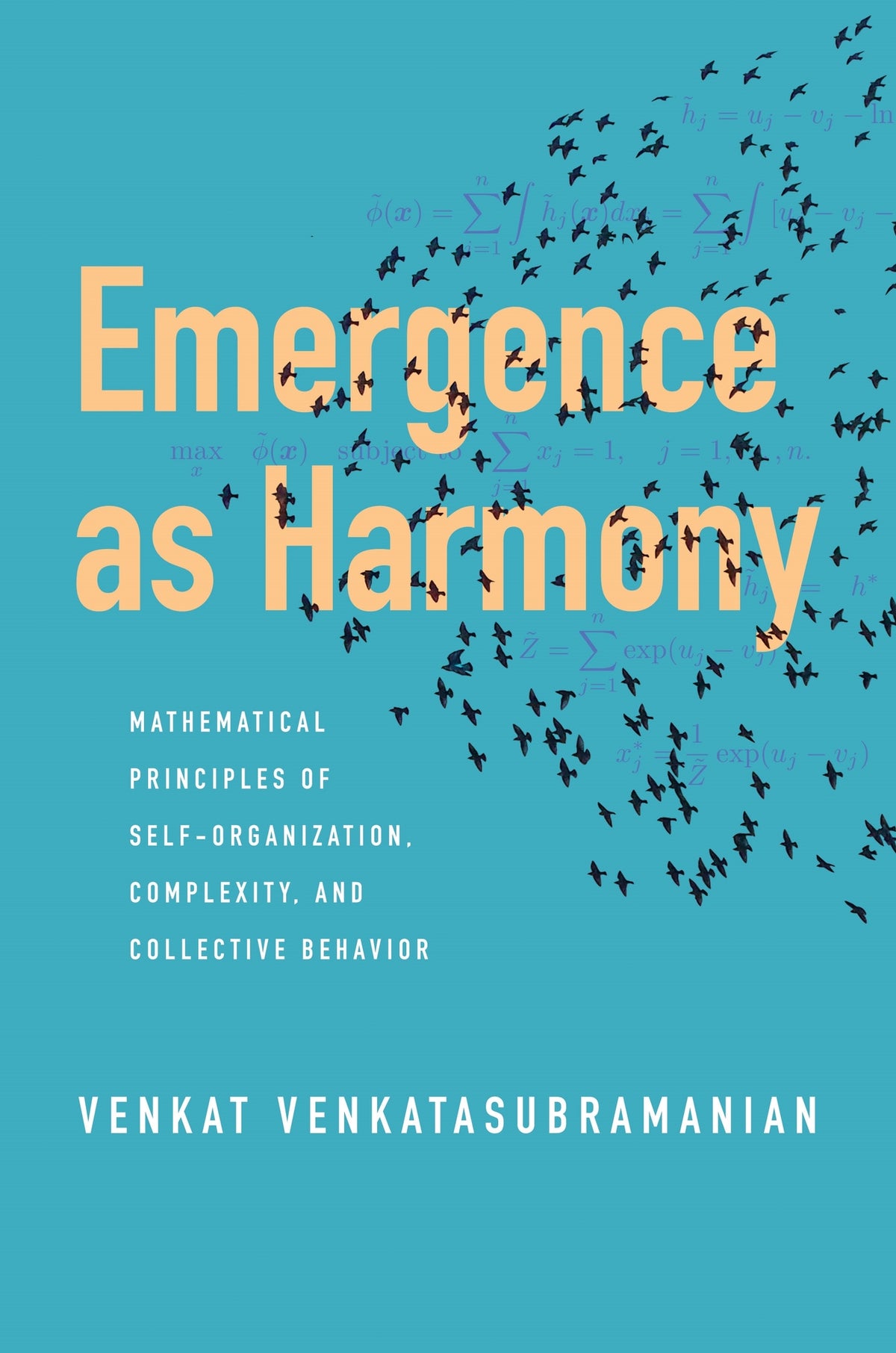
Emergent phenomena arise when complex systems exhibit properties that are absent in their constituent parts. They span scales and disciplines, from the collective intelligence of bird flocks in biology to the patterns of inequality and segregation in economics and sociology. Do these disparate examples share unifying principles? How do order and collective behavior emerge from chaos through self-organization?
Venkat Venkatasubramanian shows that a novel paradigm—statistical teleodynamics—can explain emergence. This unified theory represents a transdisciplinary synthesis integrating concepts from various fields. Venkatasubramanian formulates a mathematical framework for understanding emergent phenomena across domains, spanning physics, biology, ecology, economics, sociology, and artificial intelligence. He demonstrates that the organizational principle of emergent systems is maximizing harmony, which he examines various ways to measure. Emergence as Harmony offers new answers to fundamental questions on topics ranging from income inequality to large language models and neural networks.

— Julio Mario Ottino, author of The Nexus: Augmented Thinking for a Complex World
Preface
1. Organized Is Different
2. Teleological Systems and Game Theory
3. Statistical Teleodynamics
4. Entropic Economics: Income Inequality
5. Entropic Economics: Income Inequality in the Real World
6. Emergence in Biology: Bacteria, Ants, and Mussels
7. Emergence in Ecology: Bird Swarms
8. Emergence in Sociology: Social Segregation
9. Emergence in Artificial Intelligence: Universal Microstructure of Large Language Models
10. On the Organization of Species
References
Index