


Some error occured while loading the Quick View. Please close the Quick View and try reloading the page.
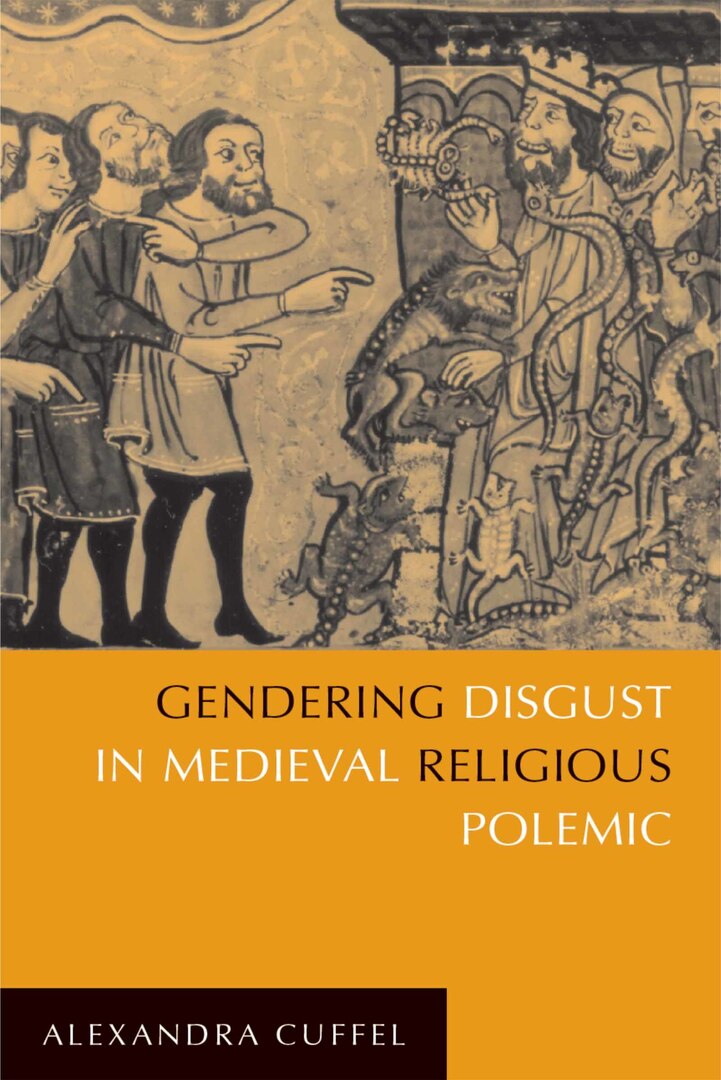
In Gendering Disgust in Medieval Religious Polemic, Alexandra Cuffel analyzes medieval Jewish, Christian, and Muslim uses of gendered bodily imagery and metaphors of impurity in their visual and verbal polemic against one another. Drawing from a rich array of sources—including medical texts, bestiaries, Muslim apocalyptic texts, midrash, biblical commentaries, kabbalistic literature, Hebrew liturgical poetry, and theological tracts from late antiquity to the mid-fourteenth century—Cuffel examines attitudes toward the corporeal body and its relationship to divinity. She shows that these religious traditions shared notions of the human body as distasteful, with many believers viewing corporeality and communion with the divine as incompatible. In particular, she explores how authors from each religious tradition targeted the woman’s body as antithetical to holiness.
Foul smell, bodily fluids and states, and animals were employed by these religious communities as powerful tropes, which they used to mark their religious opponents as sinful, filthy, and unacceptable. By defining and denigrating the religious “other,” each group wielded bodily insult as a means of resistance, of inciting violence, and of creating community boundaries. Representations of impurity or filth designed to inspire revulsion served also to reassure audiences of their religious and sometimes physical superiority and to encourage oppressive measures toward the minority.
Yet, even in the midst of opposing one another, their very polemic demonstrates that Jews, Christians, and Muslims held basic cultural assumptions and symbols in common while inflecting their meanings differently.

“Alexandra Cuffel’s Gendering Disgust takes the evolving field of medieval religious polemics into welcome new directions that build on different scholarly traditions, which she has combined in new and exciting ways. Cuffel’s extraordinarily stimulating new book extends the discussion further precisely in intercultural directions. Overall, Cuffel is to be congratulated for a book that is a very welcome addition to the growing field of medieval body studies, gender studies, history of emotions, as well as of interreligious cultural polemics.” —Speculum
Alexandra Cuffel is assistant professor of history at Macalester College.