


Some error occured while loading the Quick View. Please close the Quick View and try reloading the page.
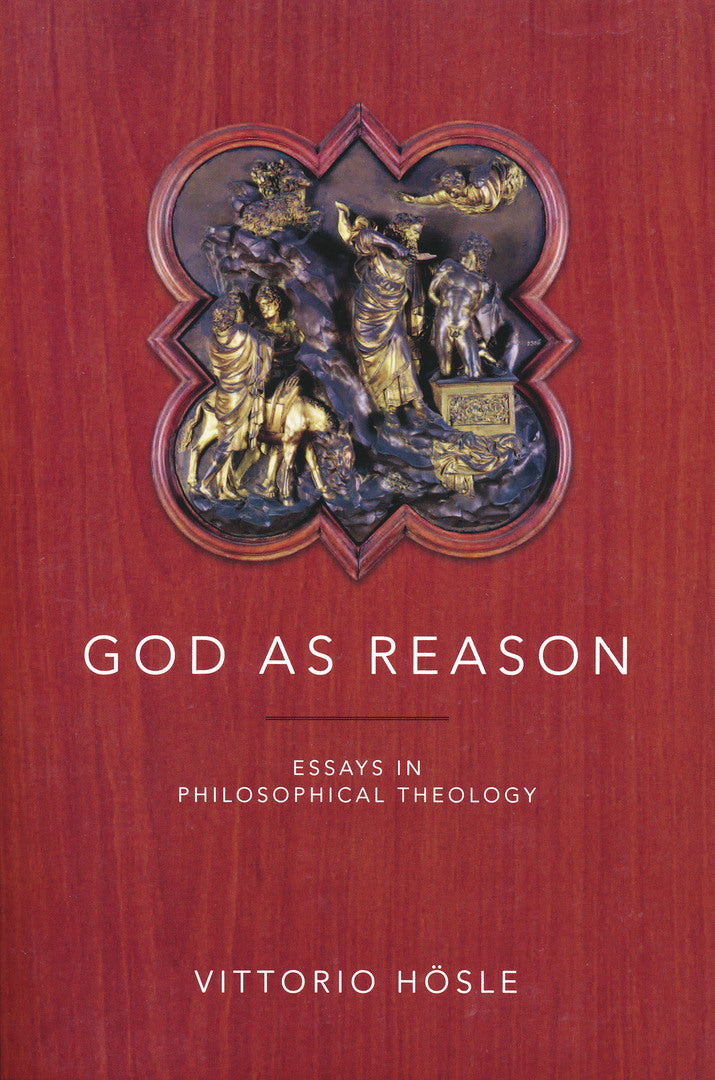
In God as Reason: Essays in Philosophical Theology, Vittorio Hösle presents a systematic exploration of the relation between theology and philosophy. In examining the problems and historical precursors of rational theology, he calls on philosophy, theology, history of science, and the history of ideas to find an interpretation of Christianity that is compatible with a genuine commitment to reason.
The essays in the first part of God as Reason deal with issues of philosophical theology. Hösle sketches the challenges that a rationalist theology must face and discusses some of the central ones, such as the possibility of a teleological interpretation of nature after Darwin, the theodicy issue, freedom versus determinism, the mindbody problem, and the relation in general between religion, theology, and philosophy. In the essays of the second part, Hösle studies the historical development of philosophical approaches to the Bible, the continuity between the New Testament concept of pneuma and the concept of Geist (spirit) in German idealism, and the rationalist theologies of Anselm, Abelard, Llull, and Nicholas of Cusa, whose innovative philosophy of mathematics is the topic of one of the chapters. The book concludes with a thorough evaluation of Charles Taylor’s theory of secularization.
This ambitious work will interest students and scholars of philosophical theology and philosophy of religion as well as historians of ideas and science.

“[Hösle] shows an especially sensitive appreciation for the ‘pragmatics’ of the exchange between the various parties before turning to consider their arguments. His treatment concludes with a useful summary and the provocative idea that ‘the human prospect would look better than it does if a function equivalent to [a common religion] could be found for the twenty-first century.’” —Toronto Journal of Theology
Vittorio Hösle is Paul G. Kimball Chair of Arts and Letters in the Department of German Languages and Literatures and concurrent professor of philosophy and political science at the University of Notre Dame. He was the founding director of the Notre Dame Institute for Advanced Study. He is the author or editor of many books, including The Philosophical Dialogue: A Poetics and a Hermeneutics (2012) and Morals and Politics (2004), both published by the University of Notre Dame Press.
Preface
Part I. Philosophical Theology
1. The Idea of a Rationalistic Philosophy of Religion and Its Challenges
2. Why Teleological Principles Are Inevitable for Reason: Natural Theology after Darwin
3. Theodicy Strategies in Leibniz, Hegel, Jonas
4. Rationalism, Determinism, Freedom
5. Encephalius: A Conversation about the Mind-Body Problem
6. Religion, Theology, Philosophy
Part II. A Rationalist’s Tradition: Interpretations of Classical Texts
7. Philosophy and the Interpretation of the Bible
8. To What Extent Is the Concept of Spirit (Geist) in German Idealism a Legitimate Heir to the Concept of Spirit (Pneuma) in the New Testament?
9. Reasons, Emotions, and God’s Presence in Anselm of Canterbury’s Dialogue Cur Deus homo (with Bernd Goebel)
10. Interreligious Dialogues during the Middle Ages and Early Modernity
11. Platonism and Anti-Platonism in Nicholas of Cusa’s Philosophy of Mathematics
12. Can Abraham Be Saved? And: Can Kierkegaard Be Saved? A Hegelian Discussion of Fear and Trembling
13. A Metaphysical History of Atheism
Notes
Source Credits
Index