


Some error occured while loading the Quick View. Please close the Quick View and try reloading the page.
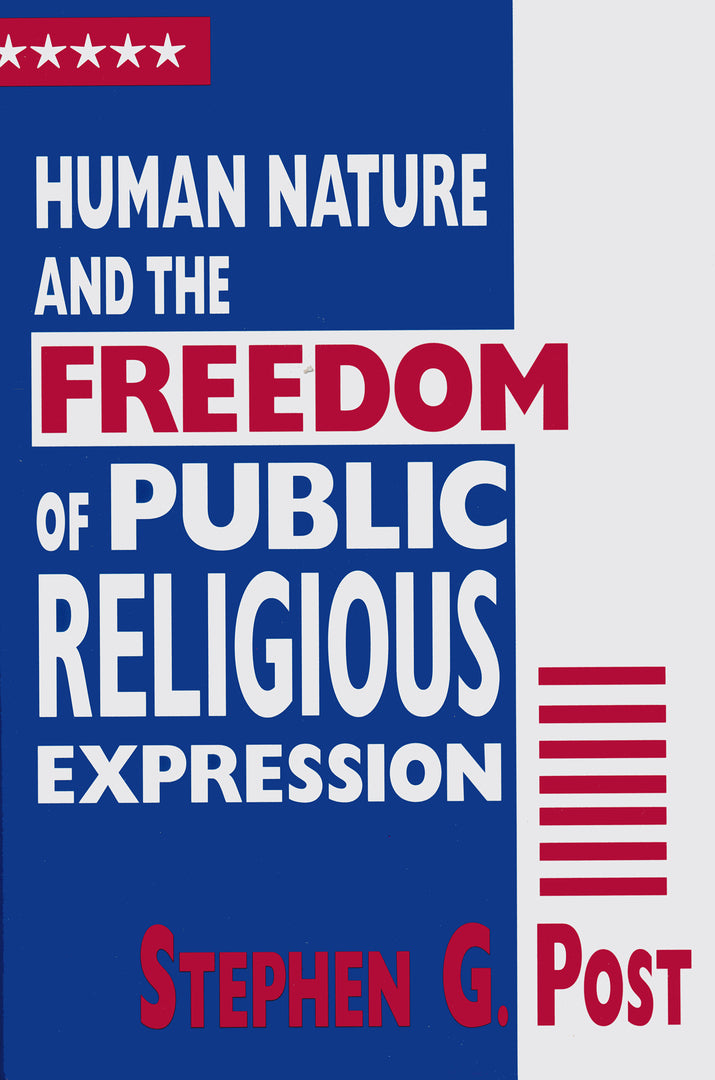
Drawing on current research in science and religion, distinguished bioethicist Stephen G. Post provocatively argues that human beings are, by nature, inclined toward a presence in the universe that is higher than their own. In consequence, the institutions of everyday life, such as schools, the workplace, and the public square, are not justified in censoring the spiritual and religious expression that freely arises from the wellspring of the human spirit.
Post believes that the privatization of religious expression, coupled with the imposition of a secular monism, is a departure from true liberal democracy in which citizens are free to assert themselves in ways that manifest their full nature. Utilizing research in the neurosciences, psychiatry, the social sciences, and evolutionary psychology, he provides scientific information supporting the idea, familiar to theories of natural law, that religious expression and freedom are essential human goods. In developing this perspective, Post also engages in a critical conversation with secular existentialism.
Human Nature and the Freedom of Public Religious Expression offers an alternative to the views of political philosophers such as Richard Rorty, and educators such as John Dewey, who fail to acknowledge the unique contribution that religious language, when thoughtfully implemented, makes to the tone and content of public debate and education. Post’s perspective privileges no particular religion, but rather asks that adherents to all faiths, including secularism, be allowed freely to express their core values in a civil, respectful, and public manner. Post calls for a recovery of the full meaning of liberal democracy in all domains of public life, so that we might again discover the value of freedom of expression.

“...a commonsense critique...” —Research News and Opportunities in Science and Theology, October 2003
Stephen G. Post is professor and associate director for educational programs in the department of bioethics at Case Western Reserve University School of Medicine. He is a senior research scholar at the Becket Institute, St. Hugh’s College, Oxford University. Dr. Post has published widely in the area of science and religion. He is editor-in-chief of the third edition of the five-volume Encyclopedia of Bioethics, and was recently named President of the Institute for Research on Unlimited Love—Altruism, Compassion, Service.