


Some error occured while loading the Quick View. Please close the Quick View and try reloading the page.
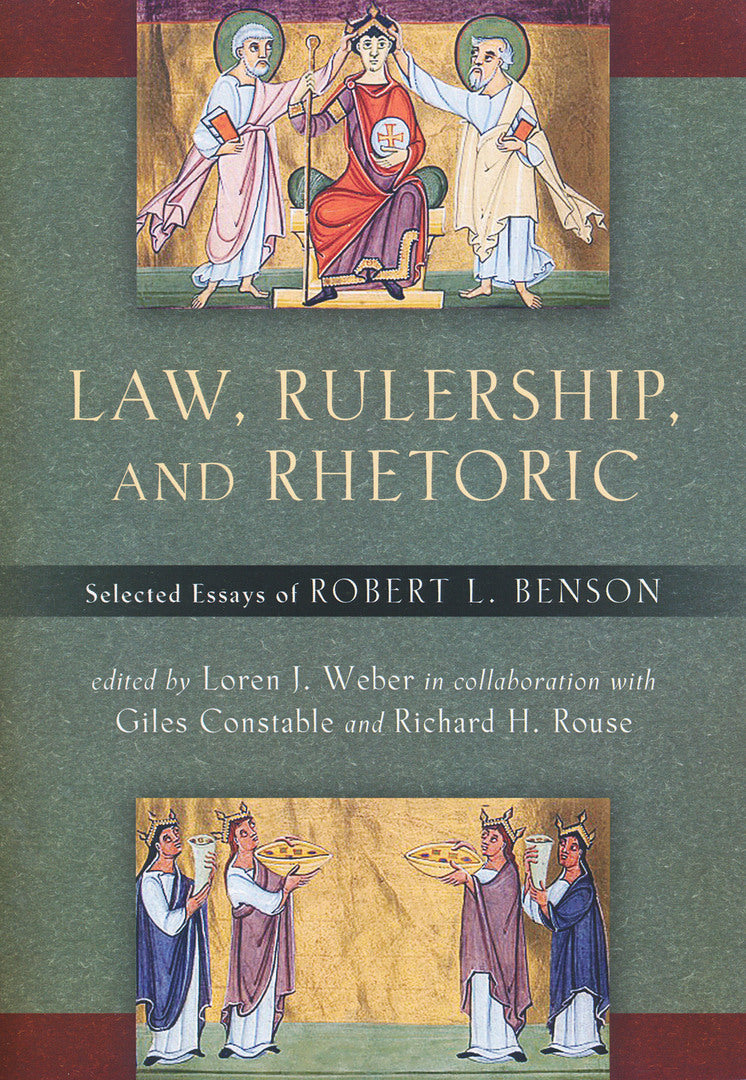
Robert L. Benson (1925–1996), professor of history at the University of California, Los Angeles, was one of the most learned and original medievalists of his generation. At his untimely death he left behind a considerable body of unpublished writings, many of which he had revised and refined and in some cases presented in lectures and at conferences over many years. The best and most significant of these previously unpublished writings are collected in this volume.
The essays in Law, Rulership, and Rhetoric span Benson’s entire career from 1955 to 1994. They comprise a rich collection covering a vast range of topics in political, intellectual, legal, and ecclesiastical history, rhetoric, and historiography. Art historians will find the three essays on medieval images of rulership and medieval art valuable, and literary scholars will be interested in the essays on, among others, Boncompagno da Signa. The volume concludes with several occasional, historiographical essays, including a spirited defense of Ernst Kantorowicz against Norman Cantor and an entertaining talk on “the medievalist as literary hero.” The volume begins with a brief biographical sketch and appreciation of Benson by Horst Fuhrmann.

“It is a testament to the strength of Robert L Benson’s scholarly personality and to his intellect that the contours of both are so clearly and consistently visible in this eclectic collection. This collection represents an effort not only to memorialize Benson but also to present his thoughts on a subject he had mastered more thoroughly than his published record would indicate.” —H-net Reviews
Richard H. Rouse is professor emeritus of history at the University of California, Los Angeles.
Foreword: In Memory of Robert L. Benson (1925–1996) Horst Fuhrmann
Editor’s Preface
List of Abbreviations
Part 1. Thought and Culture
1. Urbs et orbis: An Ancient Roman Topos in Medieval Political Language
2. Bishop, Metropolitan, and Primate: A Study on the Conceptions of Office and Hierarchy in the Eleventh and Twelfth Centuries
3. Self-Knowledge and Consciousness of Self: Aspects of Spirituality in the Meditations of Guigo I of the Charterhouse
4. The Strange Affair of the Abbess Margaret, or What a Medieval Historian Does
5. Miserrimi miserorum: Boncompagno on the Evils of Old Age
Appendix: Boncompagno, De malo senectutis et senii
Part 2. Art and Rulership
6. The Politics of Symmetry: Sacerdotium and Regnum in the Mirror of Medieval Art (800–1200)
7. Images of David in Psalters and Bibles: Medieval Interpretations of Biblical Kingship as Mirrored in Art
8. Images of Rulership on a Romanesque Chalice from Trzemeszno
Part 3. Medieval Rulership
9. In Praise of the Franks: Rhetorical Influences on the Early Germanic Monarchies
10. A Critique of Fritz Kern’s Gottesgnadentum und Widerstandsrecht im Früheren Mittelalter
11. The King as Novus David: Political Uses of the Old Testament in the Early Middle Ages
12. Imperator oeconomus Ecclesiae: Notes on a Decretistic Theory of the Imperial Office
Part 4. Frederick Barbarossa
13. The Treaty of Constance: Prelude and Epilogue
14. The Clash at Besançon (October 1157)
15. Frederick Barbarossa as “Lord of the World”
Part 5. Medieval History in Modern Perspective
16. Norman Cantor and “The Nazi Twins”: On Inventing the Middle Ages
17. Comment on a Paper by Thomas F. Mathews, “How Art History Mistook Christ for the Emperor”
18. The “Mythic” in Studies of Frederick II Hohenstaufen
19. The Medievalist as Hero
Index of Manuscripts Cited
General Index