


Some error occured while loading the Quick View. Please close the Quick View and try reloading the page.
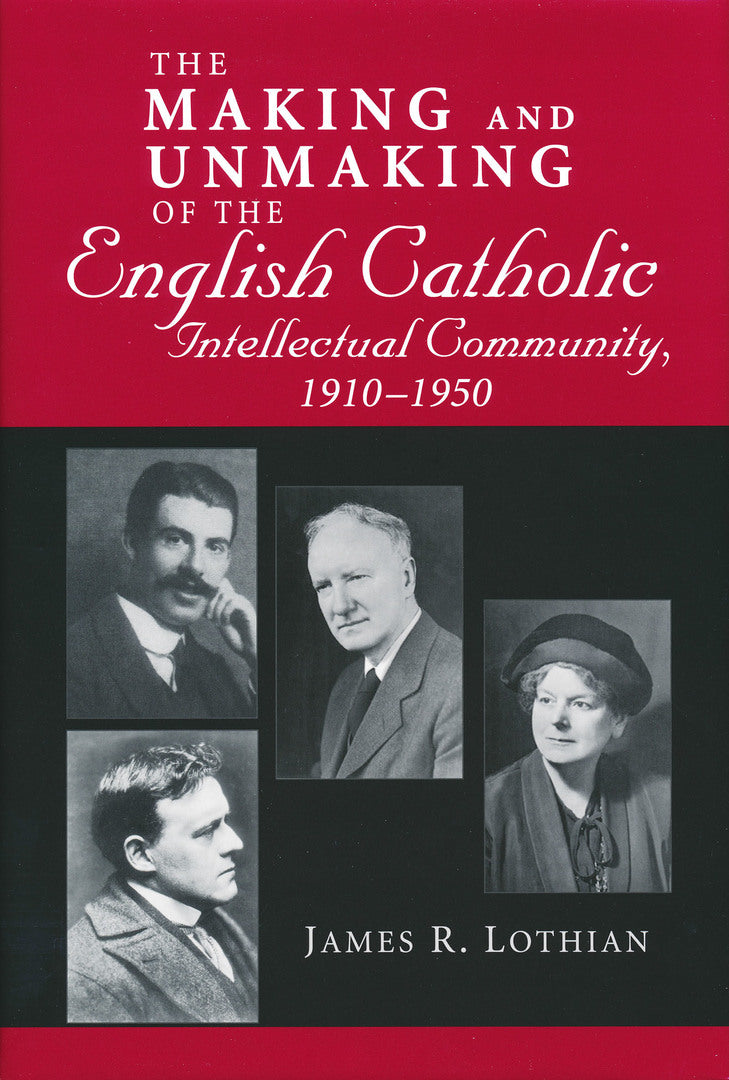
In The Making and Unmaking of the English Catholic Intellectual Community, 1910–1950, James R. Lothian examines the engagement of interwar Catholic writers and artists both with modernity in general and with the political and economic upheavals of the times in England and continental Europe. The book describes a close-knit community of Catholic intellectuals that coalesced in the aftermath of the Great War and was inspired by Hilaire Belloc's ideology. Among the more than two dozen figures considered in this volume are G. K. Chesterton, novelist Evelyn Waugh, poet and painter David Jones, sculptor Eric Gill, historian Christopher Dawson, and publishers Frank Sheed and Maisie Ward. For Catholic intellectuals who embraced Bellocianism, the response to contemporary politics was a potent combination of hostility toward parliamentary democracy, capitalism, and so-called "Protestant" Whig history. Belloc and his friends asserted a set of political, economic, and historiographical alternatives—favoring monarchy and Distributism, a social and economic system modeled on what Belloc took to be the ideals of medieval feudalism.
Lothian explores the community's development in the 1920s and 1930s, and its dissolution in the 1940s, in the aftermath of World War II. Frank Sheed and Maisie Ward, joined by Tom Burns and Christopher Dawson, promoted an aesthetic and philosophical vision very much at odds with Belloc's political one. Weakened by internal disagreement, the community became fragmented and finally dissolved.

“Lothian’s study fills a much needed gap in English Catholic history and also serves as an excellent example of historical scholarship. Thoroughly documented and very well written—Lothian’s combination of personal annotates and ideological information is a genuine tour de force—this study should stimulate a wide range of dissertation topics which hopefully will continue to shed new light on English Catholicism during the inter-war period.” —Anglican and Episcopal History
James R. Lothian is visiting assistant professor of history at Binghamton University.