


Some error occured while loading the Quick View. Please close the Quick View and try reloading the page.
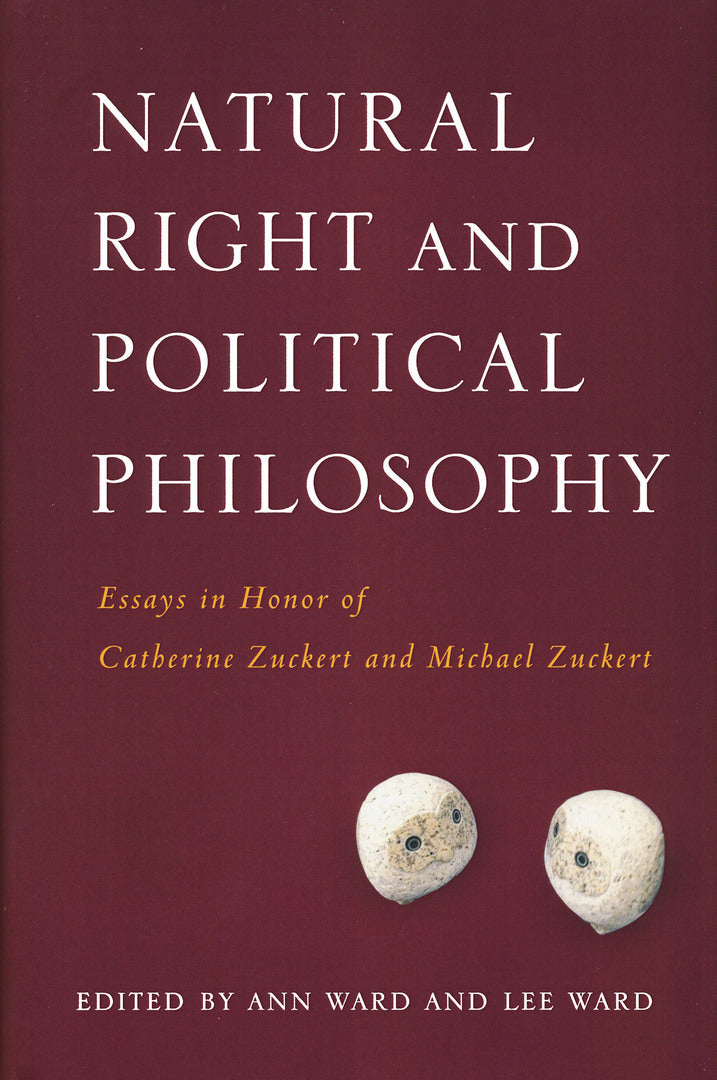
Inspired by the work of prominent University of Notre Dame political philosophers Catherine Zuckert and Michael Zuckert, this volume of essays explores the concept of natural right in the history of political philosophy. The central organizing principle of the collection is the examination of the idea of natural justice, identified in the classical period with natural right and in modernity with the concept of individual natural rights.
Contributors examine the concept of natural right and rights in all the manifold and interdisciplinary dimensions associated with the Zuckerts’ oeuvre. Part I explores the theme of natural right in the ancient and medieval political philosophy of Plato, Xenophon, Aristotle, and St. Augustine. Part II examines the early modern break from the classical tradition in the work of Montaigne, Spinoza, Montesquieu, Locke, and Hegel as well as the legacy of the modern natural rights tradition as explored by Leo Strauss and Pope John Paul II. Part III treats the theme of natural rights from the Puritans through the Founding period in such figures as Thomas Jefferson and Gouverneur Morris and up to the Progressive era with Booker T. Washington and Theodore Roosevelt. Part IV addresses questions of natural justice in literature, including works of Euripides, Cervantes, Shakespeare, Edith Wharton, and Tom Stoppard.

“Overall, the essays collected here are both thought-provoking and address important questions (not to mention being pieces of scholarship that are enjoyable to read). Therefore, this volume will be useful to scholars and graduate students working on such authors and topics or themes. Consequently, and given the volume’s potential life span, it will point future scholars to the Zuckerts and their scholarship, thus keeping both their memories and scholarship alive for future generations.” —Political Studies Review
Lee Ward is associate professor of political science at Campion College, University of Regina.
Acknowledgments
Introduction by Ann Ward and Lee Ward
Part I. Classical Natural Right
1. Virtue and Self-Control in Xenophon’s Socratic Thought by Lorraine Smith Pangle
2. The Complexity of Divine Speech and the Quest for the Ideas in Plato’s Euthyphro by Ann Ward
3. Politics and Philosophy in Aristotle’s Critique of Plato’s Laws by Kevin M. Cherry
4. Both Friends and Truth Are Dear: Aristotle’s Political Thought as a Response to Plato by Mary P. Nichols
5. Augustinian Humility as Natural Right by Mary M. Keys
Part II. Modern Natural Rights
6. On the Treatment of Moral Responsibility in Montaigne’s Essays I.15–16 by David Lewis Schaefer
7. Benedict Spinoza and the Problem of Theocracy by Lee Ward
8. Criminal Procedure as the Most Important Knowledge and the Distinction between Human and Divine Justice in Montesquieu’s Spirit of the Laws by Vickie B. Sullivan
9. Personhood and Ethical Commercial Life: Hegel’s Transformation of Locke by Jeffrey Church
10. Reflections on Faith and Reason: Leo Strauss and John Paul II by Walter Nicgorski
Part III. A merican Political Thought and Practice
11. Locke, the Puritans, and America: Reflections on the Christian Dimension of Our Personal Identities by Peter Augustine Lawler
12. Thomas Jefferson, the First American Progressive? by Jean M. Yarbrough
13. Gouverneur Morris and the Creation of American Constitutionalism by David K. Nichols
14. The Presidency in the Constitutional Convention of 1787 by David Alvis
15. From Statesman to Secular Saint: Booker T. Washington on Abraham Lincoln by Diana J. Schaub
16. Theodore Roosevelt on Statesmanship and Constitutionalism by Kirk Emmert
Part IV. Politics and Literature
17. Of “Demagogic Apes”: Euripides’ Democratic Critique of Democratic Athens by Arlene W. Saxonhouse
18. The Inevitable Monarchy: Shakespeare’s Julius Caesar by Timothy Spiekerman
19. Preliminary Observations on the Theologico-Political Dimension of Cervantes’ Don Quixote by Thomas L. Pangle
20. Custom, Change, and Character in Edith Wharton’s The Age of Innocence by Christine Dunn Henderson
21. “What’s wrong with this picture?”: On The Coast of Utopia by Michael Davis
Selected Publications by Catherine Zuckert and Michael Zuckert
List of Contributors
Index