


Some error occured while loading the Quick View. Please close the Quick View and try reloading the page.
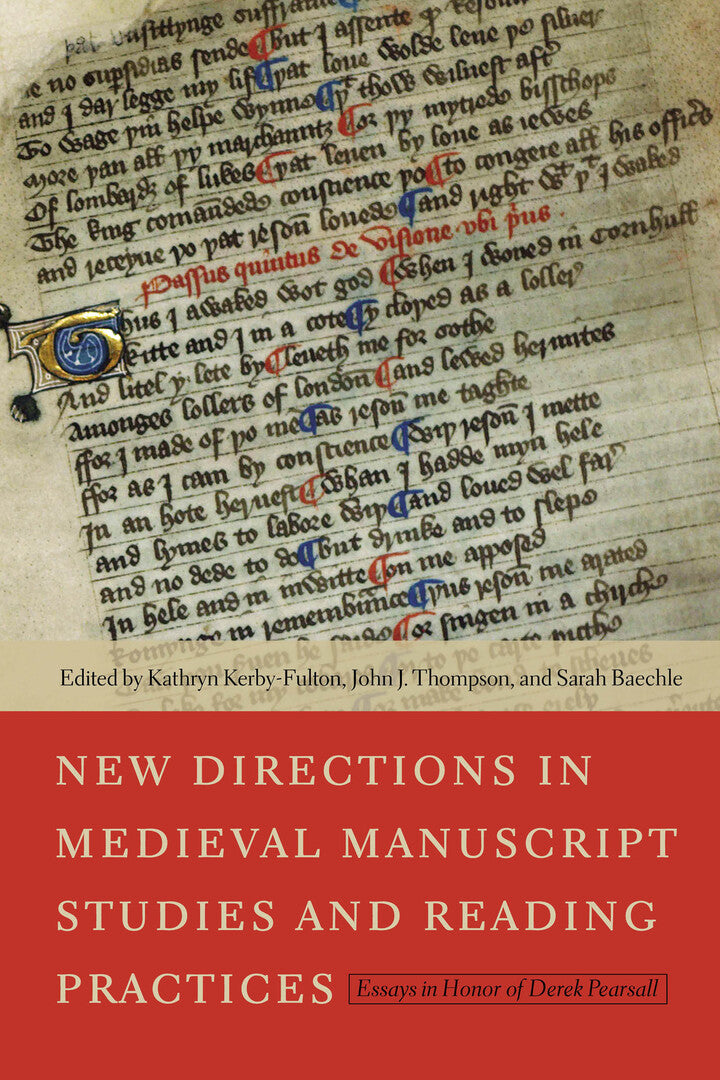
This volume gathers the contributions of senior and junior scholars—all indebted to the pathbreaking work of Derek Pearsall—to showcase new research prompted by his rich and ongoing legacy as a literary critic, editor, and seminal founder of Middle English manuscript studies. The contributors aim both to honor Pearsall’s work in the field he established and to introduce the complexities of interdisciplinary manuscript studies to students already familiar with medieval literature.
The contributors explore a range of issues, from the study of medieval literary manuscripts to the history of medieval books, libraries, literacy, censorship, and the social classes who used the books and manuscripts—nobles, children, schoolmasters, priests, merchants, and more. In addressing reading practices, essays provide a wealth of information on marginal commentaries, images and interpretive methods, international transmission, and early print and editorial methods.
Contributors: Sarah Baechle, Julia Boffey, Peter Brown, Katie Ann-Marie Bugyis, Christopher Cannon, A. I. Doyle, Martha W. Driver, Siân Echard, Nicole Eddy, A. S. G. Edwards, Hilary E. Fox, Karrie Fuller, Maura Giles-Watson, Phillipa Hardman, Kathryn Kerby-Fulton, Jill Mann, William Marx, Sarah McNamer, Carol M. Meale, Linne Mooney, Melinda Nielsen, Theresa O’Byrne, Stephen Partridge, Oliver Pickering, Susan Powell, Elizabeth Scala, A. C. Spearing, John J. Thompson, Edward Wheatley, Jocelyn Wogan-Browne, Hannah Zdansky, Nicolette Zeeman.

“On balance, this [is] a finely produced collection with many accomplished contributions. It will reward readers’ exploration.” —Modern Philology
Sarah Baechle is a post-doctoral fellow in English at the University of Notre Dame.
List of Illustrations
Preface by Kathryn Kerby-Fulton
A Brief Biographical Sketch of Derek Pearsall by Linne Mooney
Part 1. Celebrating Pearsallian Reading Practices
Foreword to Part 1. By Christopher Cannon
1. Narrative and Freedom in Troilus and Criseyde by A.C. Spearing
2. How Good Is the Outspoken South English Legendary Poet? A New Edition of the Prologue to the Conception of Mary by Oliver Pickering
3.. Derek Pearsall, Secret Shakespearean by Martha W. Driver
Part 2. England and International: Studies in Courtly Verse and Affectivity Inspired by the Work of Elizabeth Salter and Derek Pearsall at York
Foreword to Part 2. By William Marx
4. The Tongues of the Nightingale: “hertely redying” at English Courts by Jocelyn Wogan-Browne
5. Wings, Wingfields, and Wynnere and Wastoure by Susan Powell
6.. The Author of the Italian Meditations on the Life of Christ by Sarah McNamer
7. Handling The Book of Margery Kempe: The Corrective Touches of the Red Ink Annotator by Katie Ann-Marie Bugyis
Part III. The Making of a Field: York’s 1981 Manuscripts and Readers Thirty Years Later
Foreword to Part 3. by John J. Thompson
8. Assessing Manuscript Context: Visible and Invisible Evidence in a Copy of the Middle English Brut by Julia Boffey
9. Books with Marginalia from St. Mark’s Hospital, Bristol by A.I. Doyle
10. John Colyns, Mercer and Bookseller of London, and Cuthbert Tunstall’s Second Monition of 1526 by Carol M. Meale
11. Selling Lydgate Manuscripts in the Twentieth Century by A.S.G. Edwards
Part 4. Newer Directions in Manuscript Studies I: Regional and Scribal Identities
Foreword to Part 4. by Siân Echard
12. “And fer ouer þe French flod”: A Look at Cotton Nero A.x from an International Perspective by Hannah Zdansky
13. Langlandian Economics in James Yonge’s Gouernaunce: Translation and Ethics in Fifteenth-Century Dublin by Hilary E. Fox
14. Manuscript Creation in Dublin: The Scribe of Bodleian e. Museo MS 232 and Longleat MS 29 byTheresa O’Byrne
Part 5. Newer Directions in Manuscript Studies II: Women, Children, and Literacy at Work in Late Medieval and Early Tudor England
Foreword to Part 5. by Phillipa Hardman
15. The Romance of History: Lambeth Palace MS 491 and Its Young Readers by Nicole Eddy
16. Langland in the Early Modern Household: Piers Plowman in Oxford, Bodleian Library MS Digby 145, and Its Scribe-Annotator Dialogues by Karrie Fuller
17. Playing as Literate Practice: Humanism and the Exclusion of Women Performers by the London Professional Stages by Maura Giles-Watson
Part 6. Chaucerian and Post-Chaucerian Reading Practices
Foreword to Part 6. by Edward Wheatley
18. Quoting Chaucer: Textual Authority, the Nun’s Priest, and the Making of the Canterbury Tales by Elizabeth Scala
19. Chaucer, the Continent, and the Characteristics of Commentary by Sarah Baechle
20. Hoccleve in Canterbury by Peter Brown
21. The Legacy of John Shirley: Revisiting Houghton MS Eng 530 by Stephen Partridge
Part VII. What a Poet Is “Entitled to Be Remembered By”: Editorial Philosophies and the Langlandian Legacy of Derek Pearsall
Foreword to Part 7. by Nicolette Zeeman
22. Was the C-Reviser’s Manuscript Really So Corrupt? by Jill Mann
23. Emending Oneself: Compilatio and Revisio in Langland, Usk, and Higden by Melinda Nielsen
24. Confronting the Scribe-Poet Binary: The Z Text, Writing Office Redaction, and the Oxford Reading Circles by Kathryn Kerby-Fulton
List of Contributors
Index of Manuscripts and Incunabula
General Index