


Some error occured while loading the Quick View. Please close the Quick View and try reloading the page.
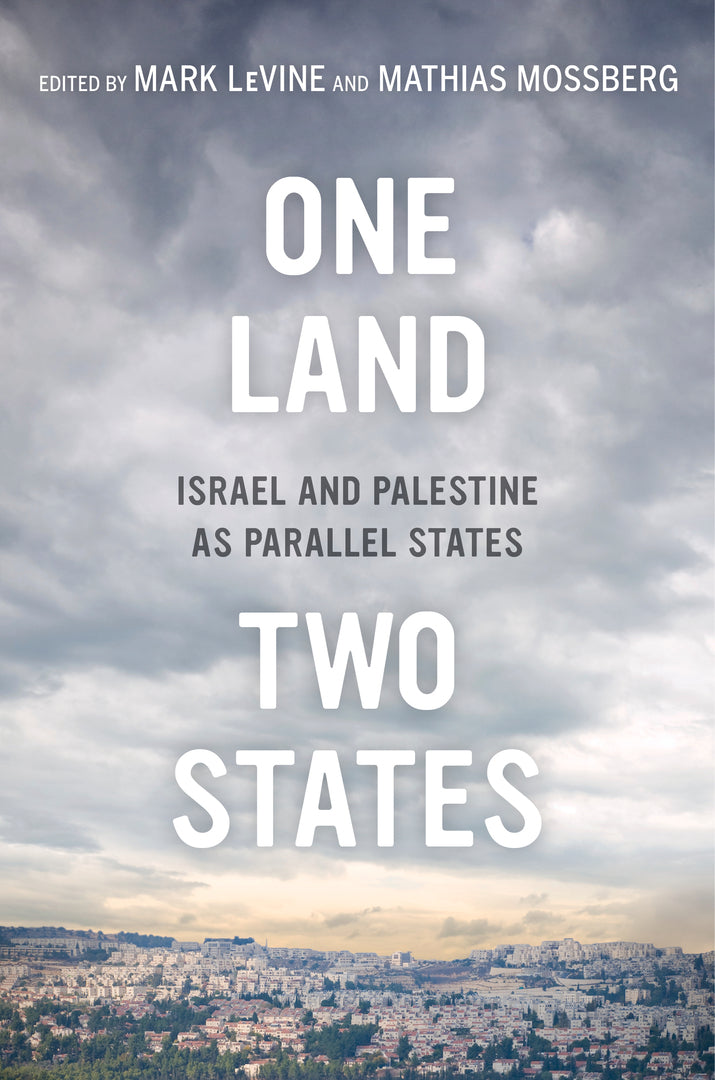
One Land, Two States imagines a new vision for Israel and Palestine in a situation where the peace process has failed to deliver an end of conflict. “If the land cannot be shared by geographical division, and if a one-state solution remains unacceptable,” the book asks, “can the land be shared in some other way?”
Leading Palestinian and Israeli experts along with international diplomats and scholars answer this timely question by examining a scenario with two parallel state structures, both covering the whole territory between the Mediterranean and the Jordan River, allowing for shared rather than competing claims of sovereignty. Such a political architecture would radically transform the nature and stakes of the Israel-Palestine conflict, open up for Israelis to remain in the West Bank and maintain their security position, enable Palestinians to settle in all of historic Palestine, and transform Jerusalem into a capital for both of full equality and independence—all without disturbing the demographic balance of each state. Exploring themes of security, resistance, diaspora, globalism, and religion, as well as forms of political and economic power that are not dependent on claims of exclusive territorial sovereignty, this pioneering book offers new ideas for the resolution of conflicts worldwide.
Leading Palestinian and Israeli experts along with international diplomats and scholars answer this timely question by examining a scenario with two parallel state structures, both covering the whole territory between the Mediterranean and the Jordan River, allowing for shared rather than competing claims of sovereignty. Such a political architecture would radically transform the nature and stakes of the Israel-Palestine conflict, open up for Israelis to remain in the West Bank and maintain their security position, enable Palestinians to settle in all of historic Palestine, and transform Jerusalem into a capital for both of full equality and independence—all without disturbing the demographic balance of each state. Exploring themes of security, resistance, diaspora, globalism, and religion, as well as forms of political and economic power that are not dependent on claims of exclusive territorial sovereignty, this pioneering book offers new ideas for the resolution of conflicts worldwide.

Price: $29.95
Pages: 296
Publisher: University of California Press
Imprint: University of California Press
Publication Date:
20 June 2014
Trim Size: 9.00 X 6.00 in
ISBN: 9780520279131
Format: Paperback
BISACs:
"A coterie of bold, open-minded international academics offers a fresh paradigm for Israeli-Palestinian coexistence. . . . A visionary approach so daring that it could actually work."
Mark LeVine is Professor of History at the University of California, Irvine, a contributing editor for Tikkun, and a senior columnist for Al Jazeera. He is the author of Overthrowing Geography and the coeditor of Struggle and Survival in Palestine/Israel (both from UC Press).
Mathias Mossberg is a retired Swedish ambassador with extensive personal experience from the peace process and related track-two diplomacy as well as from mediation efforts in other conflicts. He is Senior Fellow at the Center for Middle Eastern Studies, Lund University, Sweden.
Mathias Mossberg is a retired Swedish ambassador with extensive personal experience from the peace process and related track-two diplomacy as well as from mediation efforts in other conflicts. He is Senior Fellow at the Center for Middle Eastern Studies, Lund University, Sweden.
List of Illustrations
Foreword: Two States on One Land—Parallel States as an Option for Israel and Palestine
Álvaro de Soto
Preface
Mathias Mossberg and Mark LeVine
1. One Land—Two States? An Introduction to the Parallel States Concept
Mathias Mossberg
2. Can Sovereignty Be Divided?
Jens Bartelson
3. Parallel Sovereignty: Dividing and Sharing Core State Functions
Peter Wallensteen
4. Security Strategy for the Parallel States Project: An Israeli Perspective
Nimrod Hurvitz and Dror Zeevi
5. Palestinian National Security
Hussein Agha and Ahmad Samih Khalidi
6. An Israel-Palestine Parallel States Economy by 235
Raja Khalidi
7. Economic Considerations in Implementing a Parallel States Structure
Raphael Bar-El
8. Parallel Sovereignty in Practice: Judicial Dimensions of a Parallel States Structure
Various authors, compiled by Mathias Mossberg
9. Religion in the Palestinian-Israeli Conflict: From Obstacle to Peace to Force for Reconciliation?
Mark LeVine and Liam O’Mara IV
10. The Necessity for Thinking outside the Box
Hiba Husseini
11. Parallel Lives, Parallel States: Imagining a Different Future
Eyal Megged
Contributors
Index
Foreword: Two States on One Land—Parallel States as an Option for Israel and Palestine
Álvaro de Soto
Preface
Mathias Mossberg and Mark LeVine
1. One Land—Two States? An Introduction to the Parallel States Concept
Mathias Mossberg
2. Can Sovereignty Be Divided?
Jens Bartelson
3. Parallel Sovereignty: Dividing and Sharing Core State Functions
Peter Wallensteen
4. Security Strategy for the Parallel States Project: An Israeli Perspective
Nimrod Hurvitz and Dror Zeevi
5. Palestinian National Security
Hussein Agha and Ahmad Samih Khalidi
6. An Israel-Palestine Parallel States Economy by 235
Raja Khalidi
7. Economic Considerations in Implementing a Parallel States Structure
Raphael Bar-El
8. Parallel Sovereignty in Practice: Judicial Dimensions of a Parallel States Structure
Various authors, compiled by Mathias Mossberg
9. Religion in the Palestinian-Israeli Conflict: From Obstacle to Peace to Force for Reconciliation?
Mark LeVine and Liam O’Mara IV
10. The Necessity for Thinking outside the Box
Hiba Husseini
11. Parallel Lives, Parallel States: Imagining a Different Future
Eyal Megged
Contributors
Index