


Some error occured while loading the Quick View. Please close the Quick View and try reloading the page.
“A learned and intimate exploration of Said’s thought with deep relevance for today’s debates about Palestine and Israel and American intellectual life.”—Peter Beinart, author of Being Jewish After the Destruction of Gaza
An exploration of the political thought of one of the twentieth century's most influential thinkers and the foremost advocate for the Palestinian cause in the West
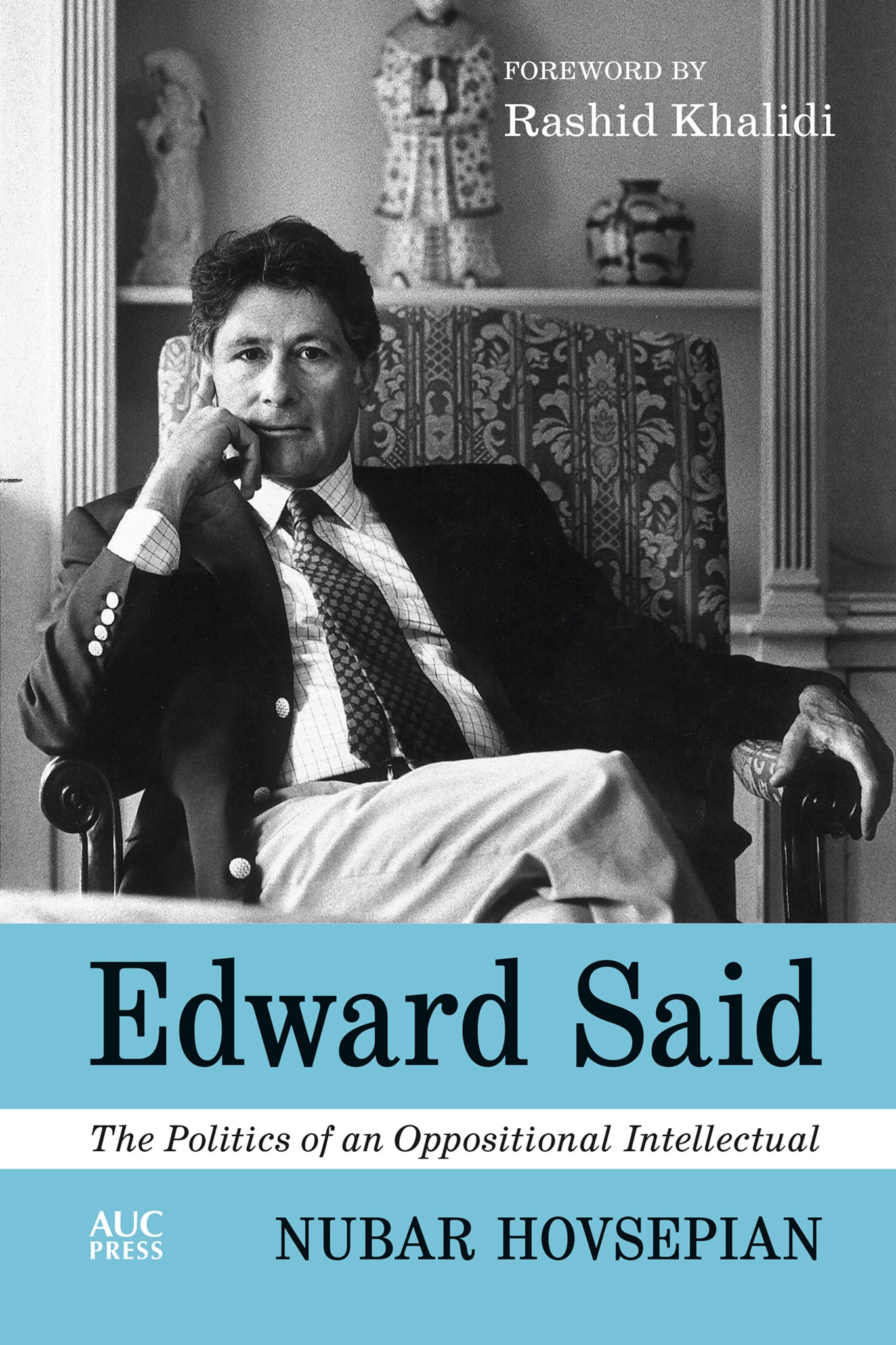
Edward Said was one of the most influential intellectuals of the twentieth century. A literary scholar with an aesthete’s temperament, he did not experience his political awakening until the 1967 Arab–Israeli war, which transformed his thinking and led him to forge ties with political groups and like-minded scholars. Said’s subsequent writings, which cast light on the interplay between cultural representation and the exercise of Western political power, caused a seismic shift in scholarly circles and beyond. In this intimate intellectual biography, by a close friend and confidant, Nubar Hovsepian offers fascinating insight into the evolution of Said’s political thought.
Through analysis of Said’s seminal works and the debates surrounding them, Edward Said: The Politics of an Oppositional Intellectual traces the influence of Foucault on Said, and how Said eventually diverged from this influence to arrive at a more pronounced understanding of agency, resistance, and liberation. He consequently affiliated more closely with Raymond Williams, Antonio Gramsci, and more contemporaneously, with his friends the late Eqbal Ahmad and Ibrahim Abu-Lughod.
Said held that it is the intellectual’s responsibility to expose lies and deceptions of the holders of power. A passionate advocate for the Palestinian cause, his solidarity did not prevent him from launching a sustained critique of the Palestinian leadership. Hovsepian charts both Said’s engagement with the Palestinian national movement and his exchanges with a host of intellectuals over Palestine, arguing that Said’s interventions have succeeded in changing the parameters of the discourse in the humanities, and among younger Jews searching for political affiliation.
Drawing on his diaries, in which he recorded his meetings with Said, as well as access to some of Said’s private letters, Hovsepian illuminates, in rich detail, the trajectory of Said’s political thinking and the depth and breadth of his engagement with peers and critics over issues that continue to resonate to this day.

"Hovsepian sketches both the portrait of a friendship and an intellectual biography. . . . This book is a useful reminder of the value of such critical perspectives." —Foreign Affairs
“[A] deeply felt and engaging political biography. . . . Twenty-three years after his death, early in a new and already frightening century, Said remains a singular prophet, a symphonist, and an exemplar for everyone struggling for a world based on peace, justice, and mutual recognition. This book will prove indispensable for continuing that struggle.”—The Markaz Review
"Hovsepian offers something new to readers who want to think about Said’s work in more integrative terms." —Political Theory
“Political scientist Hovsepian (Palestinian State Formation) delivers an incisive portrait of his ‘dear friend’. . . . It’s a moving tribute to an intellectual giant and a first-rate work of scholarship.”—Publisher’s Weekly
“Nubar Hovsepian provides us with a novel and truly compelling way of understanding Said’s thinking over time that could only have come from someone with as long and close a personal friendship with Said as the author had. Hovsepian reveals his extraordinary command of Said’s entire corpus of writings, which he examines in a manner that is both erudite and lucid. What emerges is a scholarly yet intimate but not uncritical study of Said’s life of the mind that speaks not only to Said’s brilliance but to his humanity and unyielding morality.” —Sara Roy, author of Failing Peace: Gaza and the Palestinian-Israeli Conflict
“The eloquent record of a unique and intimate friendship, as well as a privileged perspective on three decades of tormented Middle East politics, this volume fills in, like no book before it, what it means—in the messiness of real-world history as it is happening—to be an oppositional intellectual. Hovsepian does not hesitate to speak truth to and about his intellectually powerful friend, and the result is only to strengthen Said’s reputation as a peerless model of the engaged intellectual, committed both to passionate solidarity and to universal values.”—Bruce Robbins, Columbia University
“A learned and intimate exploration of Said’s thought with deep relevance for today’s debates about Palestine and Israel and American intellectual life.”—Peter Beinart, author of Being Jewish After the Destruction of Gaza
Nubar Hovsepian (Author) is associate professor emeritus of political science at Chapman University in Orange, California. He is the author of Palestinian State Formation: Education and the Construction of National Identity, and he edited and contributed to The War on Lebanon. Hovsepian has devoted enormous time to the Israel/Palestine conflict, and served, from 1982 to 1984, as political affairs officer for the United Nations Conference on the Question of Palestine.
Rashid Khalidi (Foreword by) is Edward Said Professor Emeritus of Modern Arab Studies at Columbia University. He is the author of eight books, including The Hundred Years’ War on Palestine: Settler-Colonial Conquest and Resistance, 1917–2017 (2020).
Preface: My Special Relationship with Edward Said—Why that matters
Acknowledgments
Chapter 1. Edward Said as Oppositional Intellectual
Chapter 2. Orientalism and its Afterlives
Chapter 3. Imperialism, Culture, and the Colonial Present
Chapter 4. Palestine: Inclusion Without Domination
Chapter 5. Arafat’s Man Turns Oppositional (1998-2003)
Chapter 6. “The Last Jewish Intellectual”
List of Abbreviations
Selected Reference List