


Some error occured while loading the Quick View. Please close the Quick View and try reloading the page.
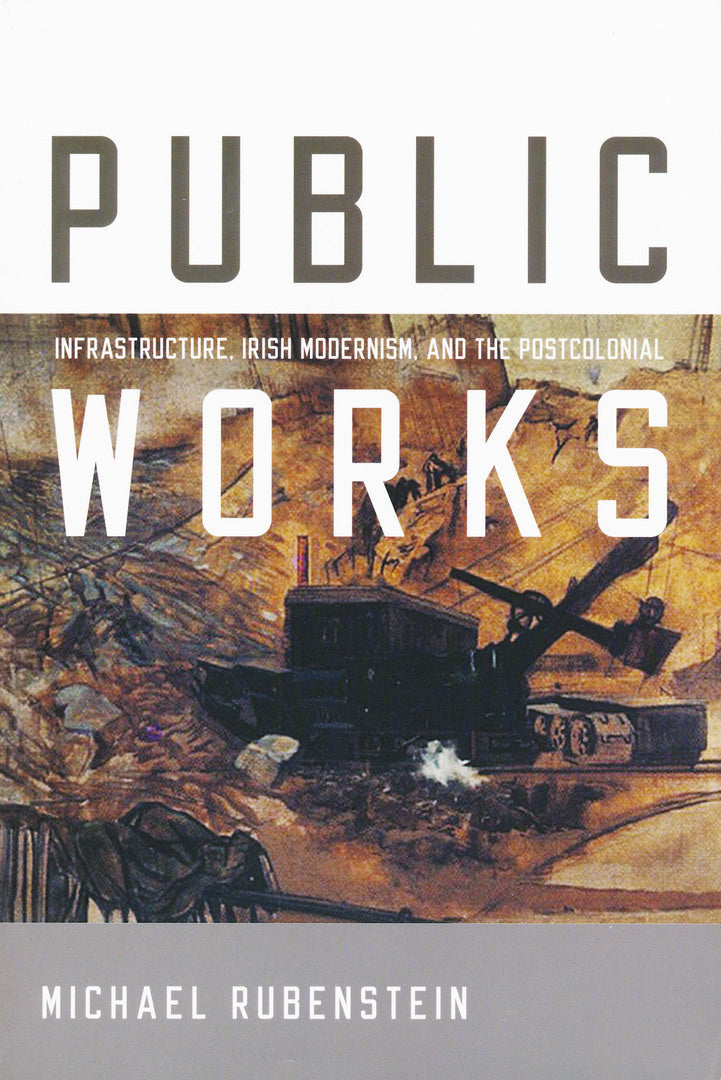
In Public Works: Infrastructure, Irish Modernism, and the Postcolonial, Michael Rubenstein documents the relationship between Irish modernism and a restricted segment of the material culture of the modern state known colloquially as “public utilities” or “water, gas, and electricity.” The water tap, the toilet, the gas jet, and the electrical light switch: these are all sites, in Irish modernism, of unexpected literary and linguistic intensities that burst through the routines of everyday life, defamiliarizing and reconceptualizing that which we might not normally consider worthy of literary attention. Such public utilities—material networks of power and provision, submission and entitlement—are taken up in Irish modernism not only as a nexus of anxieties about modern life, but also as a focal point for the hopes held out for the postcolonial Irish Free State. Public utilities figure a normative and utopian standard of modernity and modernization; they embody in Irish modernism and in other postcolonial literatures an ideal for the postcolonial state; and they figure a continuity between the material networks of the modern state and the abstract ideals of revolutionary republicanism (liberty, equality, and brotherhood). They define a new territory of contestation within the discourses of civil and human rights. Moreover, public utilities influence the formal qualities of both Irish modernist and postcolonial literature.
In analyses of literary works by James Joyce, Flann O’Brien, Elizabeth Bowen, Denis Johnston, Samuel Beckett, and Patrick Chamoiseau, Rubenstein asks us to think about the industrial networks of the twentieth century alongside self-consciously “national” literary works and to understand them as different but inherently related forms of public works. In doing so his book maps thematic and formal relationships between national infrastructure and national literature, revealing an intimate dialogue between the nation’s literary arts and the state’s engineering cultures.

“Rubenstein proceeds from an expressive homology between the production of two modern epics, Ulysses and public infrastructure in postcolonial Ireland—‘one a milestone of literary modernism and the other a milestone of technological modernization.’” —Years Work in English Studies
Michael Rubenstein is assistant professor of English at the University of California, Berkeley.