


Some error occured while loading the Quick View. Please close the Quick View and try reloading the page.
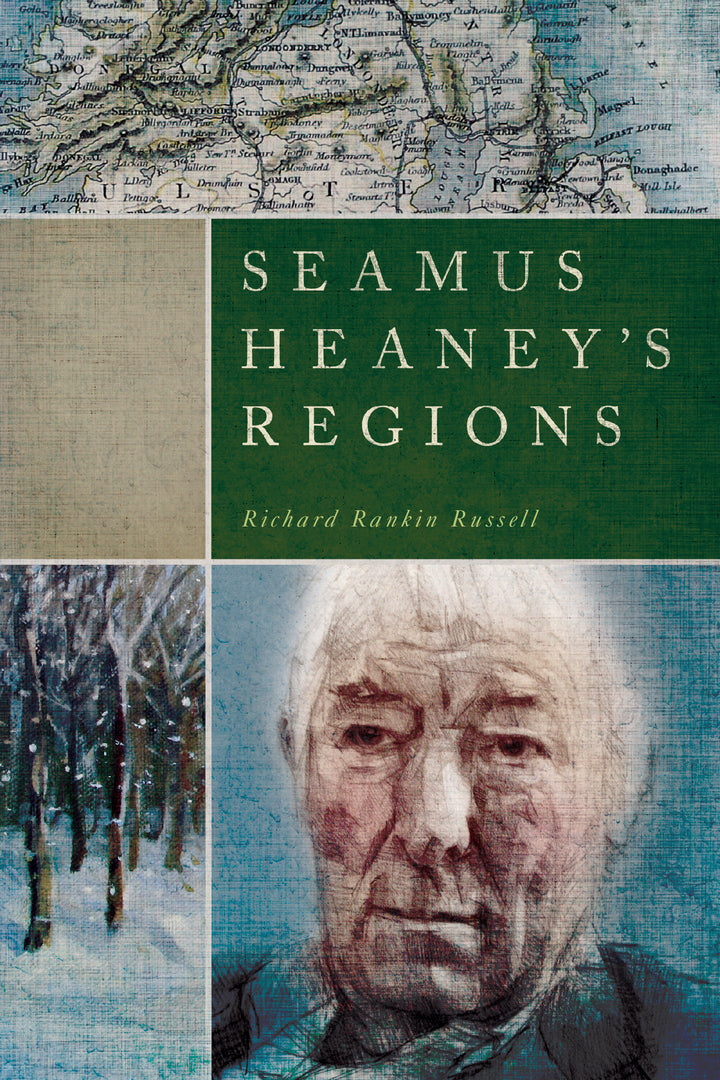
Regional voices from England, Ireland, and Scotland inspired Seamus Heaney, the 1995 Nobel prize-winner, to become a poet, and his home region of Northern Ireland provided the subject matter for much of his poetry. In his work, Heaney explored, recorded, and preserved both the disappearing agrarian life of his origins and the dramatic rise of sectarianism and the subsequent outbreak of the Northern Irish “Troubles” beginning in the late 1960s. At the same time, Heaney consistently imagined a new region of Northern Ireland where the conflicts that have long beset it and, by extension, the relationship between Ireland and the United Kingdom might be synthesized and resolved. Finally, there is a third region Heaney committed himself to explore and map—the spirit region, that world beyond our ken.
In Seamus Heaney’s Regions, Richard Rankin Russell argues that Heaney’s regions—the first, geographic, historical, political, cultural, linguistic; the second, a future where peace, even reconciliation, might one day flourish; the third, the life beyond this one—offer the best entrance into and a unified understanding of Heaney’s body of work in poetry, prose, translations, and drama. As Russell shows, Heaney believed in the power of ideas—and the texts representing them—to begin resolving historical divisions. For Russell, Heaney’s regionalist poetry contains a “Hegelian synthesis” view of history that imagines potential resolutions to the conflicts that have plagued Ireland and Northern Ireland for centuries. Drawing on extensive archival and primary material by the poet, Seamus Heaney’s Regions examines Heaney’s work from before his first published poetry volume, Death of a Naturalist in 1966, to his most recent volume, the elegiac Human Chain in 2010, to provide the most comprehensive treatment of the poet’s work to date.

“The book is impressive for its knowledge not just of Heaney’s work, but [also] of the awesome amount of scholarship that Heaney’s work has generated. By focusing on the regional, Russell achieves a task similar to that of its subject ‘the writer,’ wrote Heaney, ‘must re-envisage the region as the original point.’” —The Year’s Work in English Studies
Richard Rankin Russell is professor of English and director of graduate studies in English at Baylor University.
List of Abbreviations
Acknowledgments
Introduction
1. The Development of Northern Irish Regionalism
2. Recording Bigotry and Imagining a New Province: Heaney and BBC Northern Ireland Radio, 1968– 73
3. Heaney’s Essays on Regional Writers: The 1970s
4. Wounds and Fire: Northern Ireland in Heaney’s 1970s Poetry
5. Darkness Visible: Irish Catholicism, the American Civil Rights Movement, and the Blackness of “Strange Fruit”
6. Border Crossings: Heaney’s Prose Poems in Stations
7. Joyce, Burns, and Holub: Heaney’s Independent Regionalism in An Open Letter
8. Affirming and Transcending Regionalism: Joyce, Dante, Eliot, and the Tercet Form in Station Island and The Haw Lantern
9. The Northern Irish Context and Owen and Yeats Intertexts in The Cure at Troy
10. Guttural and Global: Heaney’s Regionalism after 1990
11. “My Ship of Genius Now Shakes Out Her Sail”: The Spirit Region and the Tercet in Seeing Things and Human Chain
Afterword. Visiting the Dead and Welcoming Newborns: Human Chain and Heaney’s Three Regions
Notes
Bibliography
Index