


Some error occured while loading the Quick View. Please close the Quick View and try reloading the page.
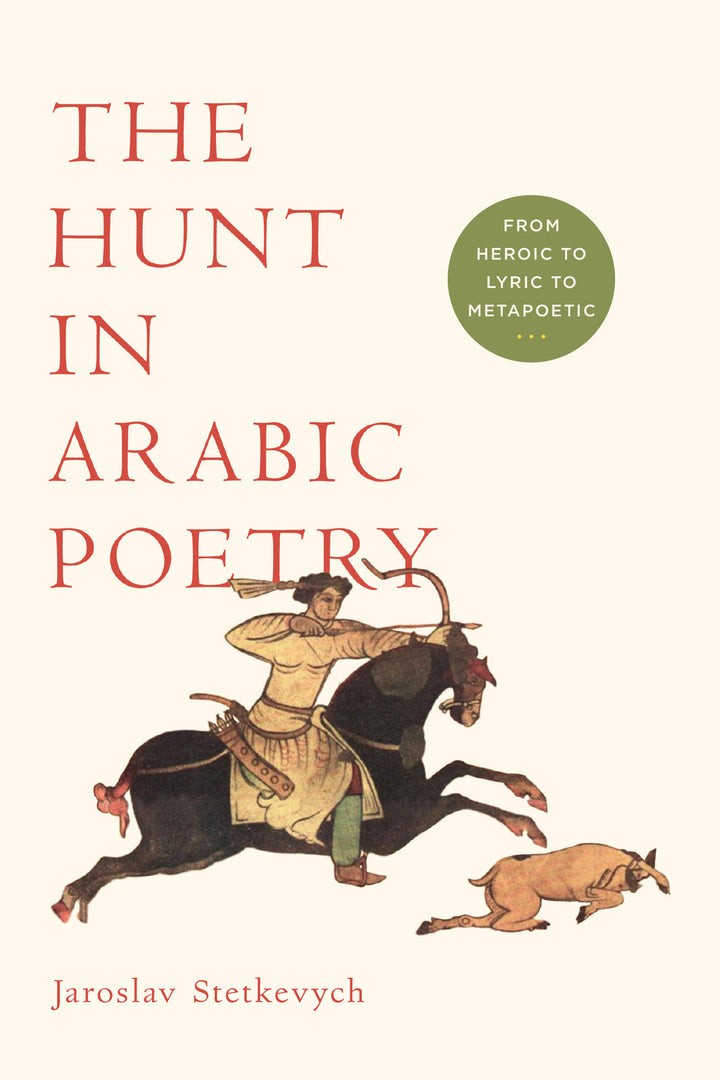
Among the world’s major literary traditions, Arabic poetry is perhaps unique in that the theme of the hunt runs in a continuous, if uneven, current from the pre-Islamic, oral tradition, dating as far back as the fifth century CE, through the coming of Islam in the seventh century and the Umayyad and 'Abbasid caliphates, ultimately serving as a classical substrate for the radical Modernism of the twentieth century. This striking continuity of theme and motif of the pursuer—the hunter, companions, his steed, hounds, or falcon—and the pursued, whether the prey be oryx, onager, gazelle, hare, quail, or fox, is subject to dramatic transformations of poetic genre, structure, and sensibility throughout the arc of Arab cultural history. Through elegant translations and compelling interpretations, Jaroslav Stetkevych brings this dynamic Arabic tradition fully into the purview of contemporary cultural and humanistic studies.
In the chapters of Part I of The Hunt in Arabic Poetry, Stetkevych explores the divergent themes of the heroic and the anti-heroic hunter within the grand genre of archaic Arabic odes and its transformation with the transition to Islam to a poetics of sacrifice and redemption. Part II traces the emergent aesthetics of the free-standing hunt lyric within the courtly culture of the Umayyad and ‘Abbasid caliphates and the transition from description to imagism, concluding with the appearance of the long narrative hunt poem. Part III moves to the high Modernism of twentieth-century Arab free-verse poets and with it the reemergence of the classical theme of the hunt, now as a metaphor for the Modernist poet’s metapoetic pursuit of the poem itself.

“Throughout, Jaroslav Stetkevych allows the poems to speak for themselves both in their original Arabic texts and in his extraordinarily poetic English translations, as he adeptly and patiently guides us to a deeper understanding of the tardiyyah, one of the classical genres of Arabic poetry." —Journal of Arabic Literature
Jaroslav Stetkevych is professor emeritus of Arabic literature at the University of Chicago.
Acknowledgments
Note on Transliteration
Introduction
Part 1.The Heroic and the Anti-Heroic in the Early Arabic Ode: The Qaṣīdah
1. The Hunt in the Pre-Islamic Ode
2. The Hunt in the Ode at the Close of the Archaic Period
3. Sacrifice and Redemption: The Transformation of an Archaic Theme in al-Ḥuṭay’ah
Part2. The Hunt Poem as Lyric Genre in Classical Arabic Poetry: The Ṭardiyyah
4. The Discreet Pleasures of the Courtly Hunt: Abū Nuwās and the ‘Abbāsid Ṭardiyyah
5.From Description to Imagism: Alī Ibn al-Jahm’s “We Walked over Saffron Meadows”
6. Breakthrough into Lyricism: The Ṭardiyyahs of Ibn al-Mu>tazz 139
7.From Lyric to Narrative: The Ṭardiyyah of Abū Firās al-Ḥamdānī
Part 3. Modernism and Metapoesis: The Pursuit of the Poem
8. The Modernist Hunt Poem in >Abd al-Wahhāb al-Bayātī and Aḥmad ‘Abd al-Mu’ṭī Ḥijāzī
9. The Metapoetic Hunt of Muḥammad ‘Afīfī Maṭar
Notes
Bibliography
Index