


Some error occured while loading the Quick View. Please close the Quick View and try reloading the page.
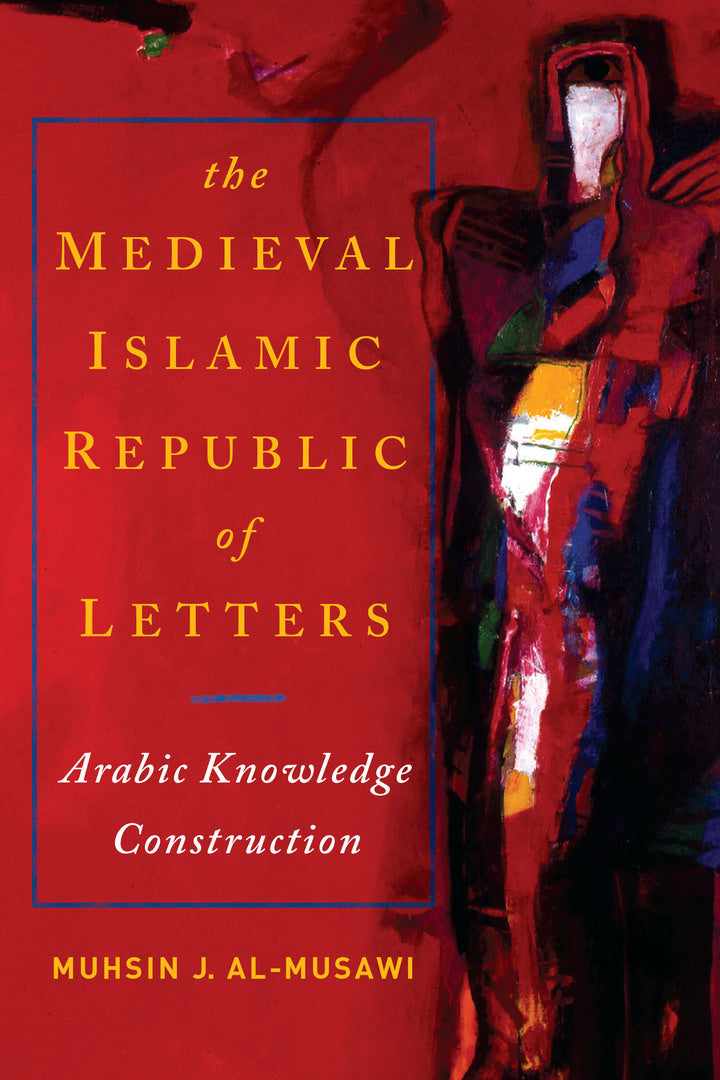
In The Medieval Islamic Republic of Letters: Arabic Knowledge Construction, Muhsin J. al-Musawi offers a groundbreaking study of literary heritage in the medieval and premodern Islamic period. Al-Musawi challenges the paradigm that considers the period from the fall of Baghdad in 1258 to the collapse of the Ottoman Empire in 1919 as an "Age of Decay" followed by an "Awakening" (al-nahdah). His sweeping synthesis debunks this view by carefully documenting a "republic of letters" in the Islamic Near East and South Asia that was vibrant and dynamic, one varying considerably from the generally accepted image of a centuries-long period of intellectual and literary stagnation.
Al-Musawi argues that the massive cultural production of the period was not a random enterprise: instead, it arose due to an emerging and growing body of readers across Islamic lands who needed compendiums, lexicons, and commentaries to engage with scholars and writers. Scholars, too, developed their own networks to respond to each other and to their readers. Rather than addressing only the elite, this culture industry supported a common readership that enlarged the creative space and audience for prose and poetry in standard and colloquial Arabic. Works by craftsmen, artisans, and women appeared side by side with those by distinguished scholars and poets.
Through careful exploration of these networks, The Medieval Islamic Republic of Letters makes use of relevant theoretical frameworks to situate this culture in the ongoing discussion of non-Islamic and European efforts. Thorough, theoretically rigorous, and nuanced, al-Musawi's book is an original contribution to a range of fields in Arabic and Islamic cultural history of the twelfth to eighteenth centuries.

"Muhsin al-Musawi, who has already written a number of smaller studies on the premodern period of Arabic creativity, now crowns his achievements with a lengthy study that should finally put to rest the Orientalist-inspired notion of a 'period of decadence' in the Arab-Islamic cultural heritage. Pointing out the differing aesthetic criteria with which previous generations of Western scholars have had such difficulty with engaging and comprehending, al-Musawi makes telling use of an enormous range of texts in order to analyze and prioritize cultural and literary trends over several medieval centuries and to demonstrate the ways in which successive generations of creative writers and those who commented on their output created a cultural milieu of considerable sophistication." —Roger Allen, Sascha Jane Patterson Harvie Professor Emeritus of Social Thought and Comparative Ethics, University of Pennsylvania
Muhsin J. al-Musawi is professor of Arabic and comparative studies at Columbia University.
Acknowledgements
Thresholds
Chapter One: Theorizing Autobiography
A. Autobiography: Space, Scope, and Objective
Gaston Bachelard in Autobiographical Discussion
Geometry and Geography
Narrative Grammar
Autobiographic Grammatica
B. What to Disclose?
Gutenberg Galaxy
Memory and its Discontents
C. Theorizing Narrative Typologies
Narrative Variations
Generic Forms and Mutations
Autobiography: a Self-Critical Art?
D. Autobiographical Properties?
E. Speaking of Arabic Autobiographical Thought?
Theory: The Spatial Lacuna
Chapter Two: The Autobiographer in Action
Autobiographical Tracks:
A. The Self-Made Intellectual: Jurjī Zaydān Jurjī Zaydān’s Journey
B. Universalist Outlook: Mīkḫāˀīl Nuˁaymah’s Seventy Year Record
C. Seven Autobiographic Trajectories
That Postcolonial Reconstruction?
From Riḥlah to Incarceration?
The Illusion of Completeness
D. Types, Prototypes, and Archetypes
Paul De Man’s Discontents
Derrida’s “Otobiographies”
E. Arabic Auto/biography: Shifting Grounds and Prospects
Rewriting Oral Self-Narrative
Individuation in Context
F. Conversion or Regeneration?
Pre-Modern Autobiography and its Semantic Field Modernists and Their Itineraries
G. Reading Registers as Autobiographical Historical Probes
Chapter Three: The Arab Enlighteners
Part One
A. The Ur-Text: Ṭāhā Ḥusayn’s Al-Ayyām (The Days)
Delegated Power of a Text?
How to Canonize Rupture?
Inaugurating the Spokesperson and the Doyen
Family, Nation, and Resentment
**B. Al-Ayyām and the Nahḍah Enlightenment Discourse **
Ḥusayn’s Ghosts
Strategies of Endearment
Ḥusayn’s Sufis
Part Two:
C. Sayyid Quṭb: Autobiography as Literary Museum
The Educational Journey
Differences from Ṭāhā Ḥusayn’s Al-Ayyām
Quṭb’s Vast Geographical Field.
D. The Isotropic Space in Sayyid Quṭb’s Autobiography
The Presence of the Village
Quṭb: Self-Sufficiency and the Circular
The Sociologue at Work
Statist Intrusion
Chapter Four: Writing Back: The Autobiographer’s Commitment
Part One
Autobiography as Act of Protest: The Educational Journey of Salāmah Mūsā
The Absence of Marx?
Engaging with ‘Modernity’ on a Donkey’s back
Mūsā’s Argument for Rationalism
Meeting Europe
Is it a Manichean Binary?
The Road to India
Map of Reading
Exploding Paradigm of the Arab Awakening: Arabic Rhetoric
The Saving Remnant?
Part Two The Self-made Marxist Novelist: Ḥannā Mīnah
Memory and its Discontents
Family and Rural Economies
The Novelist at Work
The Collective in the Circular
Departing from a Bildungsroman
Chapter Five
Women’s Voices /Women’s Journeys
Part One:
Hudā Shaʿrāwī's Third Space: Identitarian Politics of a Memoir
Sentimental Education and the Symbolic Idyll
Genealogical Tree: Rooted Ancestry
In Chalon General Stores: Commodity Fetish
Part Two: The Palestinian I in Fadwā Tūqān’s Riḥlah jabaliyyah (Mountainous Journey)
Turns in the Linguistic Space
Architectural Expression
The Split Self
The Pastoral and the Urban
From an Ancient Town to a City
Part Three: Reclaiming Pre-Islamic Ancestry: Nawāl El-Saʿadāwī’s The Daughter of Isis
Why Autobiography?
The Problematic Dotting
Ideologizing Self-Narrative
The Two Fathers: The Doyen and the Biological
Rural Space: Social and Economic Life
Menouf: Cartography of a Town
Chapter Six: Autobiographical Experimentation
Part One: Jabra’s Exceptional Spatial Hold
The Power of a Center
The Road to Jerusalem
Gathering Experience in Festivity
Jabra’s National Awakening
Christian Rituals
Axial Motivations and Geographic Traversing
Mystery beyond Borders
The Centripetal, Centrifugal Jerusalem
Towards the House of Bread
A National Geography or an Autobiographer’s Bildungsroman?
A Story-Telling Genealogy?
Part Two:
The Ṭarbūsh for the Turban: Aḥmad Amīn’s Ḥayātī (My Life )
Amīn’s Culture Trees
The Stranger
Cultural and Symbolic Power
Part Three
Fading Identitarian Sites: Sasson Somekh’s Baghdad Yesterday
Chapter Seven: Autobiographic Novels: An Open Door to a Fictionalized Self-Narrative
Part One
A. The Break with the Middle Class Novel: Khayrī Shalabī ’s Wikālat ʻAtiya (Lodging House )
The Forked Magnet Narrative
Space as the Protagonist-Producer
The Social Geographer at Work
Class or Classless Wikālah?
Education and Market Economies
‘Abd al-Nāṣir’s Crackdown on the Muslim Brotherhood
The Power of Discourse
Polemological Reading of a Wikālah Culture The Carnival
B. The Vagrant as Cartographer: Khayrī Shalabī or Samuel Shamoun?
Part Two: Maps for Contentment and Rage: The Autobiographical Ayyām al-insān al-sab‘ah (The Seven Days of Man)
The Rural Poetics of Space Hard Choices: Not a Bildungsroman The Sufi Path and Geographical Routes Multiple Geographies: The Material and the Mystical The Idyllic and the Circular The Disturbing State Power
Chapter Eight:Autobiographical Space
Part One: Poly-Generic Exilic Topographies Language and its Verities
Part Two: Maḥmūd Darwīsh’s Mythopoeia of the Nomadic and the Sedentary
Place is Passion
Exile of a Homeland
Dismantling the Euphemistic
The Road to Homecoming: the Qaṣīdah
Part Three: Narrative Cities:
Baṣrayatha: The Narrator as Cartographer
Continuum