


Some error occured while loading the Quick View. Please close the Quick View and try reloading the page.
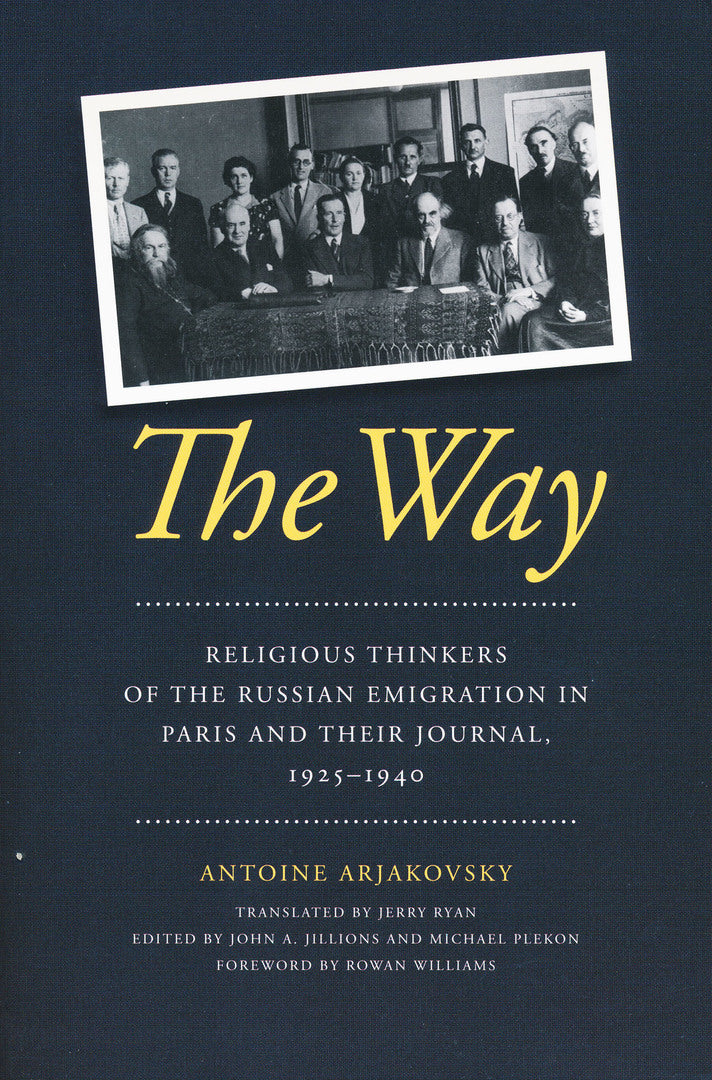
The journal Put', or The Way, was one of the major vehicles for philosophical and religious discussion among Russian émigrés in Paris from 1925 until the beginning of World War II. This Russian language journal, edited by Nicholas Berdyaev among others, has been called one of the most erudite in all Russian intellectual history; however, it remained little known in France and the USSR until the early 1990s. This is the first sustained study of the Russian émigré theologians and other intellectuals in Paris who were associated with The Way and of their writings, as published in The Way. Although there have been studies of individual members of that group, this book places the entire generation in a broad historical and intellectual context. Antoine Arjakovsky provides assessments of leading religious figures such as Berdyaev, Bulgakov, Florovsky, Nicholas and Vladimir Lossky, Mother Maria Skobtsova, and Afanasiev, and compares and contrasts their philosophical agreements and conflicts in the pages of The Way. He examines their intense commitment to freedom, their often contentious struggles to bring the Christian tradition as experienced in the Eastern Church into conversation with Christians of the West, and their distinctive contributions to Western theology and ecumenism from the perspective of their Russian Orthodox experience. He also traces the influence of these extraordinary intellectuals in present-day Russia, Western Europe, and the United States.
Throughout this comprehensive study, Arjakovsky presents a wealth of arguments, from debates over "Russian exceptionalism" to the possibilities of a Christian and Orthodox version of socialist politics, the degree to which the church could allow its agenda to be shaped by both local and global political realities, and controversies about the distinctively Russian theology of Divine Wisdom, Sophia. Arjakovsky also maps out the relationships these émigré thinkers established with significant Western theologians such as Jacques Maritain, Yves-Marie Congar, Henri de Lubac, and Jean Daniélou, who provided the intellectual underpinnings of Vatican II.

“ . . . in the majority of themes he touches, from the internal divisions of the church and the exiles, to the theological content of the work of Florovsky and Bulgakov and the philosophies of Berdyaev, Shestov, Frank, and others, Arjakovsky is on firm ground, showing a mastery of the various subjects that arise throughout the contributions to the journal over the decade and a half of existence. . . . Arjakovsky’s book is important and valuable, perhaps even more now than in the past, and worthwhile as a guidebook to this important period in intellectual and religious history.” —H-Catholic, H-Net Reviews
Antoine Arjakovsky is research director at the Collège des Bernardins in Paris and founding director of the Institute of Ecumenical Studies and professor of ecumenical theology at the Ukrainian Catholic University in Lviv, Ukraine. He is the author of a number of books, including Qu'est-ce que l'orthodoxie?
Foreword
Acknowledgements
Notes on Transliteration and Other Conventions
Introduction
Part 1: A Modernist Journal (1925–1929)
Part 2: A Nonconformist Journal (1930–1935)
Part 3: A Spiritual Journal (1935–1940)
Conclusion: The Two “Bodies” of the Review
Afterword to the English Translation
Notes
References: Articles Published in The Way
Index