


Some error occured while loading the Quick View. Please close the Quick View and try reloading the page.
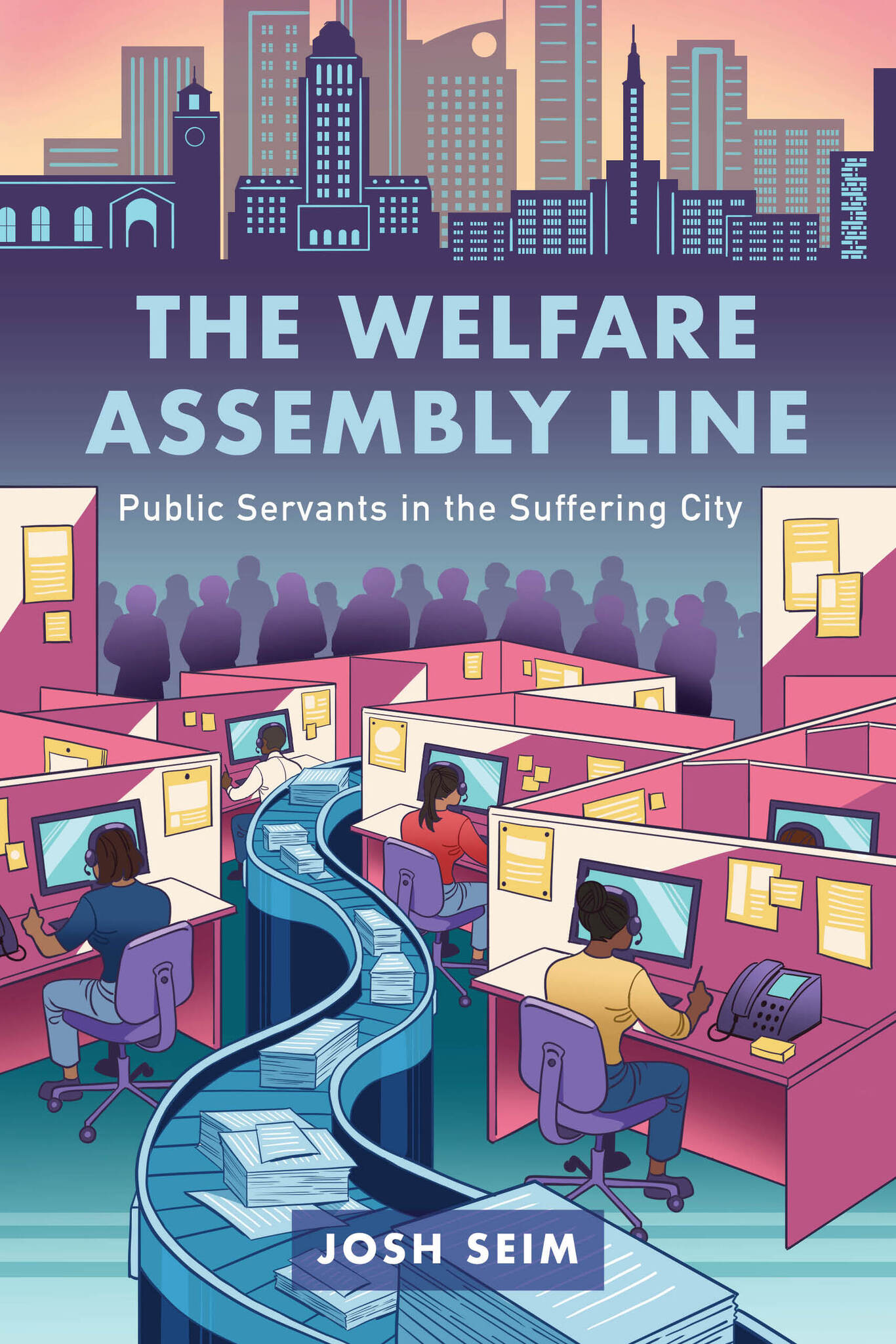
Despite claims that we live in a "post-welfare society," welfare offices remain vital not only for those who depend on them for benefits but also for those who depend on them for a paycheck. This book, a theory-driven case study of the Los Angeles County Department of Public Social Services, examines how welfare work has transformed to allow a department of just 14,000 to serve more than a third of the county.
Josh Seim argues that frontline workers at this agency—who are mostly Black and Brown women—have become increasingly proletarianized. Their work is defined less by their discretion and more by a lack of control over the productive process. This is enabled by a "welfare assembly line," where a high division of labor and heavy use of machinery resemble production regimes in factories and fast-food restaurants. With implications beyond the welfare office, The Welfare Assembly Line is a crucial addition to the broader national conversation about work, social policy, and poverty governance.
Josh Seim argues that frontline workers at this agency—who are mostly Black and Brown women—have become increasingly proletarianized. Their work is defined less by their discretion and more by a lack of control over the productive process. This is enabled by a "welfare assembly line," where a high division of labor and heavy use of machinery resemble production regimes in factories and fast-food restaurants. With implications beyond the welfare office, The Welfare Assembly Line is a crucial addition to the broader national conversation about work, social policy, and poverty governance.

Price: $29.95
Pages: 302
Publisher: University of California Press
Imprint: University of California Press
Publication Date:
10 February 2026
Trim Size: 9.00 X 6.00 in
ISBN: 9780520404168
Format: Paperback
BISACs:
Josh Seim is Associate Professor of Sociology at Boston College and author of Bandage, Sort, and Hustle: Ambulance Crews on the Front Lines of Urban Suffering.
Contents
List of Tables
Author’s Note
Acknowledgments
Glossary of Key Terms and Acronyms
Introduction
1. The Policy Factory
2. The Good County Job
3. Seeing Customers
4. Making Participants
5. Disciplining the Line
6. Dis/Connected
Conclusion
Appendix: Notes on Data and Method
Notes
References
Index
List of Tables
Author’s Note
Acknowledgments
Glossary of Key Terms and Acronyms
Introduction
1. The Policy Factory
2. The Good County Job
3. Seeing Customers
4. Making Participants
5. Disciplining the Line
6. Dis/Connected
Conclusion
Appendix: Notes on Data and Method
Notes
References
Index