


Some error occured while loading the Quick View. Please close the Quick View and try reloading the page.
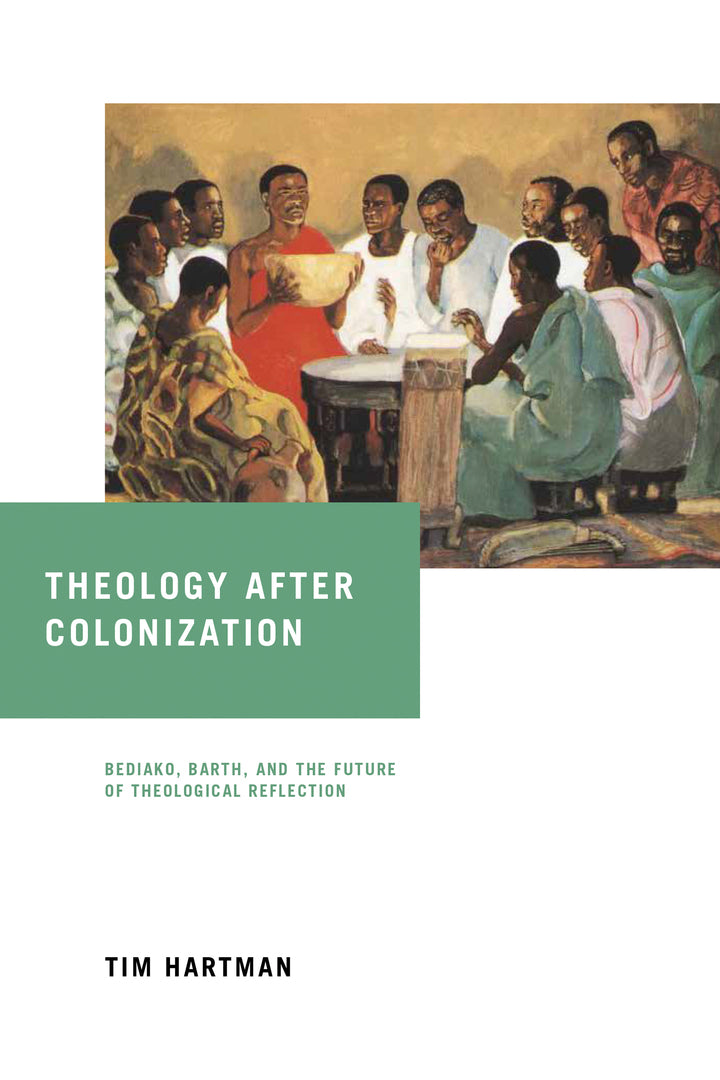
Tim Hartman's Theology after Colonization uses a comparative approach to examine two theologians, one from Europe and one from Africa, to gain insight into our contemporary theological situation. Hartman examines how the loss of cultural hegemony through rising pluralism and secularization has undermined the interconnection of the Christian faith with political power and how globalization undermined the expansive (and expanding) mindset of colonialization. Hartman engages Swiss-German theologian Karl Barth (1886–1968), whose work responded to the challenges of Christendom and the increasing secularization of Europe by articulating an early post-Christendom theology based on God's self-revelation in Jesus Christ, not on official institutional structures (including the church) or societal consensus. In a similar way, Ghanaian theologian Kwame Bediako (1945–2008) offered a post-colonial theology. He wrote from the perspective of the global South while the Christian faith was growing exponentially following the departure of Western missionaries from Africa. For Bediako, the infinite translatability of the gospel of Jesus Christ leads to the renewal of Christianity as a non-Western religion, not a product of colonialization.
Many Western theologies find themselves unable to respond to increasing secularization and intensifying globalization because they are based on the very assumptions of uniformity and parochialism (sometimes called "orthodoxy") that are being challenged. Hartman claims Bediako and Barth can serve as helpful guides for contemporary theological reflection as the consensus surrounding this theological complex disintegrates further. Collectively, their work points the way toward contemporary theological reflection that is Christological, contextual, cultural, constructive, and collaborative. As one of the first books to examine the work of Bediako, this study will interest students and scholars of Christian theology, African studies, and postcolonial studies.

"For those interested in learning more about African theology and who already have some grounding in the Western tradition, Hartman is a very able guide." —Theology Today
Acknowledgments
Abbreviations
Introduction
Part I. Western Christian Theology Today
1. A Crisis of (Shifting) Authority: The Decline of Christendom and the Rise of Secularization and Globalization
2. Transcultural Theology through Juxtaposition Transitional Theological Interlude
Part II. Rethinking Divine Revelation
3. Christological Reflection: Revelation in Jesus Christ
4. Contextual Reflection: Revelation, not Religion
5. Cultural Reflection: The Location of Revelation
6. Constructive Reflection: Imaginative and Prophetic
7. Collaborative Reflection: Learning, not Helping
Notes
Bibliography
Index