


Some error occured while loading the Quick View. Please close the Quick View and try reloading the page.
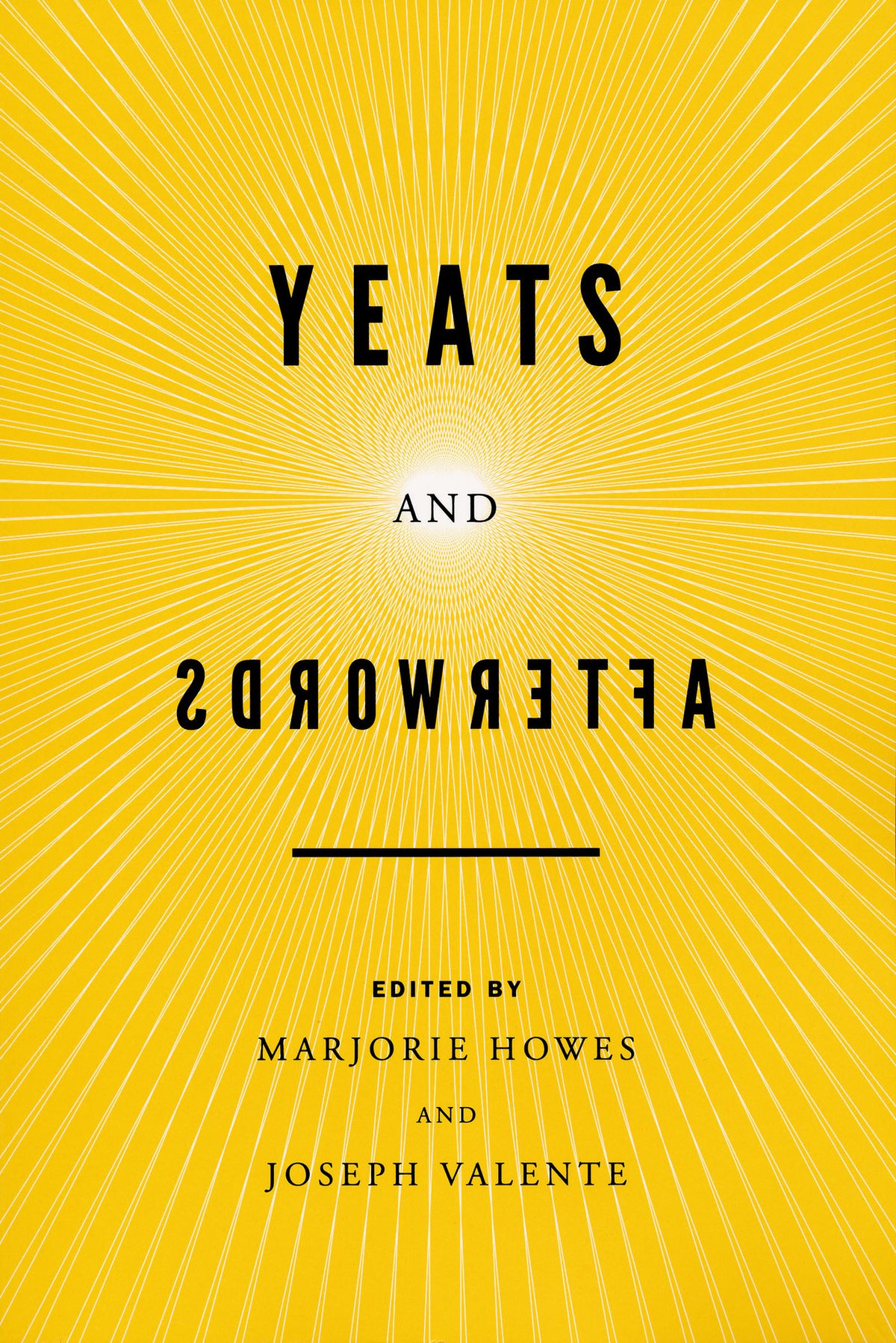
In Yeats and Afterwords, contributors articulate W. B. Yeats's powerful, multilayered sense of belatedness as part of his complex literary method. They explore how Yeats deliberately positioned himself at various historical endpoints—of Romanticism, of the Irish colonial experience, of the Ascendancy, of civilization itself—and, in doing so, created a distinctively modernist poetics of iteration capable of registering the experience of finality and loss. While the crafting of such a poetics remained a constant throughout Yeats's career, the particular shape it took varied over time, depending on which lost object Yeats was contemplating. By tracking these vicissitudes, the volume offers new ways of thinking about the overarching trajectory of Yeats's poetic engagements.
Yeats and Afterwords proceeds in three stages, involving past-pastness, present-pastness, and future-pastness. The first, "The Last Romantics," examines how Yeats repeats classic motifs and verbal formulations from his literary forebears in order to express the circumscribed cultural options with which he struggles. The essays in this section often uncover Yeats's relation to sources and precursors that are surprising or have been relatively neglected by scholars. The second section, "Yeats and Afterwords," looks at how Yeats subjects his own past sentiments, insights, and styles to critical negation, crafting his own afterwords in various ways. The last section, "Yeats's Aftertimes," explores how, thanks to the stature Yeats achieved through its invention, his style of belatedness itself comes to be reiterated by other writers. Yeats is a towering figure in literary history, hard to follow and harder to avoid, and later writers often found themselves producing words that were, in some sense, his afterwords.

“In Yeats and Afterwords, editors Marjorie Howes and Joseph Valente have collected a compelling selection of essays by twelve of the leading scholars in Irish studies around the concept of ‘belatedness’ in the work of W.B. Yeats. Although ‘afterwords’ and ‘belatedness’ may seem like conveniently vague rubrics to connect dissimilar essays, Yeats’ ‘intricate nexus of temporal vectors’ is consistently and impressively central to each peace.” —James Joyce Quarterly
Joseph Valente is UB Distinguished Professor of English at SUNY Buffalo.
Acknowledgments
Introduction
Part 1. The Last Romantics
1. The Revivalist Museum: Yeats and the Reanimation of History by Renée Fox
2. The Death of Cuchulain’s Only Son by Elizabeth Cullingford
3. The Dark Arts of the Critic: Yeats and William Carleton by James H. Murphy
4. Nation for Art’s Sake: Aestheticist Afterwords in Yeats’s Irish Revival by Joseph Valente
Part 2. Yeats and Afterwords
5. “The Age-Long Memoried Self ”: Yeats and the Promise of Coming Times by Gregory Castle
6. Afterwardsness: Yeats in Love and the Imaginary of Community by Guinn Batten
7. “The clock has run down and must be wound up again”: A Vision in Time by Margaret Mills Harper
8. Yeats’s Graves: Death and Encryption in Last Poems by Marjorie Howes
Part 3. Yeats’s Aftertimes
9. “Echo’s Bones”: Samuel Beckett After Yeats by Seán Kennedy
10. Yeats and Bowen: Posthumous Poetics by Vicki Mahaffey
11. The Legacy of Yeats in Contemporary Irish Poetry by Ronald Schuchard
12. “All that Consequence”: Yeats and Eliot at the End of the End of History by Jed Esty
List of Contributors
Index of Names