


Some error occured while loading the Quick View. Please close the Quick View and try reloading the page.
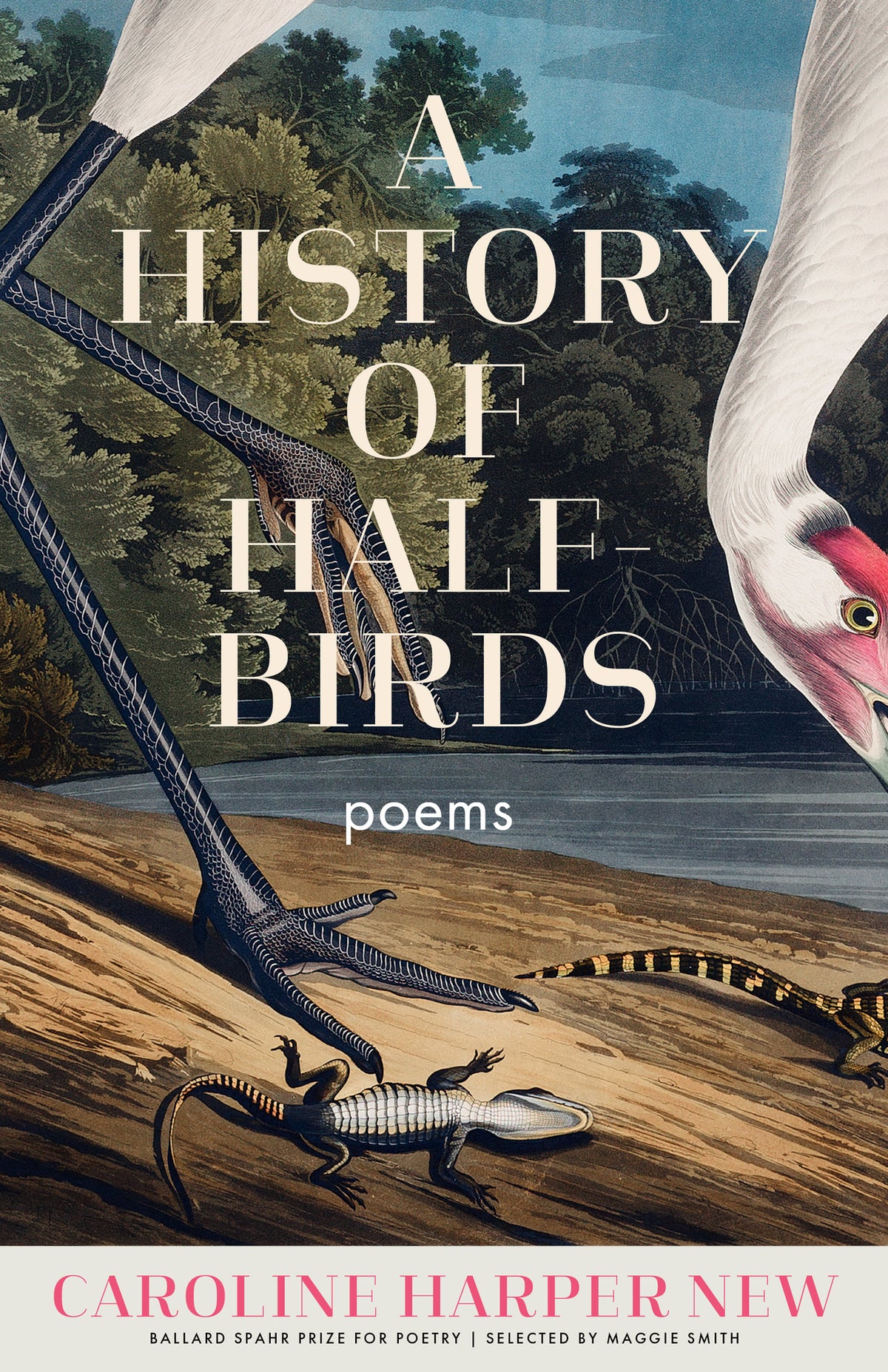
Selected by Maggie Smith for the 2023 Ballard Spahr Prize for Poetry, this debut collection of poems explores the aftermath of history’s most powerful forces: devotion, disaster, and us.
Rooted in the Gulf Coast, A History of Half-Birds measures the line between love and ruin. Part poet, part anthropologist, Caroline Harper New digs into dark places—a cave, a womb, a hurricane—to trace how violence born of devotion manifests not only in our human relationships, but also in our connections to the natural and animal worlds. Everywhere in these pages, tenderness is coupled with brutality: a deer eats a baby bird, a lover restrains another. “I promised / a love poem,” New proclaims, then teaches us about the anglerfish, how it “attracts its mate / and prey with the same lure.”
In New’s exceptional voice, familiar concepts take on a shade of the fantastic. A woman tastes the earth for acidity, buries lemons and pennies for balance. Limestone “sucks the sea / into little demitasse” and hyacinths “sip the sun / black.” A lone elephant wanders into the wilderness of rural Georgia, never to be seen again. But perhaps most arresting about New’s work are the truths told by its strangeness, like the ancient fish who “carved their shape” in a mountain’s peak, or a mother who wears a lifejacket in the bathtub.
Crafted by New’s voracious mind and carried by her matchless lyricism, A History of Half-Birds is a stunning investigation of love’s beastly impulses—all it protects, and all it destroys.

“There’s an untamed luminescence to Caroline Harper New’s debut, A History of Half Birds, a collection steeped in science and mythology.”—Rebecca Morgan Frank, Harriet Books Blog
"A History of Half-Birds, an inventive and impressively wide-ranging collection, has me considering and reconsidering the connections between seemingly disparate things: between poetry and science, both fueled by curiosity, imagination, and possibility; between history and myth, precision and ambiguity, the known and the unknown. In the Anthropocene, we may be tempted to ask what poetry can do for us when what we need are tools for survival. I’d argue that these poems are just that—expertly crafted, satisfying to hold and behold, and sharp enough to dissect what needs dissecting. We’re so lucky to have this book here and now."—Maggie Smith, author of Goldenrod
“Steeped in Gulf Coast flora and fauna, Caroline Harper New’s A History of Half-Birds is a gorgeous collection of poems that spins widdershins like a hurricane. This book embraces life’s complicated dualities—the precarious gravity of Saturn’s rings, nightmares that visit with every new love, the way an anglerfish attracts both its mate and prey with the same lure. Equally embracing facts and lyricism, New weaves stray opossums and beached whales into love poems, jellyfish and memory into a chandelier. Each poem is full of the world’s intimate facts that suddenly become mirrors. They are tender and wise and illuminate their mysteries. It’s a truly beautiful debut.”—Traci Brimhall, author of Come the Slumberless to the Land of Nod
“Like a ‘flashlight / prying through the night swamps,’ Caroline Harper New’s poems delve into the dark and treacherous corners of ourselves to ask, ‘What would any of us do / if freed?’ Through conversations with doctors and paleontologists, she traces ‘what’s left of a body,’ eroding the borders between human and non-human: inside a humpback whale she finds a sitting room, and it is unclear whether the floating lights of a Florida street are jellyfish or chandeliers. When ‘the future prickles dark at your spine,’ Caroline Harper New’s A History of Half-Birds teaches us that our only hope is to return to the body, to open our ‘shoulder / blades and dig.’”—Maia Elsner, author of Overrun by Wild Boars
"I will be forever grateful to Caroline Harper New for teaching me about widdershins, the colliding moons of Saturn, and the anatomy of sirens. Gorgeous!“—Laurel McCaull, Green Apple Books & Music, San Francisco, CA
Praise for Caroline Harper New
“I admire the vast distances crossed here—from the lake with its threatened herd to the differently threatened rings around Saturn, from the immediacy of the speaker’s moment to Galileo’s time to the future 100 million years from now. Intimacy can be lonely in a world so vast. No wonder the speaker wants something small, tangible, and nameable: ‘To hold a face between my hands and call it golden.’”—Carl Phillips, author of Then the War, on “Elk Lake”
“‘Notes on Devotion’ operates almost like the clockwork or other mechanicals it mentions, different gears turning into each other—the idea of conditioning, that of love and the inescapability of loss, the nature of ritual, and what can (and can’t) interrupt all of these things—clicking into place by sound and association. Or another mechanical analogy: it moves like a combination lock tumbling into place to release. The poem is intricate, uncanny, heartaching, and almost infinitely rereadable.”—Rebecca Lindenberg, author of Love, an Index, on “Notes on Devotion”
“‘Interview with a Cervidologist’ is a haunting poem. It spoke to me immediately in the darkness of its imagery and tone, which hints at something scary, something threatening, something unknown. The uncanny within us—of digestion, of things split and torn, hunted, and struck down. Violence. The violence of existing in a time when science, technology, and ideas all have the capacity to be both deadly and necessary, with humans at the wheel. 'Interview with a Cervidologist' imagines the roadside grit that it takes to be an urban, post-apocalyptic survivor, human or otherwise. And in that otherwise lies the poem’s strength and its challenge to readers. What do we take for granted and why? What are the costs? I hope you will take the journey that this poem offers to accept uncertainty: to feel unsettled, to feel that you’re not quite sure what’s going on and never quite safe in your knowing.”—Ki’en Debicki, on “Interview with a Cervidologist”
Caroline Harper New is the author of A History of Half-Birds, winner of the 2023 Ballard Spahr Prize for Poetry. She is a poet and visual artist from the Gulf Coast with a background in anthropology, and she holds an MFA in Writing from the University of Michigan. Her poetry has appeared or is forthcoming in American Poetry Review, Cincinnati Review, Palette Poetry, Southern Humanities Review, and Driftwood Press. She is winner of Palette Poetry’s 2023 Love & Eros Prize, the Malahat Review’s 2023 Open Season Award, the Cincinnati Review’s 2022 Robert and Adele Schiff Award, and Bellevue Literary Review’s 2022 John & Eileen Allman Prize for Poetry. She lives in Ann Arbor, Michigan.
Widdershins XXX
The Archaeology Magazine XXX
Garden of Eve XXX
Management of the Living XXX
Fieldnotes on Cape San Blas XXX
Auguries by Mouth XXX
Ekphrasis XXX
Fieldnotes on Carrying XXX
Driving Through Dunedin XXX
PART II
PARLOR TRICKS
Notes on Devotion XXX
The Bathtub XXX
If We Move Back in Together XXX
Fieldnotes on Hydrangeas XXX
Interview With a Cervidologist XXX
Etymology of Chlorophyll XXX
Patients Regain Song Before Speech XXX
If We Stage the Wizard of Oz With Alligators XXX
Fieldnotes on Juniper XXX
The Sargassum Fish XXX
My Ancestors in South Carolina XXX
Fieldnotes on the Bloodmoon XXX
Ereshkigal, Our Sinkhole Sister XXX
Love Poem for My Bird Dog XXX
PART III
HYPOTHETICAL MOONS
Moon Song for My Mother XXX
Searching for Amelia (I) XXX
Fieldnotes on the Red-Bellied Woodpecker XXX
The Women of Weeki Wachee XXX
Searching for Amelia (II) XXX
Parlor Tricks XXX
Fieldnotes on Red XXX
The Bioluminescent Bays of Vieques XXX
Fieldnotes on Hypothetical Moons XXX
Searching for Amelia (III) XXX
Elk Lake XXX
The Loon’s Solid Bones Help Her Sink XXX
Notes XXX
Gratitude XXX