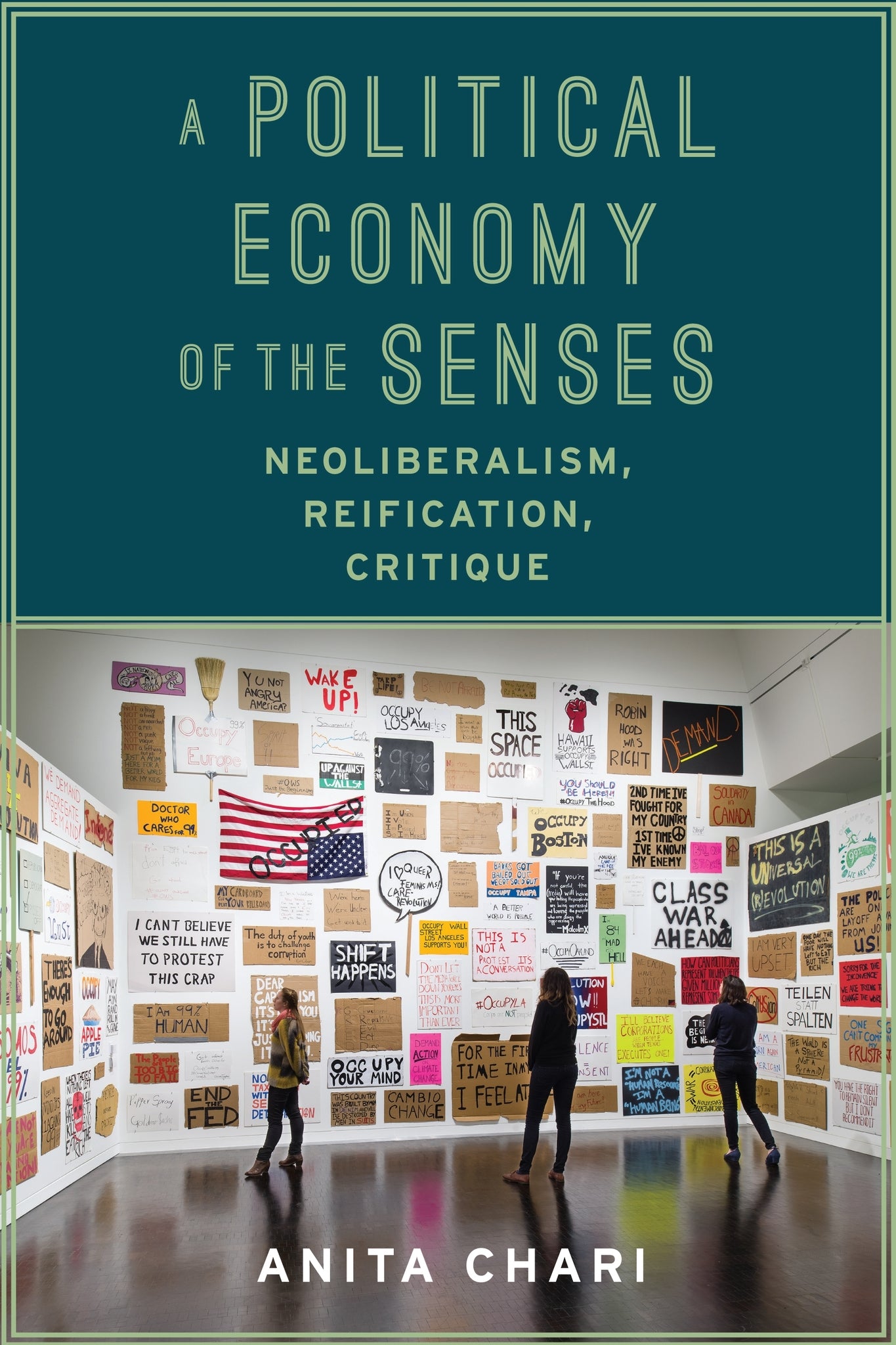
Anita Chari revives the concept of reification from Marx and the Frankfurt School to spotlight the resistance to neoliberal capitalism now forming at the level of political economy and at the more sensate, experiential level of subjective transformation. Reading art by Oliver Ressler, Zanny Begg, Claire Fontaine, Jason Lazarus, and Mika Rottenberg, as well as the politics of Occupy Wall Street, Chari identifies practices through which artists and activists have challenged neoliberalism's social and political logics, exposing its inherent tensions and contradictions.
Price: $32.00
Pages: 280
Publisher: Columbia University Press
Imprint: Columbia University Press
Series: New Directions in Critical Theory
Publication Date:
13 October 2015
Trim Size: 9.00 X 6.00 in
ISBN: 9780231173896
Format: Paperback
A Political Economy of the Senses represents the rise of a new, dynamic critical theory for the twenty-first century. It offers at once a critique of neoliberalism's inversion of the political, a renewal of the dialectical imagination of the early Frankfurt School, and an aesthetic-based re-materialization of the political subject. Occupy Wall Street emerges in these pages not as a fleeting historical event but as the signifier of a new, open-ended human potential for emancipation to be actively constructed in the social praxis of our time.
— John Bellamy Foster, editor of the Monthly Review and author of Marx's Ecology
Anita Chari is assistant professor of political science at the University of Oregon. In addition to her work as a critical theorist, she is a creative writer, composer, and musician.
Acknowledgments
Introduction: Toward the Materialization of Critique
Part I. Neoliberal Symptoms
1. Neoliberal Symptoms: The Impasse Between Economics and Politics in Contemporary Political Theory
2. Neoliberalism and Normative Ambivalence: Third-Generation Critical Theory and the Fetish of Intersubjectivity
Part II. The Critique of Reification
3. Alienation and Depoliticization: Rejoining Radical Democracy with the Critique of Capitalism
4. Lukács's Turn to a Political Economy of the Senses
5. The Reversibility of Reification: Adorno from the Aesthetic to the Social
Part III. A Political Economy of the Senses
6. Defetishizing Fetishes: Art and the Critique of Capital in Neoliberal Society
7. Occupy Wall Street: Challenging Neoliberal Reification
Notes
Bibliography
Index