


Some error occured while loading the Quick View. Please close the Quick View and try reloading the page.
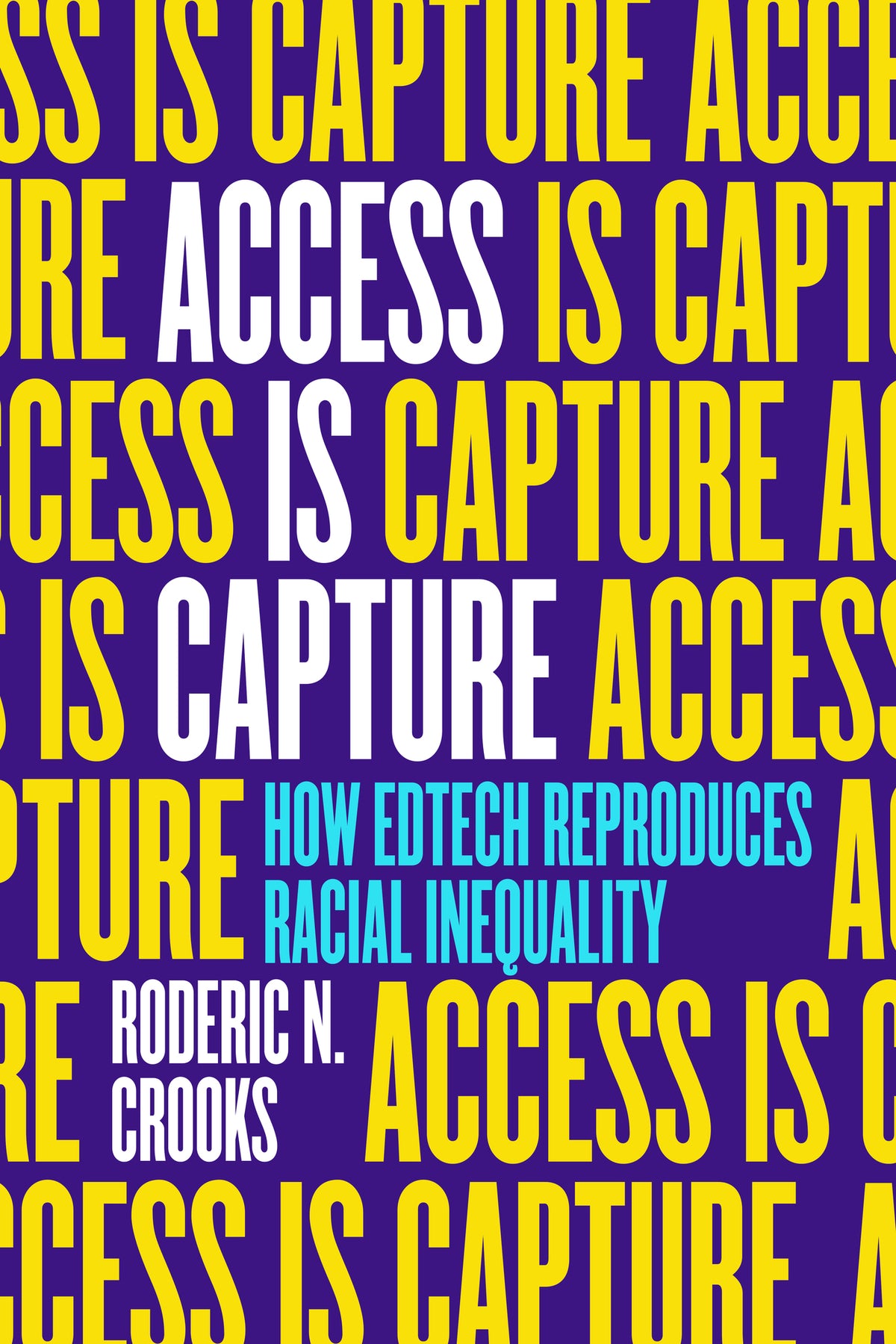
Racially and economically segregated schools across the United States have hosted many interventions from commercial digital education technology (edtech) companies who promise their products will rectify the failures of public education. Edtech's benefits are not only trumpeted by industry promoters and evangelists but also vigorously pursued by experts, educators, students, and teachers. Why, then, has edtech yet to make good on its promises? In Access Is Capture, Roderic N. Crooks investigates how edtech functions in Los Angeles public schools that exclusively serve Latinx and Black communities. These so-called urban schools are sites of intense, ongoing technological transformation, where the tantalizing possibilities of access to computing meet the realities of structural inequality. Crooks shows how data-intensive edtech delivers value to privileged individuals and commercial organizations but never to the communities that hope to share in the benefits. He persuasively argues that data-drivenness ultimately enjoins the public to participate in a racial project marked by the extraction of capital from minoritized communities to enrich the tech sector.

Price: $29.95
Pages: 269
Publisher: University of California Press
Imprint: University of California Press
Publication Date:
27 August 2024
Trim Size: 8.50 X 5.50 in
ISBN: 9780520393288
Format: Paperback
BISACs:
“[Access Is Capture] reframes access not as a neutral good, but as a contested site where racialised power structures are reconfigured under the guise of inclusion. This serves as both a cautionary tale and a call to action, urging stakeholders to prioritise pedagogy, ethics, and equity over technological novelty. Crooks’ book has significantly shaped my doctoral research on how online habits influence children’s offline social growth by challenging the assumption that increased access to digital platforms inherently benefits learners.”
Roderic N. Crooks is Assistant Professor of Informatics in the Donald Bren School of Information and Computer Sciences at the University of California, Irvine.
Contents
Acknowledgments
01 Access as Racial Progress
02 Access as Social Justice
03 Access as Surveillance
04 Access as Management
05 Access as Community Control
Conclusion: Access Is Capture (But Some of Us Get Free)
Notes
References
Index
Acknowledgments
01 Access as Racial Progress
02 Access as Social Justice
03 Access as Surveillance
04 Access as Management
05 Access as Community Control
Conclusion: Access Is Capture (But Some of Us Get Free)
Notes
References
Index