


Some error occured while loading the Quick View. Please close the Quick View and try reloading the page.
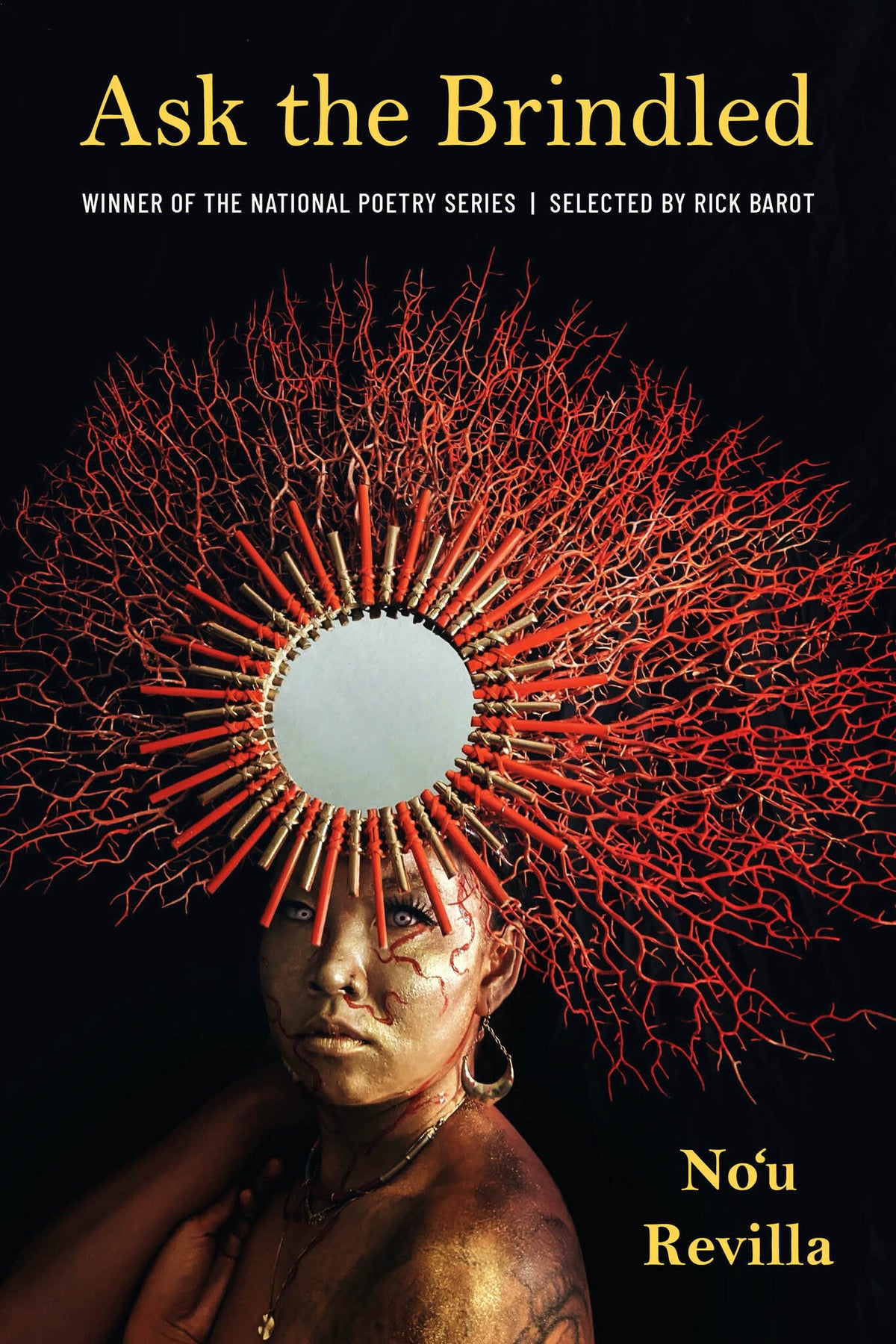
Ask the Brindled, selected by Rick Barot as a winner of the 2021 National Poetry Series, bares everything that breaks between “seed” and “summit” of a life—the body, a people, their language. It is an intergenerational reclamation of the narratives foisted upon Indigenous and queer Hawaiians—and it does not let readers look away.
In this debut collection, No‘u Revilla crafts a lyric landscape brimming with shed skin, water, mo‘o, ma‘i. She grips language like a fistful of wet guts and inks the page red—for desire, for love, for generations of blood spilled by colonizers. She hides knives in her hair “the way my grandmother—not god— / the way my grandmother intended,” and we heed; before her, “we stunned insects dangle.” Wedding the history of the Kingdom of Hawaiʻi with contemporary experiences of queer love and queer grief, Revilla writes toward sovereignty: linguistic, erotic, civic. Through the medium of formal dynamism and the material of ʻŌiwi culture and mythos, this living decolonial text both condemns and creates.
Ask the Brindled is a song from the shattered throat that refuses to be silenced. It is a testament to queer Indigenous women who carry baskets of names and stories, “still sacred.” It is a vow to those yet to come: “the ea of enough is our daughters / our daughters need to believe they are enough.”

Praise for Ask the Brindled
“The 2021 National Poetry Series, Revilla’s debut reclaims Indigenous and queer Hawaiian identity, challenging colonial narratives by investigating history and personal experience.”—Publishers Weekly
“In her debut collection, which won the 2021 National Poetry series, Native Hawaiian poet No’u Revilla explores bodies, language, the legacies of colonialism, the natural world, and grief. Her poems blend the history of the Hawaiian Kingdom, stories from ‘Öiwi culture, and experiences of queerness and queer love. It’s a beautiful book that honors the unique stories of queer and Native Hawaiian women in bright, unflinching, unforgettable language.”—Book Riot
“No‘u Revilla gifts us vertical language with words falling down the page like droplets of rain and growing up like saplings in Ask the Brindled.”—India Lena González, Poets & Writers
“To read Ask the Brindled, by No’u Revilla, is to visit a shapeshifting dictionary. Definitions morph into cosmogonies, specificities into protections against history, and abstractions into tactics for living changes.”—Lúcia Leão, RHINO Magazine
“No’u Revilla is as singular a voice as can be found.”—Foreword Reviews
“Revilla’s debut poetry collection is both lyrically and formally dynamic as she tackles themes such as sovereignty, queer desire, Hawaiian history, decolonization, queer grief, and sacred stories…. The book’s approach is intergenerational, both forward and backward looking as the poems reclaim past narratives foisted on queer Indigenous and Hawaiian peoples and dream up a future of abundance.”—Casey Stepaniuk, Autostraddle, “92 of the Best Queer Books of 2022”
“Poised in the electric space where history and lyric converge, Noʻu Revilla’s Ask the Brindled has new things to say about old things—the work of love, the work of family and community, the work of articulating a self that is ‘shattered & many-named.’ Sustained by a wily variety of forms, the poems’ abiding figure is the shapeshifter, underscoring Revilla’s accomplishment of a complex testimony. With both tenderness and urgency brought to poetry’s reparative labor, Ask the Brindled shows survivance as a gorgeous unfolding of story and polemic, audacity and song.”—Rick Barot
“Ask the Brindled is an astonishing addition to the canon (or canoe) of Pacific Islander literature. Noʻu Revilla embodies the many definitions of a queer, Indigenous shapeshifter. In this collection, she transforms the origins of hurt into seeds of healing through verse, prose, erasure, visual typography, and even a Hawaiian alphabet abecedarian. Cling tightly to these poems because they will crawl under your skin like sly lizards and ask you to shed fear and swallow abundance.”—Craig Santos Perez
"As you devour Noʻu Revilla’s poems in Ask the Brindled for their stories and secrets, for their deftness and innovation of language and form, you will, in turn, be devoured by their shape-shifting, regenerative beauty and power. Like Hāʻōʻū, Maui and the great moʻo deities from whom she descends, Revilla reveals herself as warrior, protector, witness, survivor, lover, mana whine, healer, and teacher. With the fire of transformation, the fluid memory of water, and the shimmer of light on scales, this collection is nothing short of Indigenous queer feminist decolonial revelation and revolution. This is not poetry for the heart; this poetry is only for the gut. Prepare to be swallowed whole in body and emerge with new, raw skin. Here is ʻŌiwi poetry at its finest and fiercest."—Brandy Nālani McDougall
"In Ask the Brindled, Noʻu Revilla revives a lineage nearly severed at the hands of occupation and empire. These protection songs and incantations of remembrance and resistance are forced by saltwater and mettle of queer, indigenous alchemy. Both in armor and in tender flesh, I feel seen in Revilla's world. Here, queer-femme-rage is medicine. To know the languages and aesthetics of the archipelagoes is to understand the vital arteries of earth: 'No matter who are you, who you / pretend to be on dry land, / when we get you, it is wet and honest.' Revilla wields narratives of sacrifice, regeneration, matriarchy, and femme identified myth with ferocity that resuscitates ancestral voices back to the sensual, back to blood."—Angela Peñaredondo
“Ask the Brindled reminded me of the power of poetry to reclaim and resist. Brimming with queer Indigenous brilliance, I fell in love with Revilla's generous sharing of Oiwi culture, cosmology, and history. It was a distinct pleasure to learn so much from a book blooming with lyric lushness and formal experimentation.” — Halee Kirkwood, Birchbark Books & Native Arts
I.
Definitions of moʻo 1-3
Maunakea
About the effects of shedding skin
Welcome to the gut house
Eggs
He moʻo, he wahine
Kino
Moʻolelo is the theory
My grandma tells
Memory as missionary position
How to swallow a colonizer
Catalogue of gossip, warnings & other talk of moʻo, aka an ʻōiwi abecedarian
Don’t have sex with gods
When you say “protestors” instead of “protectors”
II.
Definitions of moʻo 4-6
Iwi hilo means thigh bone means core of one’s being
Maui county fair
In search of a different ending
I. Summer with funeral & booze
II. Summer with funeral & playing house
III. Summer with funeral & 3 a.m.
Mercy
Ex is a verb
After she leaves you, femme
Lessons in quarantine
So sacred, so queer
Adze-shaped rain
III.
Erasure triptych: ʻai
Sirens out
Erasure triptych: aloha
IV.
Definitions of moʻo 7-8
Thirst traps
Myth bitch
Getting ready for work
For sisters who pray with fire
Dirtiest grand
The opposite of dispossession is not possession; it is connection
The ea of enough
Fire in Mākena
Recovery, Waikīkī
New patient form—medical history—creative option
Preparing Kaʻuiki
Basket
Shapeshifters banned, censored, or otherwise shit-listed, aka chosen family poem
Notes
Mahalo