


Some error occured while loading the Quick View. Please close the Quick View and try reloading the page.
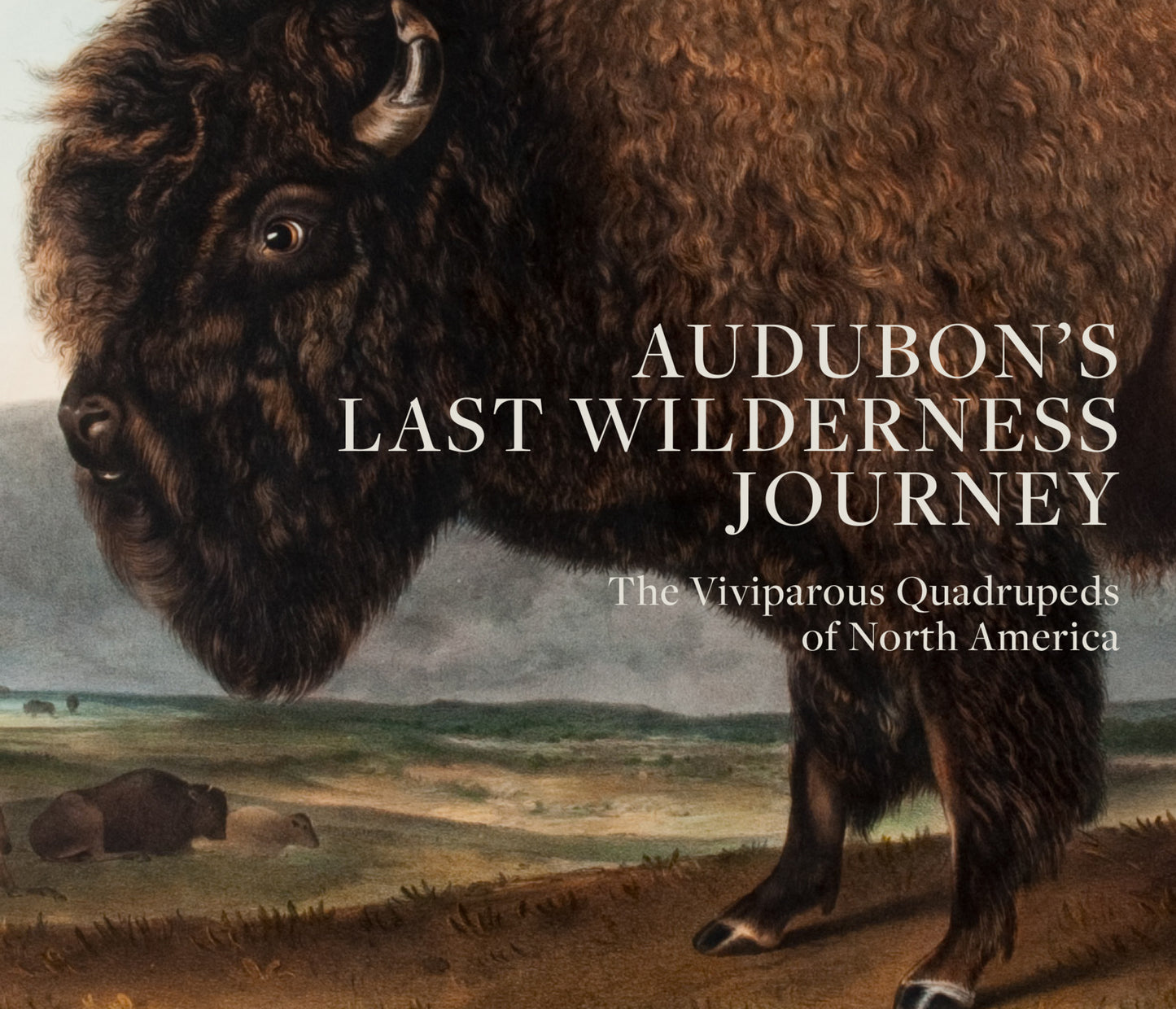
John James Audubon's Viviparous Quadrupeds of North America is the largest and most significant color plate book produced in the United States in the nineteenth century, and a fitting monument to the genius of America's most famous ornithologist, naturalist, and painter. Measuring an impressive 27 3/4 x 21 1/4 inches, the Quadrupeds was published in 1845-48 as a three-volume elephant folio broadsheet edition, the artist's final great natural history work and the first single publication to document America's animals.
Audubon’s Last Wilderness Journey reproduces all one hundred and fifty original lithographic prints in color, with a timeline of Audubon's life and career. Essays by noted experts in art history, wildlife science, and ecology put this remarkable work in context, explaining its technical, artistic, and scientific importance and legacy. They consider the enduring zoological and ecological significance of the Quadrupeds folios, including their scientific value to issues such as classification, and how our relationship towards nature has changed since the 1840s.
The volume additionally includes transcripts from the journal kept by Edward Harris, cashier to the 1843 expedition, describing the everyday details of their journey and the animals they encountered, as well as a letter, written in 1851, from Audubon’s son Victor to Harris, detailing the circumstances of his father’s death.
This entire work is a remarkable record highlighting the wider importance of the North American wilderness and the significance and beauty of Audubon’s detailed illustrations.. This exceptional new volume will have serious appeal to the general public and to art historians, scientists, environmentalists, scholars, researchers, and academics alike.

"Just like his birds, Audubon’s mammals are a joy to behold."—Garden & Gun
Charles T. Butler is the former executive director of the Columbus Museum. He served as President of the Southeastern Museums Association and is a member of the Art Museum Directors Association.Butler has many personal accolades and accomplishments. He received the Lifetime Professional Award from the Southeastern Museums Conference and the Georgia Museum Professional of the Year from the Georgia Association of Museums and Galleries.
Dennis Harper is curator of Collections and Exhibitions at the Jule Collins Smith Museum of Fine Art, Auburn, Alabama.
Daniel Patterson is professor emeritus of English Language and Literature, Central Michigan University, Mount Pleasant, Michigan and a member of the Association for the Study of Literature and Environment.
Sarah Zohdy is an assistant professor at the School of Forestry and Wildlife Sciences, Auburn University, Alabama.
Robert A. Gitzen is an assistant professor at the School of Forestry and Wildlife Sciences, Auburn University, Alabama.
James B. Armstrong is a professor at the School of Forestry and Wildlife Sciences, Auburn University, Alabama.
Christopher A. Lepczyk is a professor at the School of Forestry and Wildlife Sciences, Auburn University, Alabama
A) The Making of The Viviparous Quadrupeds of North America by Ron Tyler, PhD
Set in Stone: The Use of Lithography for Audubon’s Quadrupeds by Dennis Harper
Modernization of Natural History: From Audubon to Now by Sarah Zohdy, PhD
Human–Wildlife Interactions by James B. Armstrong, PhD
On the Scientific Value of Quadrupeds by Robert Gitzen, PhD
The Shifting Views of Nature and Wildlife by Christopher A. Lepczyk, PhD
The Quadrupeds Portfolios
Quadrupeds Timeline by Daniel Patterson,
Bibliography by Scott Bishop
Checklist
Index
- Choosing a selection results in a full page refresh.
- Opens in a new window.