Skip to product information
1 of 1

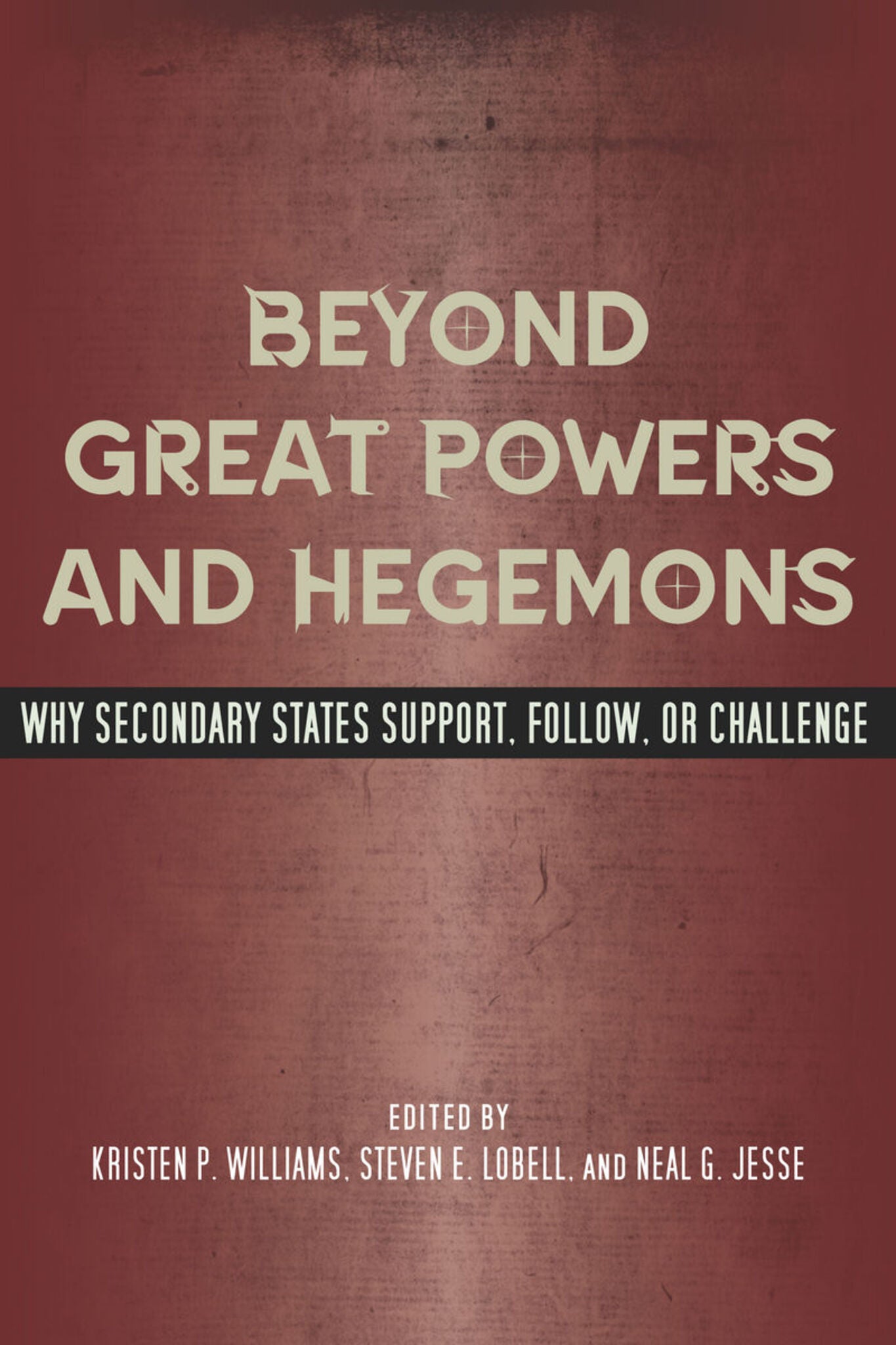
Beyond Great Powers and Hegemons

Regular price $120.00
Sale price $120.00 Regular price $120.00
Sale Sold out
This book adds a new dimension to the discussion of the relationship between the great powers and the weaker states that align with them—or not. Previous studies have focused on the role of the la...
Read More
  • Format:
  • 28 March 2012
View Product Details

This book adds a new dimension to the discussion of the relationship between the great powers and the weaker states that align with them—or not. Previous studies have focused on the role of the larger (or super) power and how it manages its relationships with other states, or on how great or major powers challenge or balance the hegemonic state. Beyond Great Powers and Hegemons seeks to explain why weaker states follow more powerful global or regional states or tacitly or openly resist their goals, and how they navigate their relationships with the hegemon. The authors explore the interests, motivations, objectives, and strategies of these 'followers'—including whether they can and do challenge the policies and strategies or the core position of the hegemon.

Through the analysis of both historical and contemporary cases that feature global and regional hegemons in Europe, Latin America, the Middle East, Africa, Asia, and South Asia, and that address a range of interest areas—from political, to economic and military—the book reveals the domestic and international factors that account for the motivations and actions of weaker states.

files/i.png Icon
Price: $120.00
Pages: 272
Publisher: Stanford University Press
Imprint: Stanford Security Studies
Publication Date: 28 March 2012
Trim Size: 9.00 X 6.00 in
ISBN: 9780804771634
Format: Hardcover
BISACs:

"Beyond Great Powers and Hegemons illustrates how secondary and tertiary states must balance short-term and long-term risks and domestic and international pressures when dealing with hegemons. The authors convincingly demonstrate that regime type does not play the critical role in the decision making process . . . As the world continues to shift toward an unbalanced multipolar power structure where emerging states will try to assert their influence, this volume's findings may prove to be especially important. This book overall is an excellent addition to international relations theory and may provide the foundation for understanding an increasingly complex international system."—Preston Musgrave, Journal of Peace Research
Kristen P. Williams is Professor of Political Science at Clark University. Steven E. Lobell is Associate Professor of Political Science at the University of Utah. Neal G. Jesse is Associate Professor of Political Science at Bowling Green State University.