


Some error occured while loading the Quick View. Please close the Quick View and try reloading the page.
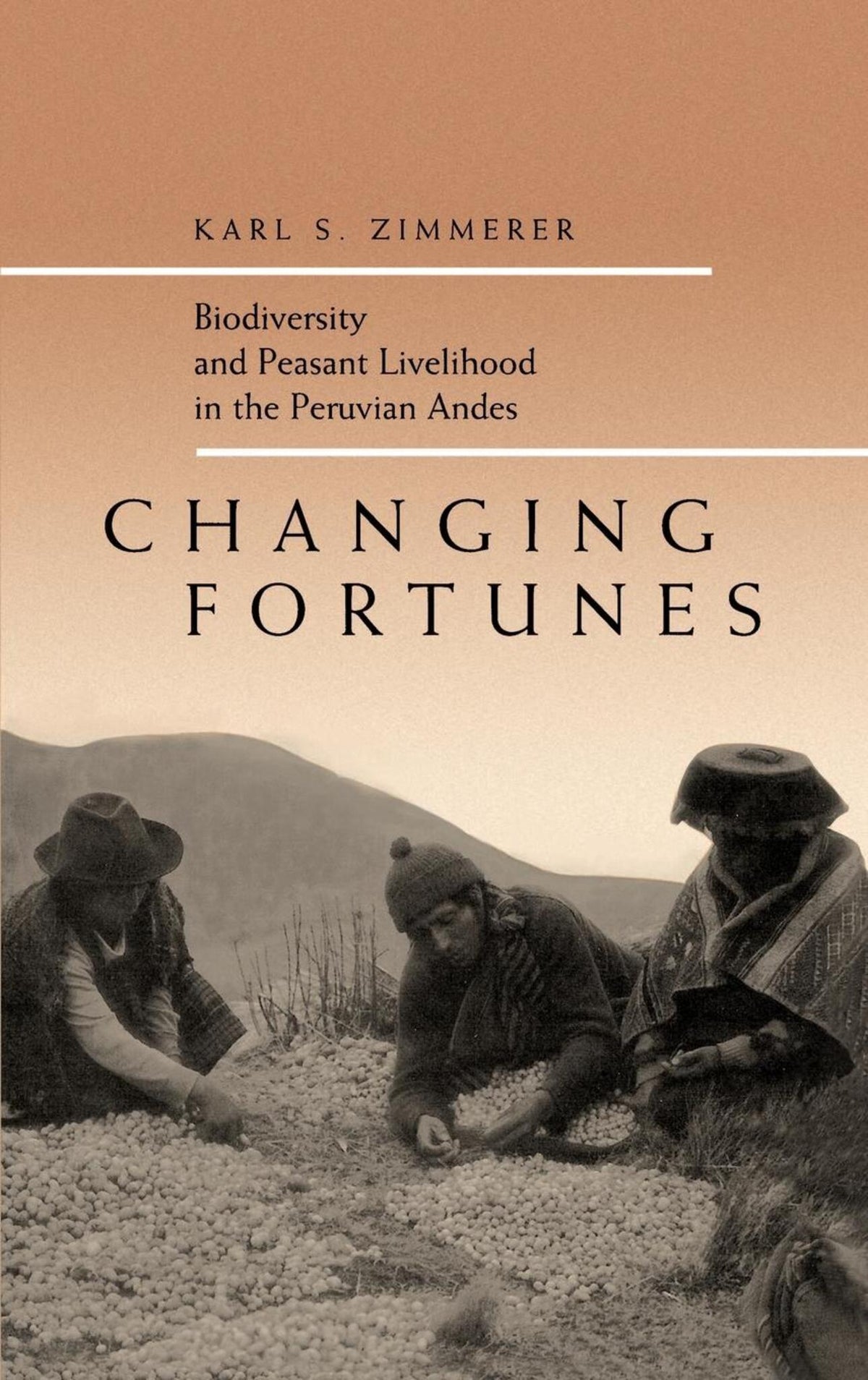
Two of the world's most pressing needs—biodiversity conservation and agricultural development in the Third World—are addressed in Karl S. Zimmerer's multidisciplinary investigation in geography. Zimmerer challenges current opinion by showing that the world-renowned diversity of crops grown in the Andes may not be as hopelessly endangered as is widely believed. He uses the lengthy history of small-scale farming by Indians in Peru, including contemporary practices and attitudes, to shed light on prospects for the future. During prolonged fieldwork among Peru's Quechua peasants and villagers in the mountains near Cuzco, Zimmerer found convincing evidence that much of the region's biodiversity is being skillfully conserved on a de facto basis, as has been true during centuries of tumultuous agrarian transitions.
Diversity occurs unevenly, however, because of the inability of poorer Quechua farmers to plant the same variety as their well-off neighbors and because land use pressures differ in different locations. Social, political, and economic upheavals have accentuated the unevenness, and Zimmerer's geographical findings are all the more important as a result. Diversity is indeed at serious risk, but not necessarily for the same reasons that have been cited by others. The originality of this study is in its correlation of ecological conservation, ethnic expression, and economic development.
Diversity occurs unevenly, however, because of the inability of poorer Quechua farmers to plant the same variety as their well-off neighbors and because land use pressures differ in different locations. Social, political, and economic upheavals have accentuated the unevenness, and Zimmerer's geographical findings are all the more important as a result. Diversity is indeed at serious risk, but not necessarily for the same reasons that have been cited by others. The originality of this study is in its correlation of ecological conservation, ethnic expression, and economic development.

Price: $63.00
Pages: 309
Publisher: University of California Press
Imprint: University of California Press
Series: California Studies in Critical Human Geography
Publication Date:
29 January 1997
Trim Size: 9.21 X 6.14 in
ISBN: 9780520203037
Format: Hardcover
BISACs:
Karl S. Zimmerer is Associate Professor of Geography and Environmental Studies at the University of Wisconsin, Madison.
Acknowledgments
1. Fields of Plenty and Want
2. The Great Historical Arch of Andean Biodiversity
3. Transitions in Farm Nature and Society, 1969-1990
4. Innovation and the Spaces of Biodiversity
5. Loss and Conservation of the Diverse Crops
6. Diversity's Sum: Geography, Ecology-Economy, and Culture
7. The Vicissitudes of Biodiversity's Fortune
1. Fields of Plenty and Want
2. The Great Historical Arch of Andean Biodiversity
3. Transitions in Farm Nature and Society, 1969-1990
4. Innovation and the Spaces of Biodiversity
5. Loss and Conservation of the Diverse Crops
6. Diversity's Sum: Geography, Ecology-Economy, and Culture
7. The Vicissitudes of Biodiversity's Fortune