


Some error occured while loading the Quick View. Please close the Quick View and try reloading the page.
Honorable Mention, 2026 Joseph Levenson Prize (China, post-1900), Association for Asian Studies
In the late nineteenth century, Chinese reformers and revolutionaries believed that there was something fundamentally wrong with the Chinese writing system. The Chinese characters, they argued, were too cumbersome to learn, blocking the channels of communication, obstructing mass literacy, and impeding scientific progress. What had sustained a civilization for more than two millennia was suddenly recast as the root cause of an ongoing cultural suicide. China needed a new script to survive in the modern world.
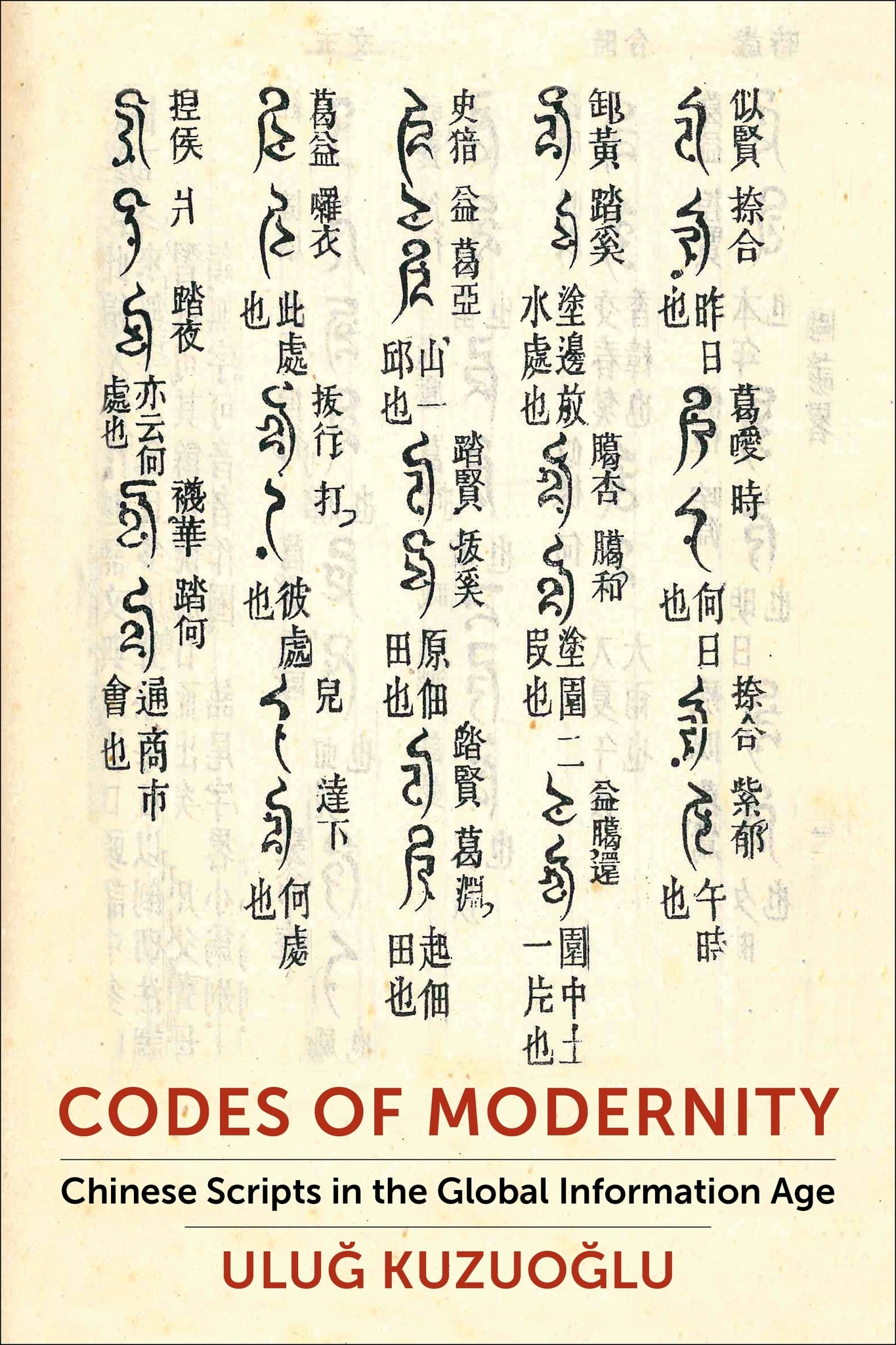
Codes of Modernity explores the global history of Chinese script reforms—efforts to alphabetize or simplify the writing system—from the 1890s to the 1980s. Examining the material conditions and political economy underlying attempts to modernize scripts, Uluğ Kuzuoğlu argues that these reforms were at the forefront of an emergent information age. Faced with new communications technologies and infrastructures as well as industrial, educational, and bureaucratic pressures for information management, reformers engineered scripts as tools to increase labor efficiency and create alternate political futures.
Kuzuoğlu considers dozens of proposed scripts, including phonetic alphabets, syllabaries, character simplification schemes, latinization, and pinyin. Situating them in a transnational framework, he stretches the geographical boundaries of Chinese script reforms to include American behavioral psychologists, Soviet revolutionaries, and Central Asian typographers, who were all devising new scripts in pursuit of informational efficiency. Codes of Modernity brings these experiments together to offer new ways to understand scripts and rethink the shared experiences of a global information age.

Acknowledgments
Introduction
1. Alphabetic Labor Time: Scripts, Wires, and Brains in the Late Qing
2. The National Phonetic Alphabet: Scripts and the Birth of Language Politics
3. Basic Chinese: Cognitive Management and Mass Literacy
4. Simplification of Chinese Characters: Mining, Counting, Seeing
5. The New Dunganese Alphabet: Latinization Across Eurasia
6. The Chinese Latin Alphabet: A Revolutionary Script
7. The Empire of Pinyin
Epilogue: A New Age of Codes
Notes
Bibliography
Index