


Some error occured while loading the Quick View. Please close the Quick View and try reloading the page.
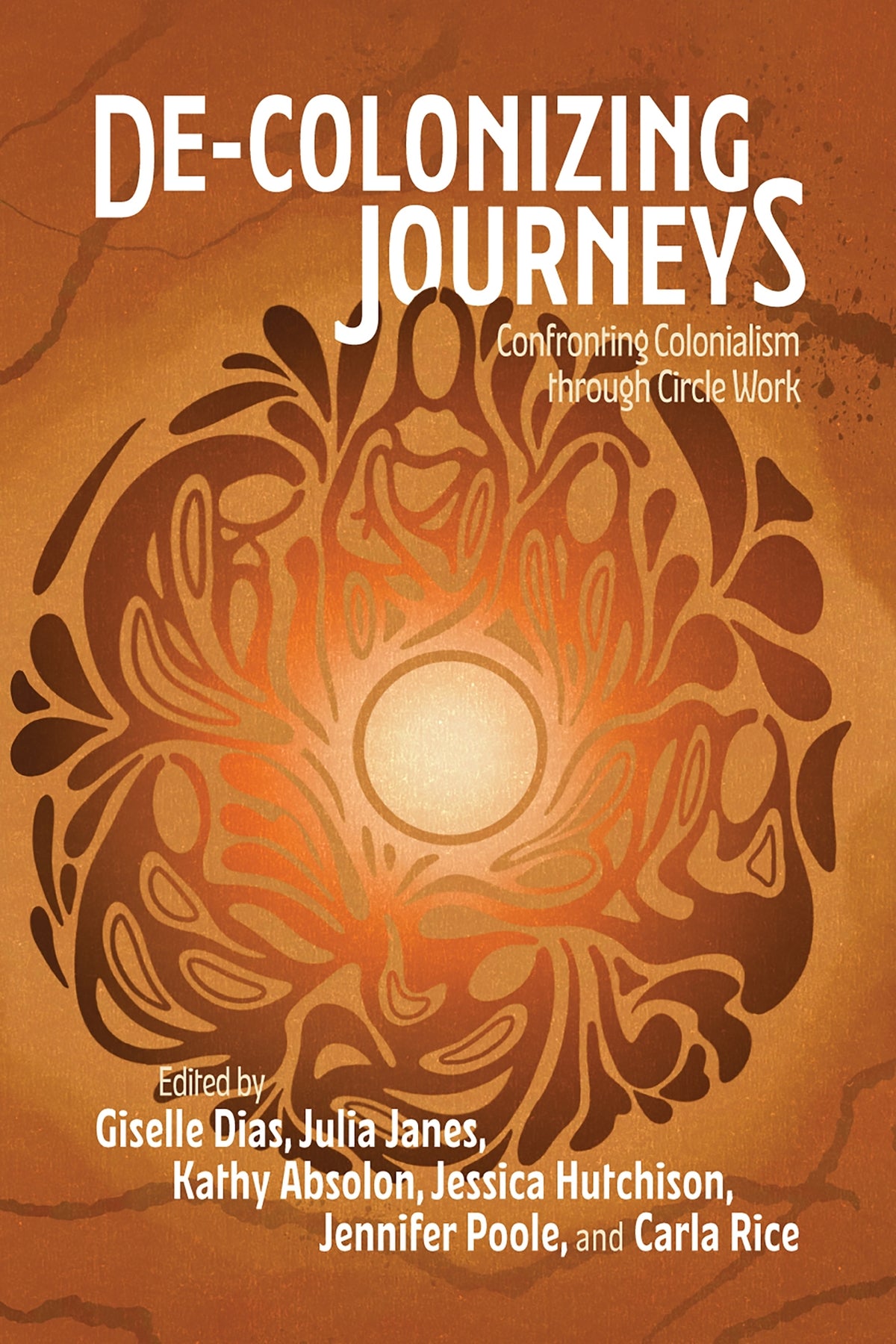
This transformative collection features Indigenous and settler peoples who engaged in years of circle work to unpack how colonialism affects their lives and professional practices. Circle work is an Indigenous methodology of building knowledge and challenging unexamined colonial assumptions. It reveals that de-colonizing isn’t linear; it is an embodied process that unfolds on multiple levels. The practices described in this book centre Indigegogy — a relational, land-based, spirit-centred approach to learning that invites vulnerability, reflexivity, and truth telling. While each person engages from their cultural context and position in society, every contributor shares how pivotal, “holy shit” moments during the experience of circle work have reshaped their ways of being.
Guided by circle work, digital storying, and land-based teachings, this is an intimate encounter with Indigenous knowledge and lived accounts of people who chose to wake up, to feel, and to act differently in the world.

Giselle Dias (Edited by)
Giselle Dias (Niigaanii Zhaawshko Giizhigokwe – Leading Blue Sky Woman) is an Indigiqueer Métis writer, activist scholar, educator, community organizer, and Auntie with roots in the Red River (Hodgson and Fidler), as well as settler ancestry. She lives and works on the Haldimand Tract, the traditional territory of the Neutral, Anishinaabe, and Haudenosaunee Peoples. Her scholarship focuses on Indigenous wholistic abolition, Indigegogy, decolonization, and land-based learning, weaving Indigiqueer feminist theory, Indigenous wholism, and community-rooted practice. Her published work engages Indigenous ethics in social work, Indigenous queer and Two-Spirit futurities, Indigenous disability and fat studies, and the responsibilities of mixed-race Indigenous and settler positionality within decolonial scholarship. She is an assistant professor in the Indigenous Field of Study in the Faculty of Social Work at Wilfrid Laurier University, where her work bridges academic scholarship and community activism in support of Indigenous sovereignty, Land Back, and abolitionist futures.
Julia Janes (Edited by)
Julia Janes is a disabled, white, settler associate professor of social work at Memorial University of Newfoundland and Labrador, situated on the unceded lands of the Beothuk and Mi’kmaq and home to Innu and Inuit. Julia’s scholarship and activisms centre decolonizing, anti-carceral, and mad praxes, community/university engagements — particularly with Indigenous communities, social work as harm reduction, arts-infused social justice working, and critical and poststructural methodologies and theories. Janes coalized and co-conspired in decolonial movements with the now closed Centre for Indigegogy. Julia supports the delivery of an Inuit-centred BSW in partnership with Nunavut Arctic College and the development of an Innu-centred BSW partnership with the Innu Nation. When the ice melts, she can be found swimming in the cool waters of Ktaqmkuk and Rama First Nation.
Kathy Absolon (Edited by)
Kathleen Absolon (Minogiizhigokwe – Shining Day Woman) is Anishinaabe kwe who is a community helper, knowledge seeker, knowledge carrier, educator, re-searcher and writer. Absolon is a member of Flying Post First Nation Treaty 9 and is also a mother, Kokum and Aunty. She carries truth stories about both a rich cultural history and Canada’s colonial history. Her lifetime of work in generating decolonial stories and Indigenous education has been informed by her land-based philosophy. Absolon is a professor in the Indigenous Field of Study, Masters of Social Work Program in the Faculty of Social Work, Wilfred Laurier University. Over the last 35 years, her academic and cultural work has been in restoring, reclaiming, re-righting Indigenous history, knowledge, and cultural worldviews and making the invisible visible — decolonization. She is the author of Kaandossiwin How We Come to Know: Indigenous re-Search Methodologies, 2nd edition (Fernwood Publishing, 2022).
Jessica Hutchison (Edited by)
Jessica Hutchison is a white settler, abolition feminist, and activist-scholar with a focus on researching and disrupting racism, settler colonialism, and gendered state violence in carceral settings such as prisons and policing, as well as other sites of social work practice such as halfway houses and shelters. She has published several articles on the harms of strip searching and calls for its abolition. She is an assistant professor in social work at Wilfrid Laurier University whose work is informed by her long-standing prisoners’ rights advocacy and solidarity with those most impacted by systems of oppression and domination. Hutchison was a research associate with the Centre for Indigegogy (until its closing in 2025), where she supported other settlers in their decolonizing journeys.
Jennifer Poole (Edited by)
Jennifer (Jen) Poole (she/her) is a white settler from England living in Tkaronto, the traditional territory of the the Petun, the Huron-Wendat, the Haudenosaunee, the Anishinaabeg, the Métis, and the Mississaugas. This land is covered by the Dish with One Spoon wampum, the Williams Treaties, and Treaty 13 with the Mississaugas of the Credit. Poole is a long-time community peer supporter and full professor in the School of Social Work at Toronto Metropolitan University. With a love of teaching/learning and a life shaped by madness and grief, Jen’s work is concerned with sanism(s), loss, pedagogies, and interrupting colonialism and white supremacy.
Carla Rice (Edited by)
Carla Rice is a full professor and Tier I Canada Research Chair Feminist Studies and Social Practice and founding and academic director of the Re•Vision Centre for Art and Social Justice at the University of Guelph. Rice specializes in feminist, difference, and disability theory and in research creation methodologies with a focus on changing systems and fostering social well-being and justice. Rice has published five books, 130 refereed papers, and over 40 refereed book chapters; produced an archive of close to 1400 films; and delivered hundreds of workshops, consultations, and keynotes nationally and internationally. She has received awards for advocacy, research, mentorship, and teaching, including from the British Psychological Society (2019) for Research Innovation, the Ontario Heritage Trust for Excellence in Conservation (2020), Canadian Psychological Association for Outstanding Feminist Mentorship (2015), and a University of Guelph Teaching Award for excellence in pedagogy (2016), and she was inducted into the Royal Society of Canada, College of New Scholars, Artists and Scientists in 2017.
A Note on Language:
Part I: : Opening the Circle
Chapter 1:: Introduction
Chapter 2:: Introducing De-colonizing Journeys
Chapter 3:: The Role of Indigegogy in Facilitating Decolonizing Journeys
Chapter 4:: Decolonial Intimacies: Supporting Courageous Digital Storytelling with Indigenous & Settler Groups
Part II: : Storytellers in Circle Work
Chapter 5:: Our Circle Opens the Decolonizing Storying Circles
Chapter 6:: What Am I Doing Here?
Chapter 7:: Coming Home to Me: Grieving, Identity and Accountability
Chapter 8:: Miskâsowin – Finding One’s Self or Finding One’s Centre
Chapter 9:: A Dream of Decolonization
Chapter 10:: Braiding, Unbraiding and Re-Braiding as an Act of Resurgence and Healing
Chapter 11:: Two Row Education: Dreaming Our Earth Medicines
Chapter 12:: The Questions I Ask Myself: Is This My Whiteness and Settlerness Showing Up?
Chapter 13:: Invisibilize Self, Invisibilize Others: Making Connections, Colonial History, Family History and Grief
Chapter 14:: Lifting the Colonial Fog
Chapter 15:: The Right Kind of Wave: Decolonizing Lessons from the Atlantic Ocean, the Grand River, and Circle Work
Chapter 16:: Hum and Reflection
Chapter 17:: Re-writing the Stories We Were Told about Canada
Chapter 18:: What Happens in a Circle?: Reflections from the Side of the Road on My Decolonizing Journey
Chapter 19:: Maybe Being Full of Holes Is a Way toward Being Whole?: On Being Porous and Other Settler Accountabilities
Chapter 20:: “I Like Myself Better When I Try’: Coming To Circle, Truth, Decolonizing and Digital Stories
Chapter 21:: A Jewish Settler’s Call for Courage
Part III: : Making Meaning and Closing the Circle
Chapter 22:: De-colonizing Landmarks: Making Meaning through Dreams and Conversation
Chapter 23:: Affecting Change: Storywork as Decolonial Mood Work
Chapter 24:: Closing the Circle