Skip to product information
1 of 0

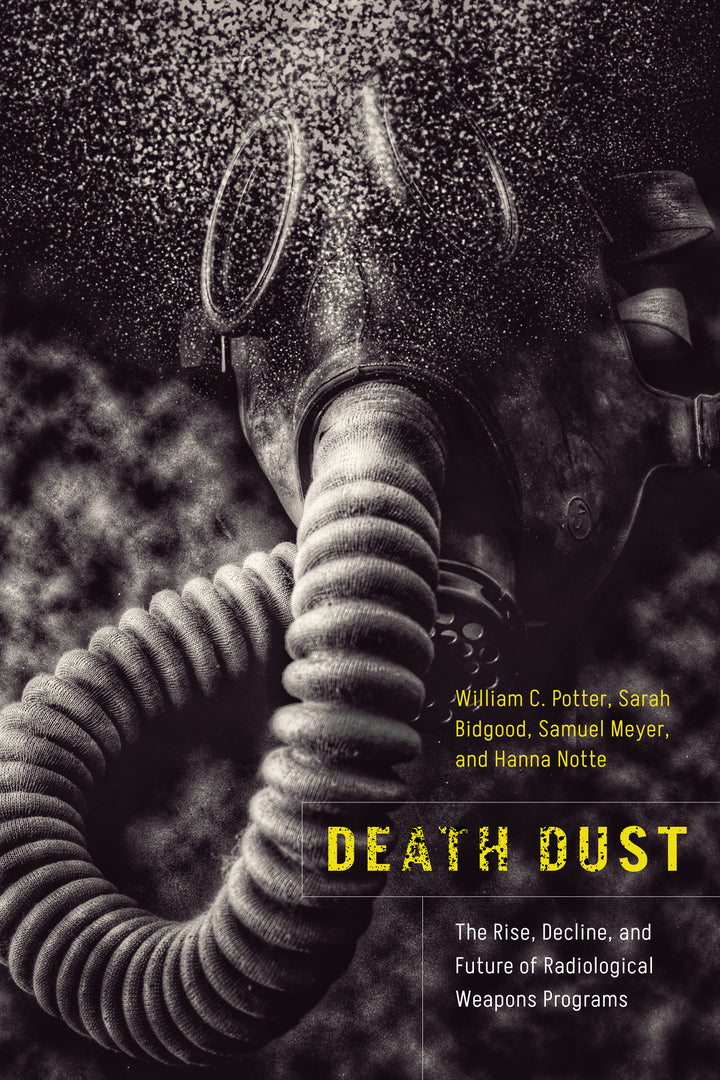
Death Dust

Regular price $26.00
Sale price $26.00 Regular price $26.00
Sale Sold out
The postwar period saw increased interest in the idea of relatively easy-to-manufacture but devastatingly lethal radiological munitions whose use would not discriminate between civilian and militar...
Read More
  • Format:
  • 19 December 2023
View Product Details

The postwar period saw increased interest in the idea of relatively easy-to-manufacture but devastatingly lethal radiological munitions whose use would not discriminate between civilian and military targets. Death Dust explores the largely unknown history of the development of radiological weapons (RW)—weapons designed to disperse radioactive material without a nuclear detonation—through a series of comparative case studies across the United States, the Soviet Union, the United Kingdom, Iraq, and Egypt. The authors illuminate the historical drivers of and impediments to radiological weapons innovation. They also examine how new, dire geopolitical events—such as the war in Ukraine—could encourage other states to pursue RW and analyze the impact of the spread of such weapons on nuclear deterrence and the nonproliferation regime. Death Dust presents practical, necessary steps to reduce the likelihood of a resurgence of interest in and pursuit of radiological weapons by state actors.

files/i.png Icon
Price: $26.00
Pages: 230
Publisher: Stanford University Press
Imprint: Stanford University Press
Publication Date: 19 December 2023
Trim Size: 9.00 X 6.00 in
ISBN: 9781503637658
Format: Paperback
BISACs:

"In this meticulously researched history of states pursuing the dirty bomb, the authors show how countries like the US, Russia, and the UK concluded that it is a weapon of mass disruption, not mass destruction, and not worth pursuing. They present excellent suggestions how to keep it that way. A great read."—Siegfried S. Hecker, author of Hinge Points: An Inside Look at North Korea's Nuclear Program
William C. Potter is Sam Nunn and Richard Lugar Professor of Nonproliferation Studies and Founding Director of the James Martin Center for Nonproliferation Studies (CNS) at the Middlebury Institute of International Studies at Monterey (MIIS). Sarah Bidgood is Director of the Eurasia Nonproliferation Program at CNS. Samuel Meyer is a nuclear and radiological security analyst in the Washington, DC area. Hanna Notte is a Senior Research Associate with the Vienna Center for Disarmament and Non-Proliferation.
Introduction
1. The United States
2. The Soviet Union
3. The United Kingdom
4. Egypt
5. Iraq
Conclusion: Patterns across Cases and Prospects for the Future