


Some error occured while loading the Quick View. Please close the Quick View and try reloading the page.
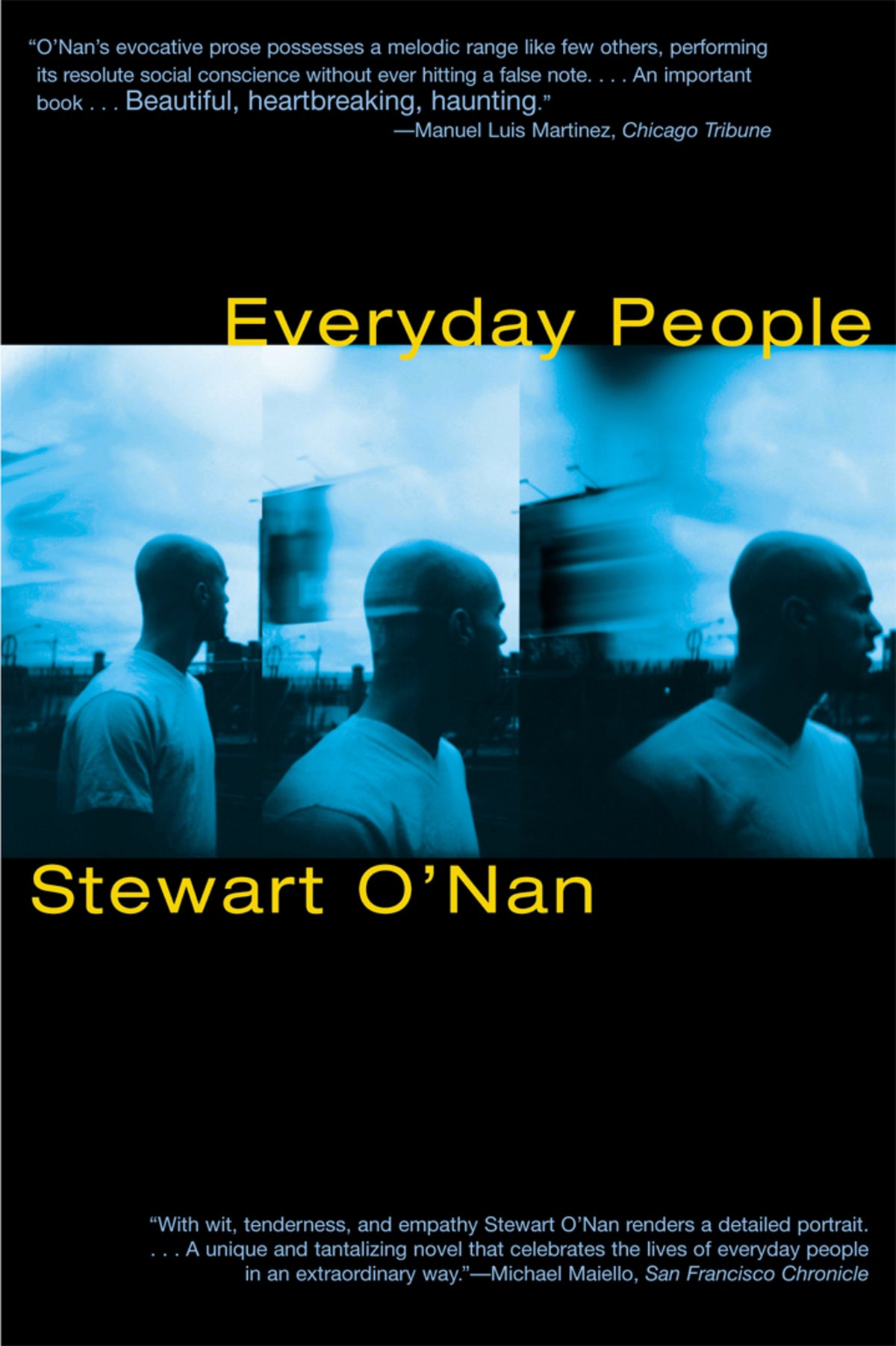
This novel of Pittsburgh, by the author of Last Night at the Lobster, "celebrates the lives of everyday people in an extraordinary way" (San Francisco Chronicle).
Pittsburgh, 1998: Chris "Crest" Tolbert is eighteen years old, a soon-to-be father, and partially paralyzed after an accident that left his best friend dead. As he navigates the challenges of new fatherhood and life as a paraplegic, Crest must also negotiate his relationships with his born-again brother and his father, who has been cheating on Crest's mother with a younger man.
In Everyday People, acclaimed novelist Stewart O'Nan offers a multifaceted portrait of Crest and of East Liberty, the African American neighborhood he calls home. The result is "a living, breathing history lesson that brings together a set of compelling voices that make real and immediate the ups and downs of a black urban community" (Chicago Tribune).
"Like Sherwood Anderson's Winesburg, Ohio or Gloria Naylor's Women of Brewster Place, Everyday People weaves its tale elliptically. . . . O'Nan creates vivid interior worlds, evoking conflicts and joys with astonishing grace and agility." —Pittsburgh Post-Gazette

Praise for Everyday People
“O’Nan’s Everyday People is dynamic, out there and operating at a frequency that has you feeling things at the most unexpected of moments. . . . Reading this novel will reward with a profound, sobering realization of the differences that exist between us while insisting nonetheless that we share a profound sameness. O’Nan accomplishes a rare thing, for he has us mourn a common loss. . . . Everyday People aims at restoring to the sufferer and the victim . . . their full and due humanity. . . . It is not a thing easily done. But Stewart O’Nan has pulled it off in beautiful, heartbreaking, haunting fashion.” —Manuel Luis Martinez, The Chicago Tribune
“With wit, tenderness, and empathy Stewart O’Nan renders a detailed portrait. . . . A unique and tantalizing novel that celebrates the lives of everyday people in an extraordinary way.” —Michael Maiello, San Francisco Chronicle
“Compassionate, sharply observed . . . Everyday People moves us close—sometimes uncomfortably close—to the lives of ordinary folks who are trapped in circumstances beyond their control.” —David Haynes, Minneapolis Star-Tribune
“O’Nan’s protean imagination, if it can be summed up at all, seems to be civic. . . . He is a writer who reaches out, both making and bridging worlds. . . . The novel is like a neighborhood, with chapters about various characters set side by side like so many doors on the same street.” —Stacey D”Erasmo, The New York Times Book Review
“A sad and haunting novel . . . The struggles of the Tolbert family, with love and obligation, with hope and the end of hope, give shape to a plot that does not wholly unspool until the last sentence—about the most dramatic and poignant I have ever read.” —Jack Beatty, The Atlantic Monthly
“The only thing certain about a work by Stewart O’Nan is that it will be full of unexpected, and occasionally underappreciated, gifts. His fiction reflects the full richness of experience in all its spirited and tragic power. Everyday People is his latest in a long line of surprises, an unusually constructed piece full of unflinching insight. . . . It’s a wonderful experience for any reader who relishes a subtle challenge wrapped in rhythmic prose.” —Robin Vidimos, The Denver Post
“O’Nan has too much respect for his characters to reduce them to stereotypes. His tender, unjudgmental portrayals and his command of slang and popular culture prevent his characters’ lives from devolving into the mere “pat tragedies in blackface” that Crest observes during his endless hours of watching television. Instead, the novel reveals a group of quietly heroic everyday people.” —Michael Connery, Time Out New York
“Despite the horror of his subjects and the graphic energy of his writing, O’Nan studiously avoids sensationalism and sentimentality. This stylistic sure-footedness and lightness of touch is just as essential to the success of his latest novel, Everyday People, with its struggles of much more mundane proportions.” —Tess Lewis, The Baltimore Sun
“Among the blessings available to anybody with a library card is Stewart O’Nan, surely the novelist of his generation most capable of ushering readers into a world that, like their own, is one they won’t want to leave, no matter how its joys collapse and die and its terrors loom. . . . Stewart O’Nan draws [the characters of Everyday People] with such skill that they become people we know better than the people we really know. We know them even better than ourselves, in fact, and that is precisely what makes O’Nan’s every sentence so resonant, his every novel so good.” —David Kirby, The Atlanta Journal-Constitution
“The title promises lyrical social realism, and the novel delivers, weaving gritty street rhythms with a Faulknerian flow.” —Entertainment Weekly
“Everyday People is an engaging picture of the lives of the working poor—with plenty of soul and no easy answers.” —Judith Wynn, Boston Herald
“Stewart O’Nan’s emotional novel depicts a community and its people in gritty, poetic prose.” —Lee Milazzo, The Dallas Morning News
“[A] deeply satisfying book that reveals the limits to any one person’s knowledge of exactly how he or she fits into the story that is his or her life. O’Nan’s prose is supple and generous . . . a compelling document of the danger and mercies of being human.” —Amy Benfer, Salon
“Like Sherwood Anderson’s Winesburg, Ohio or Gloria Naylor’s Women of Brewster Place, Everyday People weaves its tale elliptically, through vignettes that evoke the nuances of East Liberty. . . . Everyday People never stumbles. . . . O’Nan creates vivid interior worlds for each character, evoking their conflicts and joys with a grace and agility that is astonishing. . . . What makes Everyday People remarkable is that it does not rely on facts—the oft-cited statistics about crime, or, say, the numbers of black men in prison—but rather on the stories of its characters, illuminating East Liberty’s endless tug of war with fate.” —John Freeman, Kansas City Star
“O’Nan puts his readers inside the hearts and minds of the neighborhood’s many characters by switching points of view from one chapter to the next. Telling a story in so many different ways is risky; if not handled well, the narrative line can fragment. The narrative soars in Everyday People, however, and knits together every character’s thoughts and experiences into a seductive whole.” —Kassie Rose, Columbus Dispatch
“A tough, bold, expertly tender, beautiful novel. Everyday People takes us deeply into its singular characters and treats them with respect. Stewart O’Nan is a wise, powerful writer.” —Joanna Scott
“Explores a Pittsburgh neighborhood with . . . nonjudgmental empathy and respect for ordinary folks . . . Quietly passionate, imbued with a subtle understanding of how the personal and political intertwine: another fine effort from an always-intriguing writer.” —Kirkus Reviews
“Set in a black neighborhood of Pittsburgh during one eventful week in 1998, this novel focuses on a group of residents struggling to survive amidst a landscape of poverty and gang violence. . . . Often sad, sometimes hopeful, and always richly rendered.” —Library Journal
“The protean O’Nan seems determined to touch nearly every facet of human experience in a remarkable variety of times and places. . . . O’Nan’s empathy for his characters conveys their sense of frustration and powerlessness, the restlessness of teenagers and the older generation’s stoic dignity.” —Publishers Weekly
Praise for Stewart O’Nan:
“I think that if you haven’t read Stewart O’Nan . . . you have some catching up to do.” —Stephen King, Entertainment Weekly
Stewart O’Nan is the author of numerous books, including Wish You Were Here, Everyday People, In the Walled City, The Speed Queen, and Emily, Alone. His 2007 novel, Last Night at the Lobster, was a national bestseller and a finalist for the Los Angeles Times Book Prize. He lives in Boston.