


Some error occured while loading the Quick View. Please close the Quick View and try reloading the page.
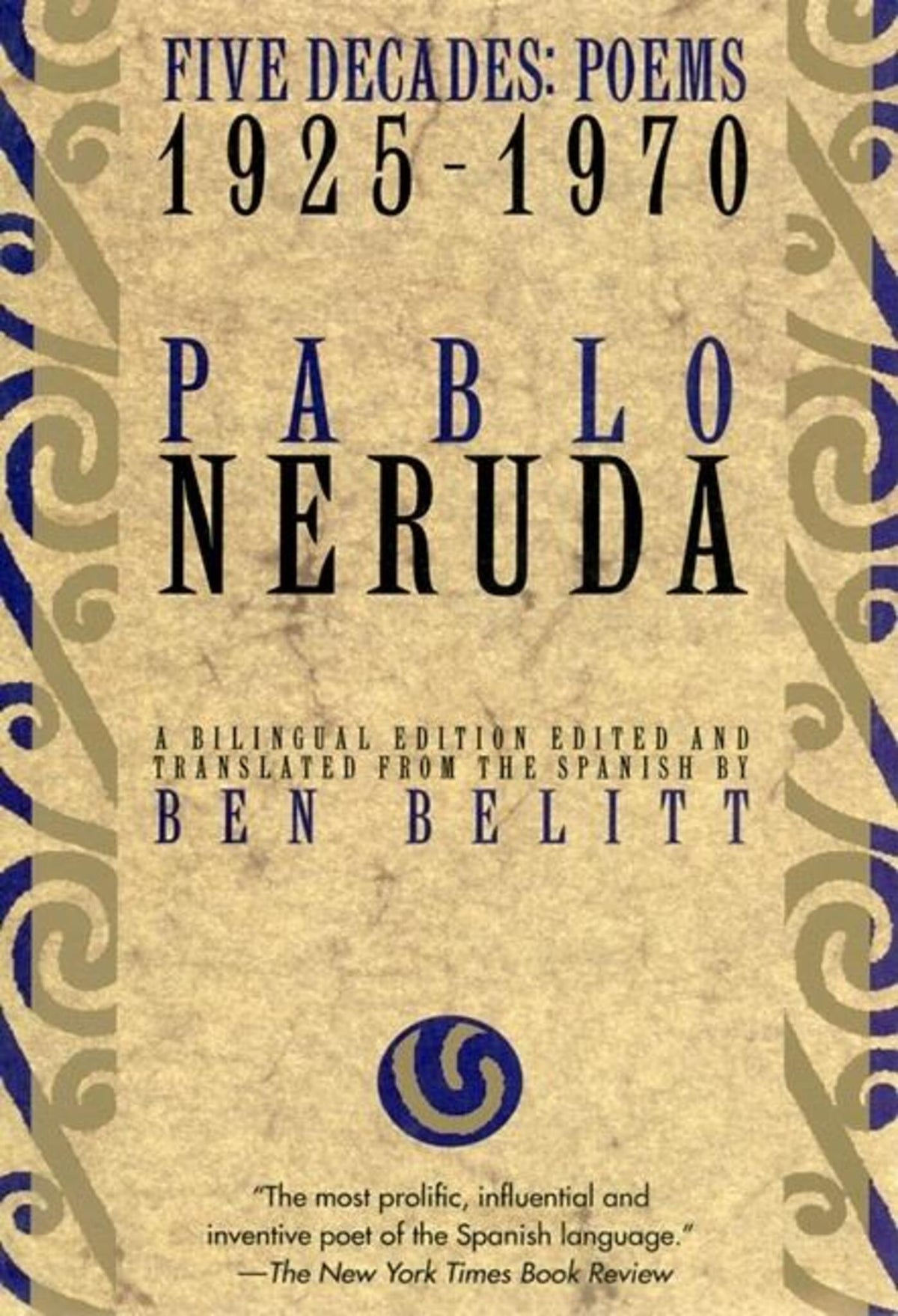
“The most prolific, influential and inventive poet of the Spanish language.” —The New York Times Book Review
This bilingual volume is the definitive collection of the poetry of Pablo Neruda, the 1971 Nobel Prize winner, “our great Latin-American Whitmanesque father” (Library Journal), and one of the most profoundly influential poets of the twentieth century. His love poems are earthy and transcendent, and his political poems are the work of a man as incisive, impassioned, and ferociously intelligent as he was sensual. “Neruda’s poetry inevitably calls forth Wagnerian language from overwhelmed observers—force of nature, “avalanche,” “volcano’ . . . [He] led an epic life as a revolutionary prophet and . . . national hero in Chile” (The New York Times Book Review).
Ben Belitt has drawn the 138 selections in Five Decades from all of Neruda’s major works, including the early volumes Residence on Earth, General Song, Elemental Odes, Voyages and Homecomings, Book of Vagaries, A Hundred Love Sonnets, Black Island Memorial, and the later The Hands of Day, World’s End, and Skystones.

“The most prolific, influential and inventive poet of the Spanish language.” —The New York Times Book Review
“It is difficult to speak of Pablo Neruda’s poetry as poetry. It is easier to compare him to Bartok for his driving rhythms, his intensity of passion, or to Stravinsky for his harsh dissonances and strange harmonies. Or if not music, perhaps painting. Critic Angel Flores likens him to Picasso . . . [for] “their fertile, chameleon-like creativeness, their constant, unpredictable transformations.” —The Christian Science Monitor
“The poems, in both Spanish and English, are so extraordinarily quotable that no sampling will suffice. . . . A magnificent legacy by perhaps the greatest living poet of this century.” —Library Journal
Pablo Neruda, the nom de plume of Ricardo Eliecer Neftalí Ricardo Reyes Basoalto, was born in Chile, in 1904. His first collection of poems, Crepusculario, was published in 1923 when he was nineteen years of age, but it was his second, Twenty Love Poems and a Song of Despair (1924), that would ultimately earn him literary celebrity. Other notable works include: Spain in My Heart (1933), inspired by Neruda’s experiences during the Spanish Civil War and by the death of his friend and fellow poet, Federico García Lorca; Residence on Earth (1933), a collection of obscure and surreal poems; and Canto General (1950), an expansive work, composed in exile about the socio-political history of Latin America from a Marxist ethos. Neruda was an active politician, as well a writer, and held administrative positions in Spain, Burma (Myanmar), Indonesia, and Ceylon (Sri Lanka). He was also forced into exile 1949 because of his politics, but returned to Chile in 1952. He was close to Salvador Allende and from 1970 to 1972 Neruda served as the Chilean ambassador to France. In 1971, Neruda was awarded the Nobel Prize in Literature “for a poetry that with the action of an elemental force brings alive a continent’s destiny and dreams”. The Colombian author, Gabriel Garcia Marquez, once called Pablo Neruda, “the greatest poet of the twentieth century in any language.” He died in 1973.