


Some error occured while loading the Quick View. Please close the Quick View and try reloading the page.
One of Hyperallergic's Top Ten Art Books for 2021
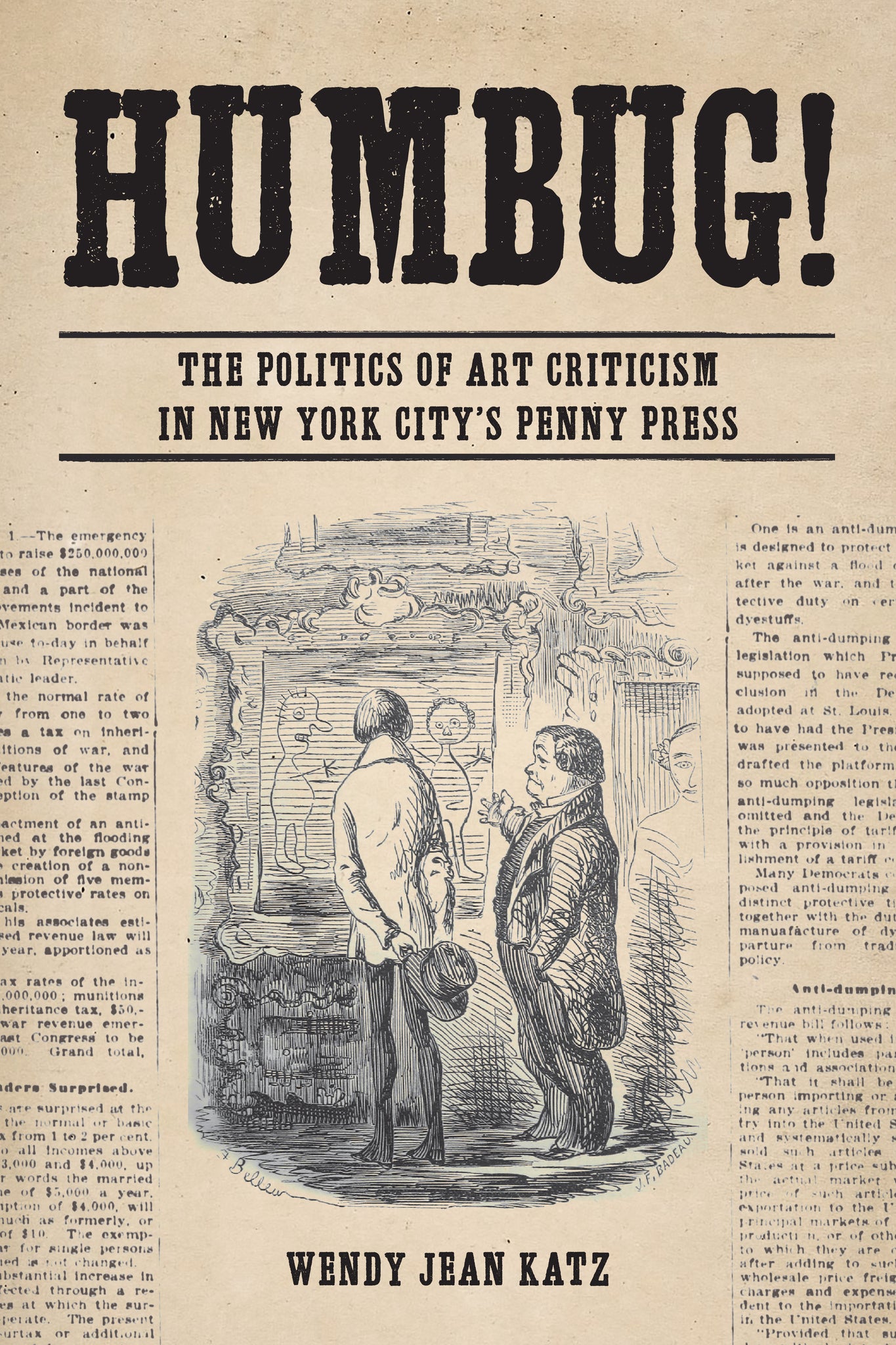
Approximately 300 daily and weekly newspapers flourished in New York before the Civil War. A majority of these newspapers, even those that proclaimed independence of party, were motivated by political conviction and often local conflicts. Their editors and writers jockeyed for government office and influence. Political infighting and their related maneuvers dominated the popular press, and these political and economic agendas led in turn to exploitation of art and art exhibitions. Humbug traces the relationships, class animosities, gender biases, and racial projections that drove the terms of art criticism, from the emergence of the penny press to the Civil War.
The inexpensive “penny” papers that appeared in the 1830s relied on advertising to survive. Sensational stories, satire, and breaking news were the key to selling papers on the streets. Coverage of local politicians, markets, crime, and personalities, including artists and art exhibitions, became the penny papers’ lifeblood. These cheap papers, though unquestionably part of the period’s expanding capitalist economy, offered socialists, working-class men, bohemians, and utopianists a forum in which they could propose new models for American art and society and tear down existing ones.
Arguing that the politics of the antebellum press affected the meaning of American art in ways that have gone unrecognized, Humbug covers the changing politics and rhetoric of this criticism. Author Wendy Katz demonstrates how the penny press’s drive for a more egalitarian society affected the taste and values that shaped art, and how the politics of their art criticism changed under pressure from nativists, abolitionists, and expansionists. Chapters explore James Gordon Bennett’s New York Herald and its attack on aristocratic monopolies on art; the penny press’s attack on the American Art-Union, an influential corporation whose Board purchased artworks from living artists, exhibited them in a free gallery, and then distributed them in an annual five-dollar lottery; exposés of the fraudulent trade in Old Masters works; and the efforts of socialists, freethinkers, and bohemians to reject the authority of the past.

List of Illustrations | vii
Introduction: The Penny Press | 1
1 The Aristocracy of Art and Bennett’s Herald | 25
2 Artists, Their Agents, and Press Manipulation | 58
3 Old Masters versus Young America | 91
4 The Penny Press’s Utopian Alternative | 124
5 The Genteel and the Bohemian | 156
6 Rearing Statues amid Gothic Spires | 188
Conclusion: Art and Politics | 227
Acknowledgments | 237
Notes | 239
Index | 291