


Some error occured while loading the Quick View. Please close the Quick View and try reloading the page.

Julie Fedor is lecturer in Modern European History at the University of Melbourne. She has taught modern Russian history at the Universities of Birmingham, Cambridge, Melbourne, and St Andrews. She is the author of Russia and the Cult of State Security (2011); coauthor of Remembering Katyn (2012); and coeditor of Memory and Theory in Eastern Europe (2013) and Memory, Conflict and New Media: Web Wars in Post-Socialist States (2013).
Andreas Umland (Edited by)
Andreas Umland (Dr.Phil. FU Berlin, Ph.D. Cambridge) is a Research Fellow at the Swedish Institute of International Affairs (UI) in Stockholm and Senior Expert at the Ukrainian Institute for the Future (UIM) in Kyiv, as well as editor of the book series Soviet and Post-Soviet Politics and Society (ibidem-Verlag, 2004–). His articles have appeared in, among others, Foreign Affairs, Foreign Policy, Harvard International Review, World Affairs, Survival, Political Studies Review, Perspectives on Politics, European Political Science, Journal of Democracy, Terrorism and Political Violence, European History Quarterly, Europe-Asia Studies, Problems of Post-Communism, Communist and Post-Communist Studies, The Russian Review, Nationalities Papers, East European Jewish Affairs, Journal of Slavic Military Studies, Demokratizatsiya, Internationale Politik, Österreichische Zeitschrift für Politikwissenschaft, Osteuropa, Jahrbuch für Ostrecht, Politicheskie issledovaniia, and Voprosy filosofii.
Andrey Makarychev (Edited by)
Andrey Makarychev is guest professor at the Johan Skytte Institute of Political Science at the University of Tartu. His areas of expertise include EU–Russia studies, the EU–Russia common neighborhood, and regionalism in the post-Soviet space. He is coauthor (with Alexandra Yatsyk) of Celebrating Borderlands in a Wider Europe: Nations and Identities in Ukraine, Georgia and Estonia (Nomos, 2016) and Lotman’s Cultural Semiotics and the Political (Rowman and Littlefield, 2017). His articles appeared in Russian Politics, Region: Regional Studies of Russia, Eastern Europe and Central Asia, Ethnopolitics, Geopolitics, Slavic Review, Journal of Contemporary Central and Eastern Europe, and other academic outlets.
MAIN
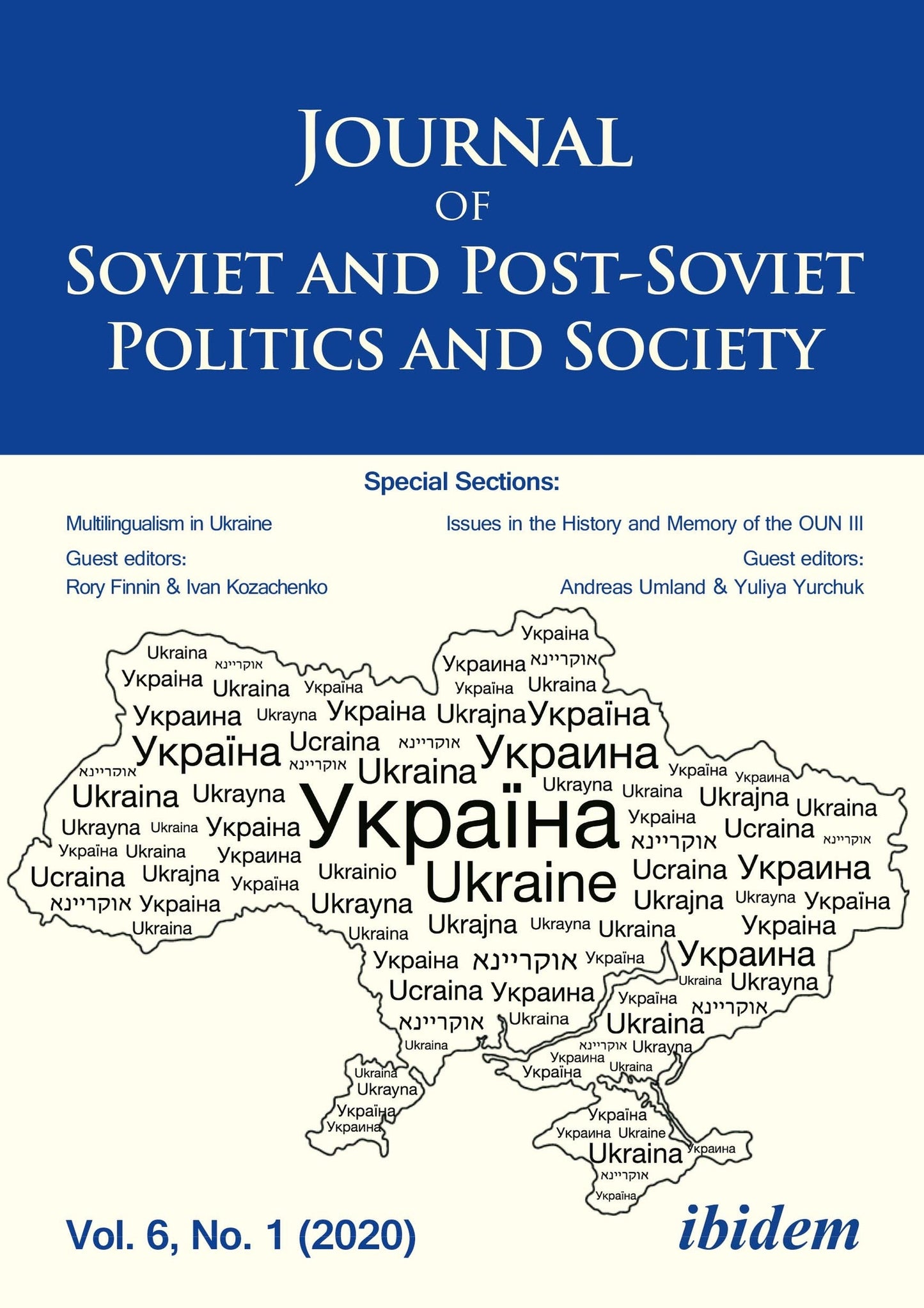
Special Section: Multilingualism in Ukraine
Rory Finnin, Ivan Kozachenko: Introduction: Ukraine’s Multilingualism
Taras Koznarsky: The Languages and Tongues of Mykola Markevych
Myroslav Shkandrij: Channel Switching: Language Change and the Conversion Trope in Modern Ukrainian Literature
Laada Bilaniuk: Linguistic Conversion in Ukraine: Nation-Building on the Self
Vitaly Chernetsky: Ukrainian Cinema and the Challenges of Multilingualism: From the 1930s to the Present
Iryna Shuvalova: “I Will Understand You, Brother, Just Like You Will Understand Me”: Multilingualism in the Songs of the War in Donbas
Reports:
Olenka Bilash: Multilingualism in the Academy: Language Dynamics in Ukraine’s Higher Education Institutions
Alina Zubkovych: Language Use among Crimean Tatars in Ukraine: Context and Practice
Special Section: Issues in the History and Memory of the OUN III
Andreas Umland, Yuliya Yurchuk: Introduction: The Organization of Ukrainian Nationalists and European Fascism During World War II
Kai Struve: The OUN(b), the Germans, and Anti-Jewish Violence in Eastern Galicia during Summer 1941
Yuri Radchenko: The Biography of the OUN(m) Activist Oleksa Babii in the Light of His “Memoirs on Escaping Execution” (1942)
Tomislav Dulić, Goran Miljan: The Ustašas and Fascism: “Abolitionism,” Revolution, and Ideology (1929–42)
Reviews
Olga Khabibulina on:
Ksenia Maksimovtsova, Language Conflicts in Contemporary Estonia, Latvia, and Ukraine: A Comparative Exploration of Discourses in Post-Soviet Russian-Language Digital Media
Olena Nedozhogina on:
Mariёlle Wijermars and Katja Lehtisaari (eds.), Freedom of Expression in Russia’s New Mediasphere
Oleksii Poltorakov on:
Nadja Douglas, Public Control of Armed Forces in the Russian Federation