


Some error occured while loading the Quick View. Please close the Quick View and try reloading the page.
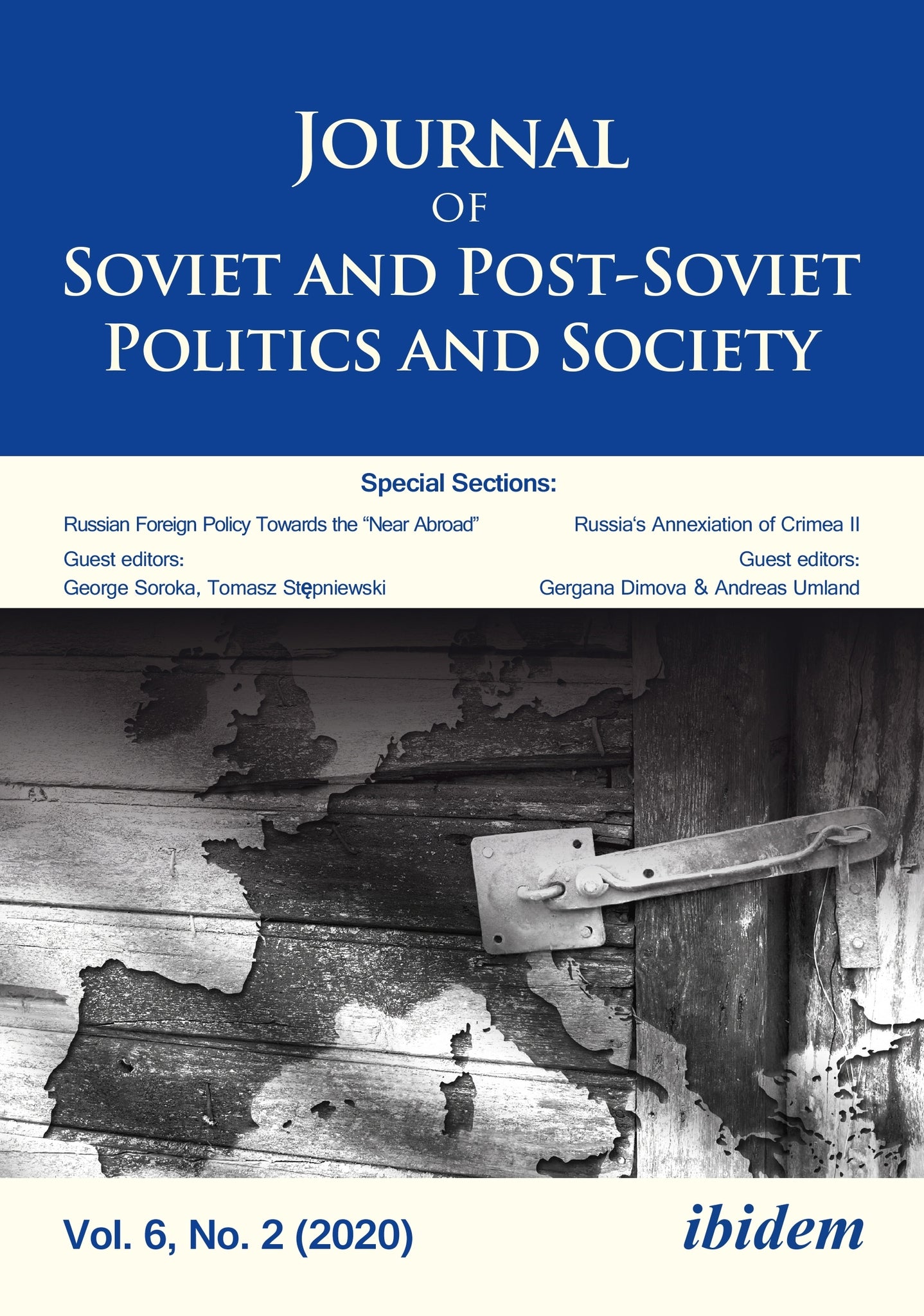
This special section deals with Russia’s post-Maidan foreign policy towards the so-called “near abroad,” or the former Soviet states. This is an important and timely topic, as Russia’s policy perspectives have changed dramatically since 2013/2014, as have those of its neighbors. The Kremlin today is paradoxically following an aggressive “realist” agenda that seeks to clearly delineate its sphere of influence in Europe and Eurasia while simultaneously attempting to promote “soft-power” and a historical-civilizational justification for its recent actions in Ukraine (and elsewhere). The result is an often perplexing amalgam of policy positions that are difficult to disentangle. The contributors to this special issue are all regional specialists based either in Europe or the United States.
This issue also features a special section on Russia’s Annexation of the Crimea.
JSPPS’s second special section on Russia’s annexation of Crimea is less focused on Moscow’s 2014 land grab per se. Instead it discusses how to interpret and contextualize some salient judicial, historical and political issues concerning the annexation. The section’s papers document how these issues have been interpreted and contextualized by various relevant public actors including politicians, journalists and scholars, in Ukraine, Russia and the West. Natalya Belitser’s “The Status of the Crimean Tatars in Ukrainian and International Law” shines new light on the long legal and political fight of the Crimean Tatars to acquire the special status of indigenous people. Alina Cherviatsova’s “The 1954 Transfer of Crimea: Debunking the Myth of a ‘Royal Gift’ to Ukraine” focuses on select Soviet legal and historical issues related to Moscow’s various apologetic discourses since 2014. Maryna Rabinovych’s “How the Federal Republic Reacted to Russia’s Annexation of Crimea: Berlin’s Diplomatic Response and German Media Representations in 2014-2020” portrays today’s Germany as caught in the middle of two of its fundamental competing foreign affairs principles, multilateralism and Ostpolitik, in the aftermath of Russia’s annexation of Crimea and intervention in the Donets Basin (Donbas). The three papers add new observations, comparisons, and interpretations to the growing body of academic literature, on Russia’s annexation of Crimea. They provide insights into hitherto insufficiently highlighted aspects of this consequential event in current European history.

George Soroka received his PhD in Political Science from Harvard University. He is currently working on a book regarding how contentious historical interpretations function in defining contemporary foreign-policy objectives between Poland, Ukraine, and Russia.
Tomasz Stępniewski (Edited by)
Tomasz Stępniewski is associate professor at the Institute of Political Science and International Affairs, Faculty of Social Sciences, The John Paul II Catholic University of Lublin. He is also coeditor (along with Soroka) of the book Ukraine after Maidan: Revisiting Domestic and Regional Security (Stuttgart: ibidem 2018).
Gergana Dimova (Edited by)
Gergana Dimova received her Ph.D. from Harvard University, and has subsequently assumed research and teaching positions at the University of Cambridge and at Winchester University in the UK. Her most recent books are Democracy beyond Elections (Palgrave 2019) and Political Uncertainty (ibidem 2020). She is the convenor of the Anti-Politics Specialist Group of the UK Political Science Association. Her academic articles have been published in Demokratizatsiya, Observatorio, Global Media Journal, and others. Her expertise has been featured in the Atlantic Council, Huffington Post, the LSE Policy Institute, Global Risk Insights, and Bulgarian TV and radio. She serves on the editorial board of Democratic Theory, Journal of Soviet and Post-Soviet Politics and Society, and Journal of Liberty and International Affairs, and consults for the European Commission.
Andreas Umland (Edited by)
Andreas Umland (Dr.Phil. FU Berlin, Ph.D. Cambridge) is a Research Fellow at the Swedish Institute of International Affairs (UI) in Stockholm and Senior Expert at the Ukrainian Institute for the Future (UIM) in Kyiv, as well as editor of the book series Soviet and Post-Soviet Politics and Society (ibidem-Verlag, 2004–). His articles have appeared in, among others, Foreign Affairs, Foreign Policy, Harvard International Review, World Affairs, Survival, Political Studies Review, Perspectives on Politics, European Political Science, Journal of Democracy, Terrorism and Political Violence, European History Quarterly, Europe-Asia Studies, Problems of Post-Communism, Communist and Post-Communist Studies, The Russian Review, Nationalities Papers, East European Jewish Affairs, Journal of Slavic Military Studies, Demokratizatsiya, Internationale Politik, Österreichische Zeitschrift für Politikwissenschaft, Osteuropa, Jahrbuch für Ostrecht, Politicheskie issledovaniia, and Voprosy filosofii.