


Some error occured while loading the Quick View. Please close the Quick View and try reloading the page.
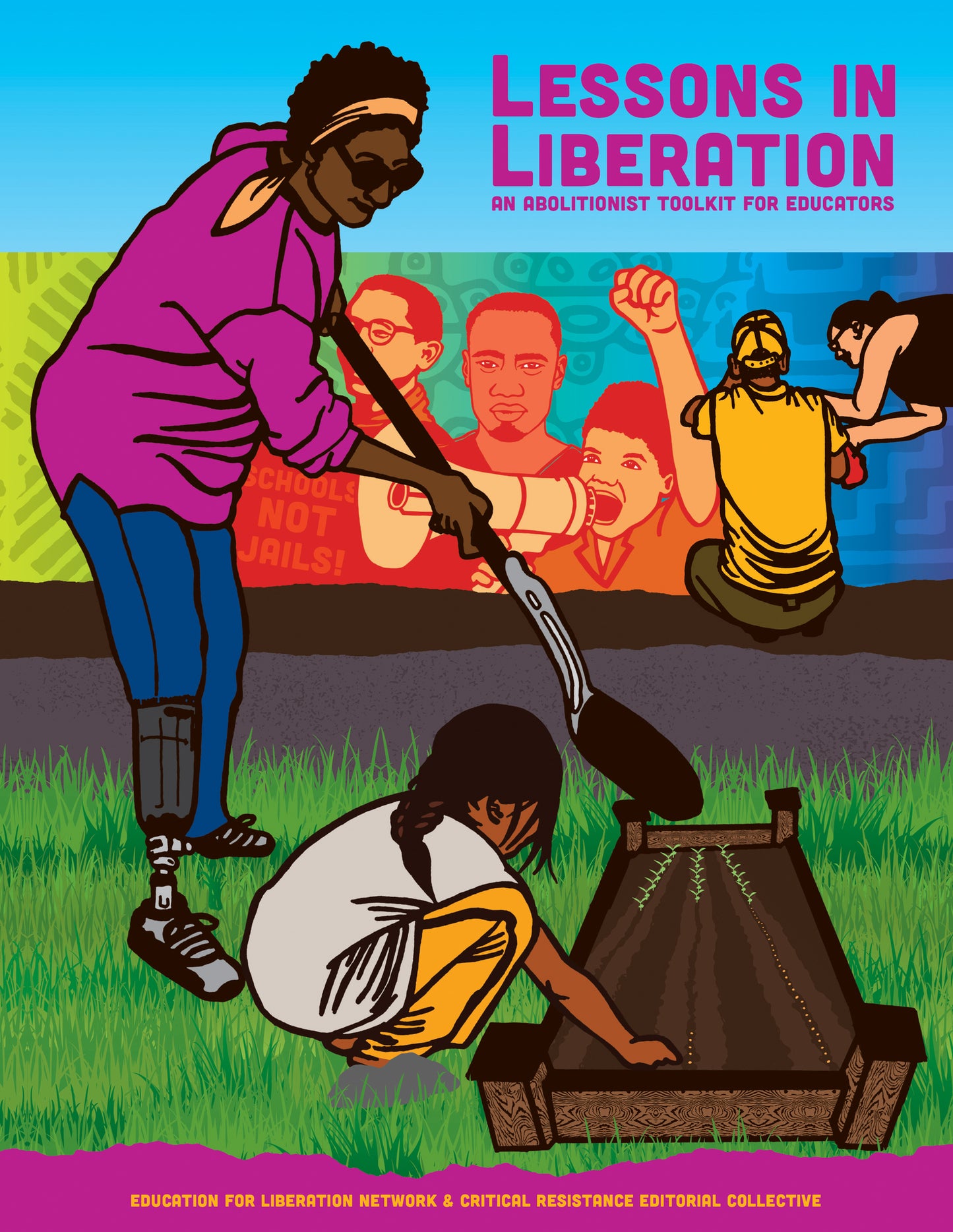
A political vision for a future ripe with alternatives to imprisonment and punishment.
Born from sustained organizing, and rooted in Black and women of color feminisms, disability justice, and other movements, abolition calls for an end to our reliance on imprisonment, policing and surveillance, and to imagine a safer future for our communities. Lessons in Liberation: An Abolitionist Toolkit for Educators offers entry points to build critical and intentional bridges between educational practice and the growing movement for abolition. Designed for educators, parents, and young people, this toolkit shines a light on innovative abolitionist projects, particularly in pre-K–12 learning contexts. Sections are dedicated to entry points into Prison Industrial Complex abolition and education; the application of the lessons and principles of abolition; and stories about growing abolition outside of school settings. Topics addressed throughout include student organizing, immigrant justice in the face of ICE, approaches to sex education, arts-based curriculum, and building abolitionist skills and thinking in lesson plans.
The result of patient and urgent work, and more than five years in the making, Lessons in Liberation invites educators into the work of abolition.
Contributors include Black Organizing Project, Chicago Women’s Health Center, Mariame Kaba and Project NIA, Bettina L. Love, the MILPA Collective, and artists from the Justseeds Collective, among others.

PART ONE: Openings/Groundings
Building Our Analysis
- Fierce Urgency of Now! —Farima, Chrissy, Patricia, and Erica
- Intersections of Justice in the Time of Coronavirus —Cara Page & Eesha Pandit
- Reflections from a Dean of Transformative Discipline: What abolitionist education means to me —Sagnicthe Salazar
- Dismantling ICE means Defunding the Police —Irene Romulo
- We Tryna Get Free On Our Own Terms: A Conversation Between Bettina Love and David Stovall
- Abolition: One Genealogy —Erica Meiners
- School Abolition Already in Progress: Understanding “Dysfunctional” Schools as Liberated by Student Power —Jay Gillen
Building our Knowledge - What is the PIC? —Critical Resistance
- The Knotted Line Curriculum (reprint) —Evan Bissell
- How to Share Space: Creating Community in the Classroom —Project NIA & Annie Terrell
- Seven Easy Steps: Ideas & Questions for Everyday Abolitionist Organizing —Critical Resistance
Building Our Power - Policing, Reform vs. Abolition Chart —Critical Resistance
- Black Organizing Project Sanctuary Pledge & Black Organizing Project —Jackie Byers
PART TWO: Every Day in Every Way
Building Our Analysis
- Imagining “Classroom Management” as an Abolitionist Project —Carla Shalaby
- Young People Building Movements: Negotiating Adultism in Schools and Beyond —RYSE
- A Classroom Reimagined: Experiments in Teaching through a Feminist Abolitionist Lens —Amreen Karmali
- Abolitionist Teaching —Terisa Siagatonu
- Reparations Can Be Won—and Must Be Taught: Lessons from the Chicago Public Schools’ Reparations Won Curriculum —Jen Johnson
Building our Knowledge
- Building Classroom Communities: A Pedagogical Reflection —Harper Keenan
- Why Spiritual Revival Matters: Spirit Murdering that Shapes Elementary Schooling —Farima Pour-Khorshid and Marylin Zuñiga
- Woke Wonderings —Akiea Gross
- Educators Against ICE Training —California Immigrant Youth Justice Alliance
- Classroom as Quilombo: Literacy, Ancestral Memory, and Everyday Resistance —Osceola Ward
- Thick Glass Walls —Tania Peralta
- 10 Ways Sex Education Can and Should Be Abolitionist —Chicago Women’s Health Center
Building Our Power
- ICE Out of Schools: Teacher and Community Action —Holly Hardin
- Coins, Cops, & Communities: A Toolkit —Debbie Southorn
- Freedom Charter 2030 —Young Women’s Freedom Center
- Plight of the Girl —Mariame Kaba & Naimah Thomas
- Children of the MILPA: Culture and Community Unlocking Education —MILPA Collective
- Beginning with the Body: Strategies on Building and Defining Safety in Unsafe Schools —Stephanie Cariaga
PART THREE: Growing our work [unsure about this section title]
Building Our Analysis
- Abolition Education in High School and Alternative Spaces: A Dialogue —Kyle Beckham and Chrissy Hernandez
- Toward a Greenhouse Model: An Interview with Dr. Shawn Ginwright about Healing-Centered Engagement — Farima Pour Khorshid
- Build the Block —Arab Resource and Organizing Center (AROC)
- Letter to Brandon: Heal, Grow, and Change the World —Emily Borg, Rossa Socco, CaseyAnn Carbonell, & Lupe Renteria Salome
- I Know Why the Caged Bird Doesn’t Sing: Creating a Healing Space for Black Girls to Reclaim Their Bodies —Aja D. Reynolds
Building our Knowledge
- Bill of Rights —Oscar Calderon & Project What!
- Abolition, not reform: Kinder, gentler youth prisons are still prisons —Subini Ancy Annamma
Building Our Power
- Thinking Beyond “Counselors, Not Cops”: Imagining & Decarcerating Care in Schools —Emma Williams
- The 4I’s Are Not Enough: The Struggle to Ensure That Restorative Justice Is Transformative —Anita Wadhwa
- Cultivating a Culture for Transformative Youth Organizing —Emily Bautista
- Arts-Based Abolitionist Education: Free Money Curriculum —Sefanit Habtom