


Some error occured while loading the Quick View. Please close the Quick View and try reloading the page.
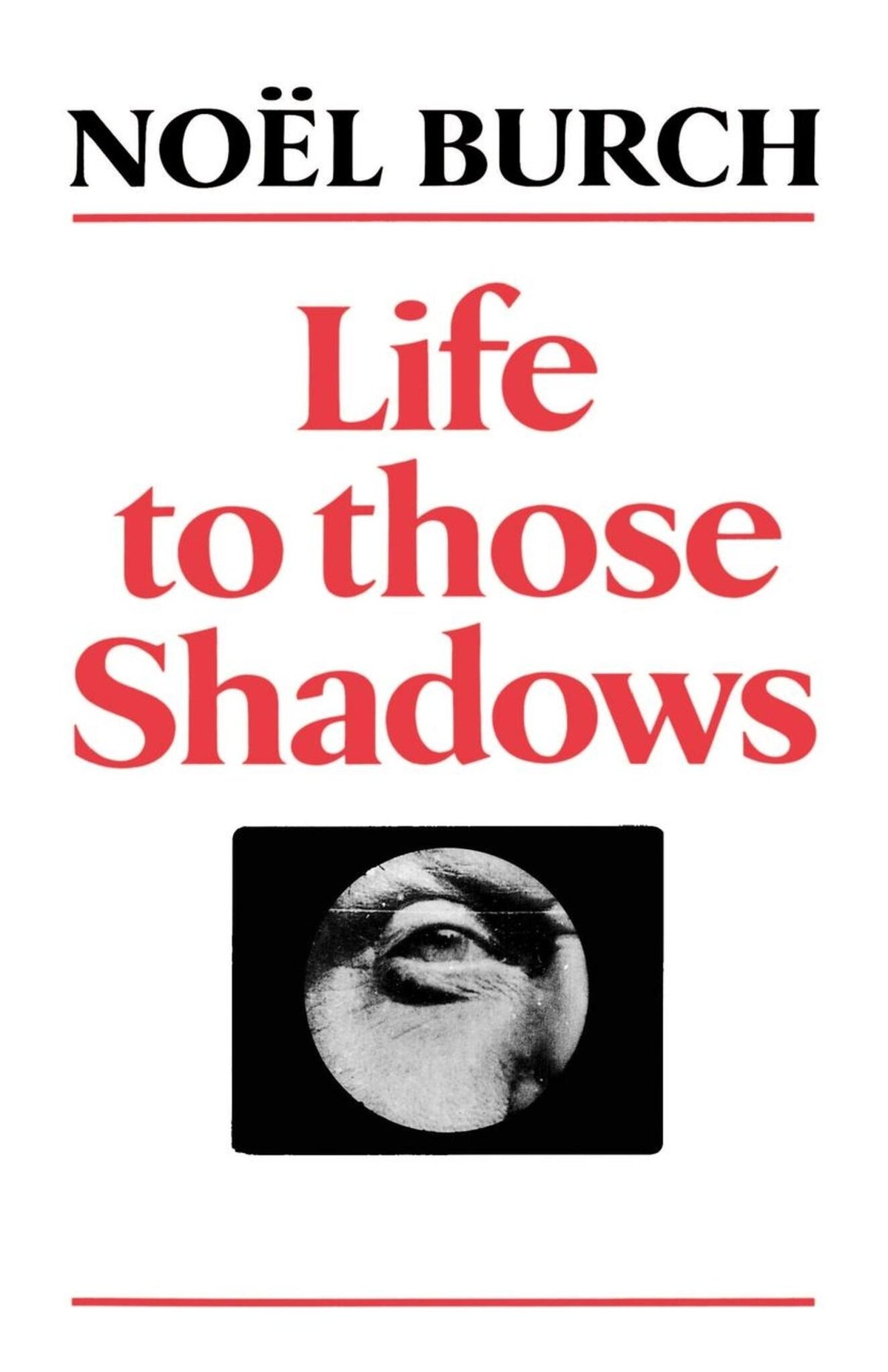
Noël Burch's singularly perceptive view of film and its origins will interest all who care about film theory and history. Life to Those Shadows presents a critique of "classical" approaches to film: the assumptions that what we call the language of film was a natural, organic development, and that it lay latent from the outset in the basic technology of the camera, waiting for the prescient pioneers to bring it into being. The view that film language was a universal, neutral medium, innocent of any social or historical meaning in itself, is also challenged here.
Burch's major thesis is that, on the contrary, film language has a social and economic history, that it evolved in the way it did because of when and where it was constructed—in the capitalist and imperialist West between 1892 and 1929.
From this perspective, the book examines the emergence of what it defines as cinema's Institutional Mode of Representation and the sociohistorical circumstances in which it took place. Central to the Institutional Mode are the principles of visualization—camera placement and movement, lighting, editing, mise-en-scène—that filmmakers and audiences came to internalize over the first three decades. Special emphasis is laid on the all-important change that occurred in the placing of the spectator, from a position of exteriority to the film image—implicit in both film-form and viewing conditions during the primitive era (pre-1909)—to the imaginary centering of the spectator-subject—completed only with the generalization of lip-synch sound after 1929. Burch contends that this imaginary centering of a sensorially isolated spectator is the keystone of the cinematic illusion of reality, still achieved today by the same means as it was sixty years ago.
Burch's major thesis is that, on the contrary, film language has a social and economic history, that it evolved in the way it did because of when and where it was constructed—in the capitalist and imperialist West between 1892 and 1929.
From this perspective, the book examines the emergence of what it defines as cinema's Institutional Mode of Representation and the sociohistorical circumstances in which it took place. Central to the Institutional Mode are the principles of visualization—camera placement and movement, lighting, editing, mise-en-scène—that filmmakers and audiences came to internalize over the first three decades. Special emphasis is laid on the all-important change that occurred in the placing of the spectator, from a position of exteriority to the film image—implicit in both film-form and viewing conditions during the primitive era (pre-1909)—to the imaginary centering of the spectator-subject—completed only with the generalization of lip-synch sound after 1929. Burch contends that this imaginary centering of a sensorially isolated spectator is the keystone of the cinematic illusion of reality, still achieved today by the same means as it was sixty years ago.

Price: $41.95
Pages: 317
Publisher: University of California Press
Imprint: University of California Press
Publication Date:
21 November 1990
Trim Size: 8.50 X 5.50 in
ISBN: 9780520071445
Format: Paperback
BISACs:
Noël Burch has exerted an important influence on film studies; he is the author of Theory of Film Practice and To the Distant Observer.
Introduction
Charles Baudelaire versus Doctor Frankenstein
Life to Those Shadows
The Wrong Side of the Tracks
Those Gentlemen of the Lantern and the Parade
Business is Business: An Invisible Audience
Passions and Chases-A Certain Linearisation
Building a Haptic Space
A Primitive Mode of Representation?
The Motionless Voyage: Constitution of the Ubiquitous Subject
Beyond the Peephole, the Logos
Narrative, Diegesis: Thresholds, Limits
Conclusion
Bibliography
Filmography
Index
Charles Baudelaire versus Doctor Frankenstein
Life to Those Shadows
The Wrong Side of the Tracks
Those Gentlemen of the Lantern and the Parade
Business is Business: An Invisible Audience
Passions and Chases-A Certain Linearisation
Building a Haptic Space
A Primitive Mode of Representation?
The Motionless Voyage: Constitution of the Ubiquitous Subject
Beyond the Peephole, the Logos
Narrative, Diegesis: Thresholds, Limits
Conclusion
Bibliography
Filmography
Index