


Some error occured while loading the Quick View. Please close the Quick View and try reloading the page.
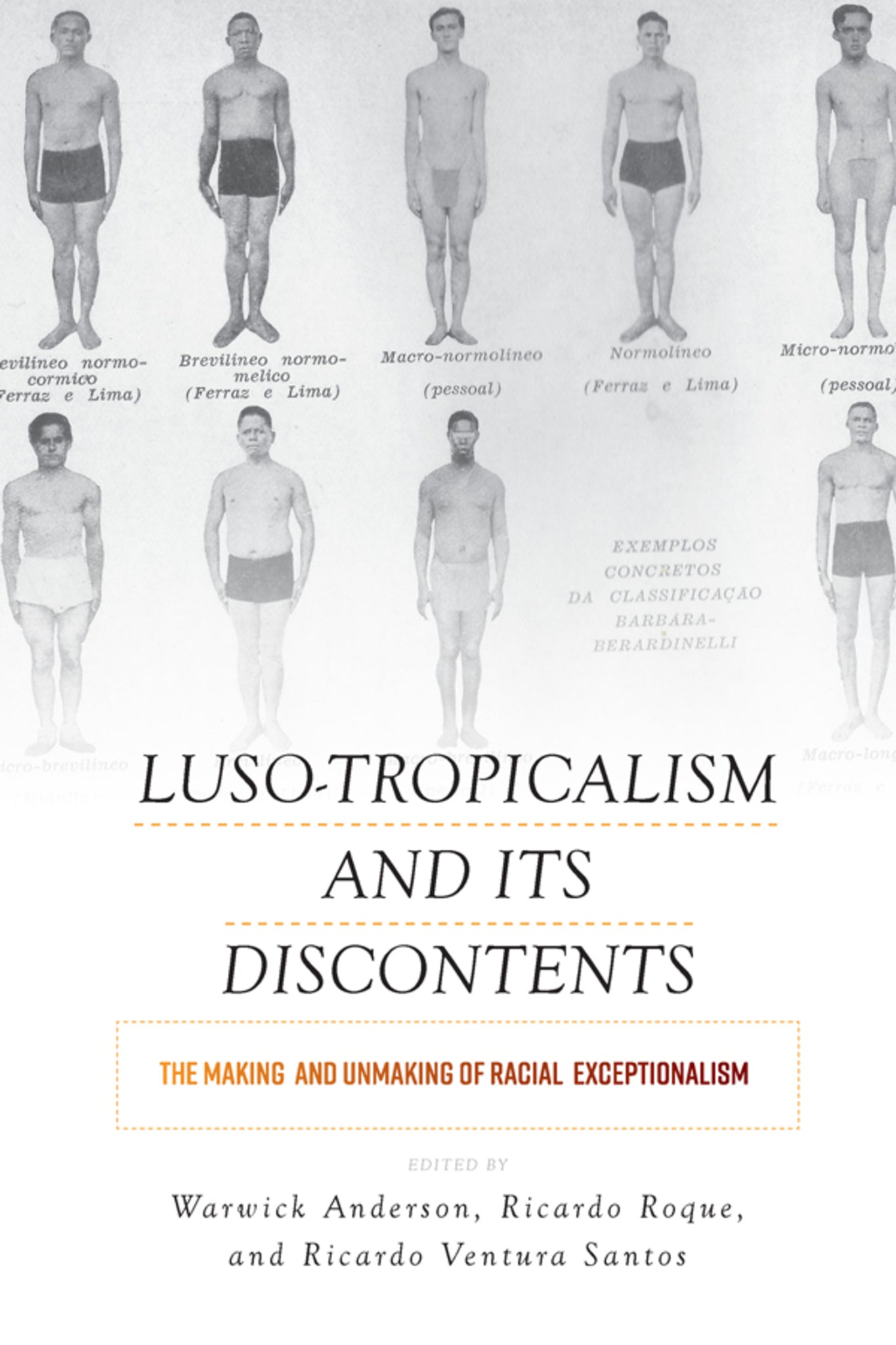
Modern perceptions of race across much of the Global South are indebted to the Brazilian social scientist Gilberto Freyre, who in works such as The Masters and the Slaves claimed that Portuguese colonialism produced exceptionally benign and tolerant race relations. This volume radically reinterprets Freyre’s Luso-tropicalist arguments and critically engages with the historical complexity of racial concepts and practices in the Portuguese-speaking world. Encompassing Brazil as well as Portuguese-speaking societies in Africa, Asia, and even Portugal itself, it places an interdisciplinary group of scholars in conversation to challenge the conventional understanding of twentieth-century racialization, proffering new insights into such controversial topics as human plasticity, racial amalgamation, and the tropes and proxies of whiteness.

“This well-edited, highly stimulating book provides a ‘view from the edge’ that will be of great interest not only to Luso-Brazilianists and historians of Portuguese colonialism, but also to scholars concerned with racial theories, eugenics, biopolitics, and (post-)colonial studies.” • Centaurus
“Despite scholarly consensus regarding the fallacy of lusotropicalism, the idea continues to circulate in both classic and neological forms. This volume makes a valiant attempt to reroute the conversation.” • Hispanic American Historical Review
“A valuable and wide-ranging addition to the literature on Luso-tropicalism, this book will appeal to a variety of readers and make a considerable impact on the field.” • Maria Lúcia G. Pallares-Burke, Emmanuel College
“The breadth of analysis in Luso-tropicalism and Its Discontents is extraordinary, and the diverse range of contributors here is second to none. The collective and individual aspects of the work contribute in new ways to the discussion on race relations and global history.” • Richard Cleminson, University of Leeds
Warwick Anderson is the Janet Dora Hine Professor of Politics, Governance and Ethics in the Department of History and the Charles Perkins Centre at the University of Sydney. He is the author of The Cultivation of Whiteness (2002), Colonial Pathologies (2006), The Collectors of Lost Souls (2008), and with Ian R. Mackay, Intolerant Bodies (2014).
List of Illustrations
Acknowledgments
Introduction
Warwick Anderson, Ricardo Roque, and Ricardo Ventura Santos
PART I: PICTURING AND READING FREYRE
Chapter 1. Gilberto Freyre’s View of Miscegenation and Its Circulation in the Portuguese Empire (1930s–1960s)
Cláudia Castelo
Chapter 2. Gilberto Freyre: Racial Populism and Ethnic Nationalism
Jerry Dávila
Chapter 3. Anthropology and Pan-Africanism at the Margins of the Portuguese Empire: Trajectories of Kamba Simango
Lorenzo Macagno
PART II: IMAGINING A MIXED-RACE NATION
Chapter 4. Eugenics, Genetics and Anthropology in Brazil: The Masters and the Slaves, Racial Miscegenation and Its Discontents
Robert Wegner and Vanderlei Sebastião de Souza
Chapter 5. Gilberto Freyre and the UNESCO Research Project on Race Relations in Brazil
Marcos Chor Maio
Chapter 6. “An Immense Mosaic”: Race Mixing and the Creation of the Genetic Nation in 1960s Brazil
Rosanna Dent and Ricardo Ventura Santos
PART III: THE COLONIAL SCIENCES OF RACE
Chapter 7. The Racial Science of Patriotic Primitives: António Mendes Correia in Portuguese Timor
Ricardo Roque
Chapter 8. Reassessing Portuguese Exceptionalism: Racial Concepts and Colonial Policies toward the “Bushmen” in Southern Angola, 1880s–1970s
Samuël Coghe
Chapter 9. “Anthropobiology”, Racial Miscegenation and Body Normality: Comparing Biotypological Studies in Brazil and Portugal, 1930–1940
Ana Carolina Vimieiro Gomes
PART IV: PORTUGUESENESS IN THE TROPICS
Chapter 10. Luso-Tropicalism Debunked, Again: Race, Racism, and Racialism in Three Portuguese-Speaking Societies
Cristiana Bastos
Chapter 11. Being Goan (Modern) in Zanzibar: Mobility, Relationality and the Stitching of Race
Pamila Gupta
Afterword I: Mixing the Global Color Palette
Nélia Dias
Afterword II: Luso-tropicalism and Mixture in the Latin American Context
Peter Wade
Index