


Some error occured while loading the Quick View. Please close the Quick View and try reloading the page.
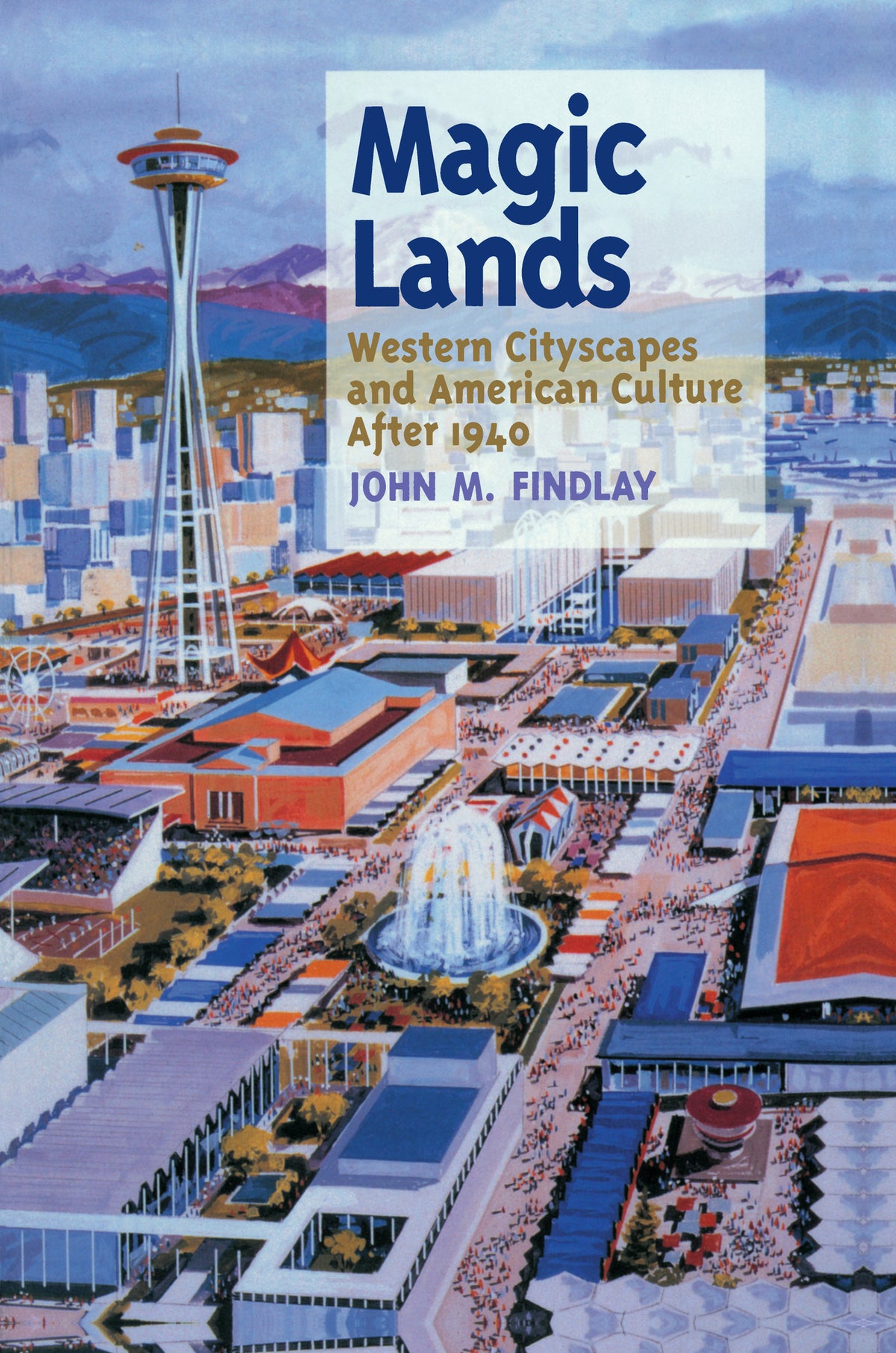
The American West conjures up images of pastoral tranquility and wide open spaces, but by 1970 the Far West was the most urbanized section of the country. Exploring four intriguing cityscapes—Disneyland, Stanford Industrial Park, Sun City, and the 1962 Seattle World's Fair—John Findlay shows how each created a sense of cohesion and sustained people's belief in their superior urban environment. This first book-length study of the urban West after 1940 argues that Westerners deliberately tried to build cities that differed radically from their eastern counterparts.
In 1954, Walt Disney began building the world's first theme park, using Hollywood's movie-making techniques. The creators of Stanford Industrial Park were more hesitant in their approach to a conceptually organized environment, but by the mid-1960s the Park was the nation's prototypical "research park" and the intellectual downtown for the high-technology region that became Silicon Valley.
In 1960, on the outskirts of Phoenix, Del E. Webb built Sun City, the largest, most influential retirement community in the United States. Another innovative cityscape arose from the 1962 Seattle World's Fair and provided a futuristic, somewhat fanciful vision of modern life.
These four became "magic lands" that provided an antidote to the apparent chaos of their respective urban milieus. Exemplars of a new lifestyle, they are landmarks on the changing cultural landscape of postwar America.
In 1954, Walt Disney began building the world's first theme park, using Hollywood's movie-making techniques. The creators of Stanford Industrial Park were more hesitant in their approach to a conceptually organized environment, but by the mid-1960s the Park was the nation's prototypical "research park" and the intellectual downtown for the high-technology region that became Silicon Valley.
In 1960, on the outskirts of Phoenix, Del E. Webb built Sun City, the largest, most influential retirement community in the United States. Another innovative cityscape arose from the 1962 Seattle World's Fair and provided a futuristic, somewhat fanciful vision of modern life.
These four became "magic lands" that provided an antidote to the apparent chaos of their respective urban milieus. Exemplars of a new lifestyle, they are landmarks on the changing cultural landscape of postwar America.

Price: $33.95
Pages: 394
Publisher: University of California Press
Imprint: University of California Press
Publication Date:
28 October 1992
Trim Size: 9.00 X 6.00 in
ISBN: 9780520084353
Format: Paperback
BISACs:
John M. Findlay is Associate Professor of History at the University of Washington and the author of People of Chance: Gambling in American Society from Jamestown to Las Vegas (1986).
LIST OF ILLUSTRATIONS
ACKNOWLEDGMENTS
INTRODUCTION
1
The Explosive Metropolis:
Urbanization in the Far West After 1940
Growth and Its Discontents
People and Cities in Motion
Cities out of Control
Chaos, Community, and Culture
in the Urban West
2
Disneyland: The Happiest Place on Earth
The Urbanization of Disneyland
A Controlled Western Environment
To Soothe and to Sell: Managing
Customers at Disneyland
Disneyland in the Customer's Mind
Disneyland and Southern California
A Disney World
3
Stanford Industrial Park: Downtown for Silicon Valley
The Origins of the Park
A Suburban Campus for Industry
From "Garden of the World"
to Silicon Valley
Urban Order in Silicon Valley
4
Sun City, Arizona: New Town for Old Folks
Retirement in Postwar America
Packaging Paradise: The Beginning
of Sun City
From Retirement Community
to Resort Town
The Retirees' Community Becomes
a Hometown
Growing Together: Sun City
and Phoenix
5
The Seattle World's Fair of 1962:
Downtown and Suburbs in the Space Age
The Downtown Origins of the Fair
An American Temple of Science
Suburbia at Century 21
The Future According to 1962
Century 21's Legacy to Seattle
6
Western Cityscapes and American Culture
The Urban West as a Chosen Land
Constructing Meaning in the
Western Metropolis
Building a Legible City
A Sense of Place
LIST OF ABBREVIATIONS
NOTES
BIBLIOGRAPHICAL ESSAY
INDEX