


Some error occured while loading the Quick View. Please close the Quick View and try reloading the page.
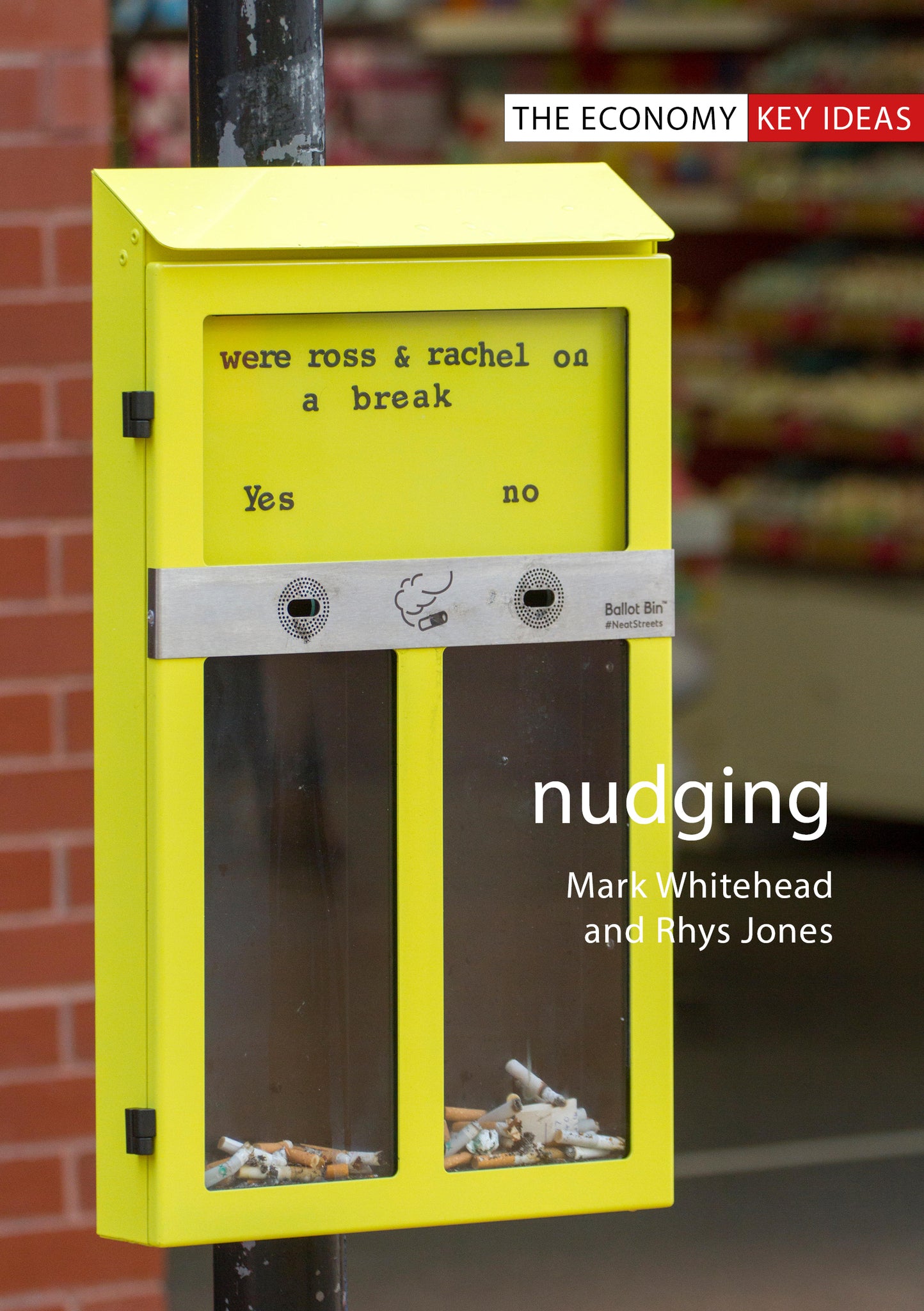
Nudging is a controversial technique for changing people’s behaviours. It burst into public consciousness in the early 2000s with the launch of “nudge units” and departments in government. Its use as a policy tool is particularly polarizing as it raises moral and constitutional issues about freedom of choice and coercion.
Mark Whitehead and Rhys Jones consider how the nudge as a mechanism for policy implementation came about and why it gives rise to such strong feelings. They explain what a nudge is, how it differs from other behavioural prompts, and consider whether we should use them and, if so, when and where they are best deployed. In particular, they explore how the proliferation of digital media throughout our lives has given nudging a new impetus and sphere of operation, which can be both harder for consumers and citizens to detect and more contentious.

— Professor Peter John, Head of School of Politics and Economics, King’s College London
Rhys Jones is a Professor of Human Geography at Aberystwyth University. His research interests are in the broad area of political geography, focusing on themes such as the state, nationalism, behaviour change. He has published 12 books.
Mark Whitehead is a Professor of Human Geography at Aberystwyth University. His research interests span urban studies, sustainability, the impacts of the psychological sciences on public policy, and the social implications of smart technology. He has authored and edited 11 books.
1. Nudge: a gentle form of power
2. Histories of nudging
3. Nudges in practice
4. Critiques of controversies
5. The digital future
6. Conclusion