


Some error occured while loading the Quick View. Please close the Quick View and try reloading the page.
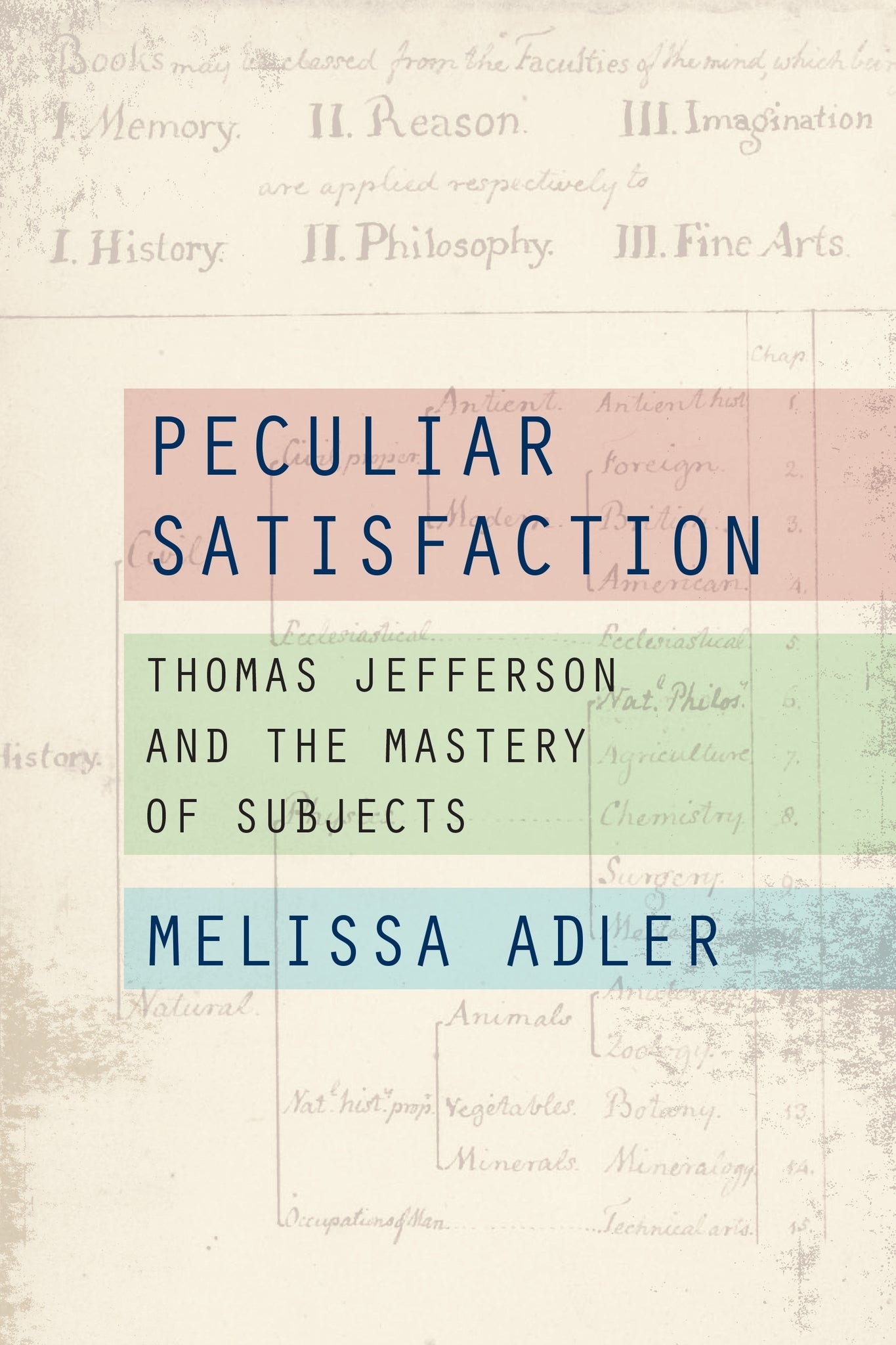
How Thomas Jefferson’s vision for knowledge shapes what we know and how we access it—and why that matters more than ever
As the United States approaches the 250th anniversary of the Declaration of Independence, Peculiar Satisfaction examines how the ideals and contradictions of the nation’s founding live on in libraries, archives, and museums. Thomas Jefferson championed an informed citizenry as essential to democracy, yet the systems he built to organize knowledge reinforced racial and ideological hierarchies that persist today.
Melissa Adler explores Jefferson’s lasting influence on public institutions, from his personal library, which became the foundation of the Library of Congress, to his archival practices in government record-keeping and his museum at Monticello as a site of colonial knowledge production. Through an interdisciplinary lens, she reveals how his methods of classification and preservation shaped national memory and democratic participation.
Drawing from archival research and critical theory, Peculiar Satisfaction exposes the paradoxes of access, exclusion, and control embedded in information systems. As censorship and disinformation threaten democracy, Adler argues that understanding these foundational structures is essential to defending the role of knowledge in public life.
Offering a fresh perspective on the ways information, power, and race have shaped American institutions, this book will engage scholars and general readers interested in how libraries, archives, and museums influence history, democracy, and collective memory and argues for a nuanced understanding of these institutions at a critical moment where disinformation and authoritarian rule threaten to undo them.

This book is a masterful tour of how information worlds – even those more than 200 years old – continue to shape our cultural and political sensibilities. Choices about what to include and exclude from an archive or a library, how to organize and arrange those items, and how we memorialize our memories and histories rarely come together in one book. Adler handles all these themes deftly and clearly. This will be of great use to cultural historians, librarians, media scholars, and Jefferson fans alike.
---Siva Vaidhyanathan, Professor of Media Studies, the University of VirginiaPrologue | ix
Note on Language, Spelling, Naming, and Citationality | xxiii
Introduction: “These Precious Monuments of Our Property and Our History” | 1
PART 1 – ARCHIVES
1 Information as Revolutionary Action | 31
2 Archives and the Making of American History | 55
3 Haunted Ontologies | 83
PART 2 – LIBRARIES
4 “A Blueprint of His Own Mind”: Jefferson’s Libraries | 115
5 The Racial Aesthetic of Jefferson’s Library Catalog | 149
6 From Geography to History | 173
PART 3 – MUSEUMS
7 Jefferson’s “Indian Hall” and the Doctrine of Discovery | 197
8 How the American Antelope [sic] Became a Document | 220
Coda: Afterlife of Information | 241
Acknowledgments | 257
Notes | 261
Bibliography | 301
Index | 325