


Some error occured while loading the Quick View. Please close the Quick View and try reloading the page.
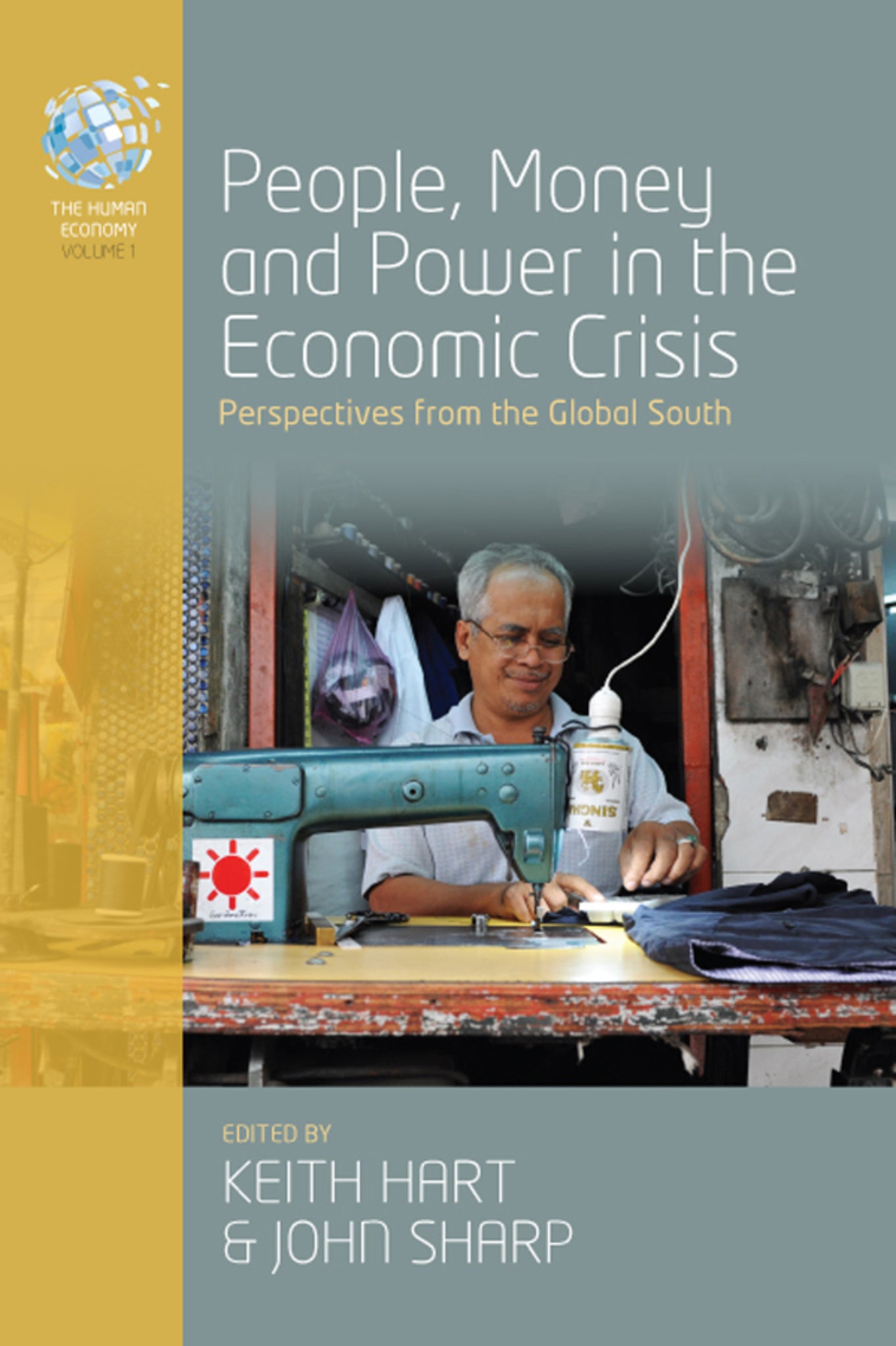
The Cold War was fought between “state socialism” and “the free market.” That fluctuating relationship between public power and private money continues today, unfolding in new and unforeseen ways during the economic crisis. Nine case studies -- from Southern Africa, South Asia, Brazil, and Atlantic Africa – examine economic life from the perspective of ordinary people in places that are normally marginal to global discourse, covering a range of class positions from the bottom to the top of society. The authors of these case studies examine people’s concrete economic activities and aspirations. By looking at how people insert themselves into the actual, unequal economy, they seek to reflect human unity and diversity more fully than the narrow vision of conventional economics.

“A striking element of the volume is the interdisciplinarity of its textual form. While most of the contributors are in fact sociocultural anthropologists, the appropriation of templates and literary conventions within and across the fields of history, sociology, political economy and geography reflects the seriousness of the authors’ coalition building aspirations.” · Anthropological Forum
“[This volume} represents a vital disciplinary turn away from formal institutions toward the ways that individuals, classes, races, or ethnic groups actually navigate and respond to their economic circumstances. As anthropologists, this material should be inspirational, for many reasons among which are an appreciation that informal activities are not unimportant or disorganized activities, that 'subalterns' are not passive in the face of their disadvantages, and that 'resistance' is not the only option open to them.” · Anthropology Review Database
“This volume will be a valuable contribution to economic anthropology. The empirically rigorous cases reveal just why the methods that we associate with anthropology are fundamental to our understanding of the economy… [It] urges us to rethink what ‘the crisis’ – the aftermath of the 2008 financial meltdown - really is.” · Erik Bähre, Leiden University
Keith Hart is a co-director of the Human Economy Program at the University of Pretoria and Centennial Professor of Economic Anthropology at the London School of Economics and Political Science. His recent books include The Human Economy: A Citizen’s Guide (with Jean-Louis Laville and Antonio David Cattani, 2010) and Economic Anthropology: History, Ethnography, Critique (with Chris Hann, 2011).
Preface: The Human Economy Project
Keith Hart and John Sharp
Introduction
Keith Hart and John Sharp
Chapter 1. After the Big Clean-up: Street Vendors, the Informal Economy and Employment Policy in Zimbabwe
Busani Mpofu
Chapter 2. Immoral Accumulation and the Human Economy of Death in Venda
Fraser McNeill
Chapter 3. ‘Letting Money Work for Us’: Self-organization and Financialization from Below in an All-male Savings Club in Soweto
Detlev Krige
Chapter 4. Market, Race and Nation: History of the White Working Class in Pretoria
John Sharp
Chapter 5. Negotiating Inequality: the Contemporary Black Middle Classes in Salvador, Brazil
Doreen Gordon
Chapter 6. Live Music in the Age of Digital Reproduction: Cape Verde
Juliana Braz Dias
Chapter 7. Congo-Gauteng: Congolese Migrants in South Africa
Saint-José Inaka and Joseph Trapido
Chapter 8. Neither Nationals nor Cosmopolitans: the Political Economy of Belonging for Mozambican Indians
Jason Sumich
Chapter 9. Marwari Traders between Hindu Neoliberalism and Democratic Socialism in Nepal
Mallika Shakya
References
Notes on Contributors
Index