


Some error occured while loading the Quick View. Please close the Quick View and try reloading the page.
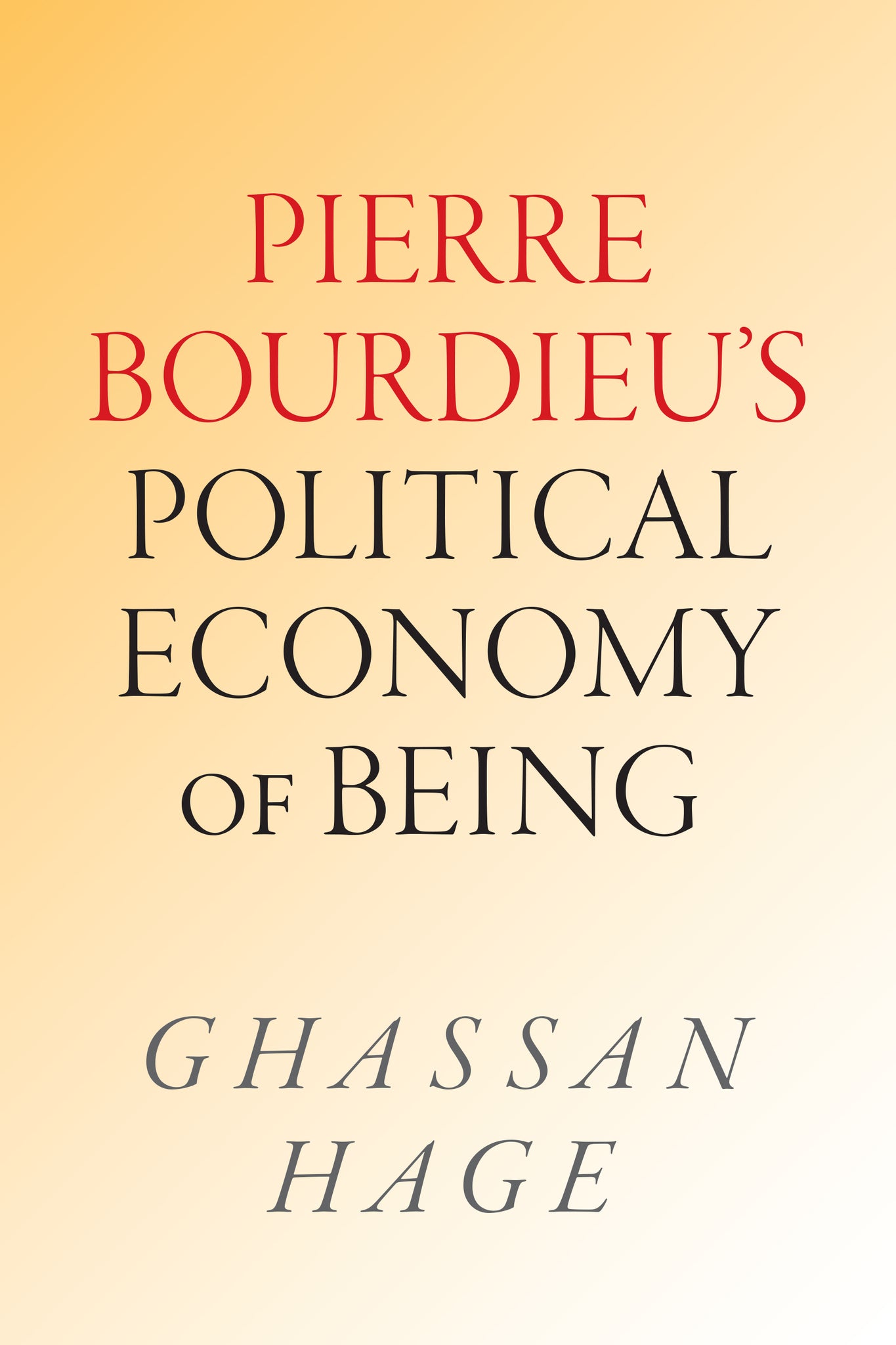
In Pierre Bourdieu’s Political Economy of Being, Ghassan Hage explores the great French social theorist’s work and revitalizes conventional and undertheorized aspects of his thinking. Hage focuses on Bourdieu’s concern with social being and what constitutes a worthwhile and fulfilling life. Such a life is not something that one either has or does not have; rather, society distributes and assigns values to ways of living. These values are structured by relations of power and domination and are subject to the outcome of political conflicts. Hage elucidates this political economy of being by reworking Bourdieu’s key concepts of habitus, illusio, symbolic capital, and field. In this political economy, people enjoy a worthwhile life to the degree that they are able to orient and deploy themselves practically in the world that surrounds them, have a sense of purpose, and achieve a level of social recognition. For Hage, the project of theorizing and understanding how people struggle to define, legitimize, and live a viable life in the face of symbolic domination permeates all of Bourdieu’s work.

Price: $23.95
Pages: 184
Publisher: Duke University Press
Imprint: Duke University Press
Publication Date:
14 October 2025
Trim Size: 9.00 X 6.00 in
ISBN: 9781478032625
Format: Paperback
BISACs:
“Ghassan Hage offers an enlightened and lucid rereading of Pierre Bourdieu’s theory. With conceptual clarity, Hage shows that Bourdieu’s dual insistence on both the empirical and the philosophical is very productive and generative. A brilliant book.”—Françoise Vergès, author of, Making the World Clean: Wasted Lives, Wasted Environment, and Racial Capitalism
“Among the innumerable studies on Pierre Bourdieu’s work, Ghassan Hage’s essay stands out as a personal inquiry into unexplored tracks. Extracting unexpected gems from the French sociologist’s empirically grounded political philosophy, it is a thoughtful intellectual enterprise by one of the most original anthropologists of our time.”—Didier Fassin, Professor at the Collège de France and the Institute for Advanced Study
“Among the innumerable studies on Pierre Bourdieu’s work, Ghassan Hage’s essay stands out as a personal inquiry into unexplored tracks. Extracting unexpected gems from the French sociologist’s empirically grounded political philosophy, it is a thoughtful intellectual enterprise by one of the most original anthropologists of our time.”—Didier Fassin, Professor at the Collège de France and the Institute for Advanced Study
Ghassan Hage is Professor of Anthropology and Social Theory at the University of Melbourne and the author of several books, including The Racial Politics of Australian Multiculturalism and The Diasporic Condition: Ethnographic Explorations of the Lebanese in the World.
Preface vii
Acknowledgments xi
Introduction: The Political Economy of Being . . . and How to Analyze It 1
1. Social Efficiency and Social Complicity 20
2. Structure, Capacity, and Dispositionality 41
3. On the Production and Distribution of the Meaningful Life 62
4. The Means and Ends of Recognition 80
5. The Social Physics of Existential Mobility 92
Conclusion: Viability and the Politics of Existential Ecologies 113
Notes 133
Bibliography 149
Index 161
Acknowledgments xi
Introduction: The Political Economy of Being . . . and How to Analyze It 1
1. Social Efficiency and Social Complicity 20
2. Structure, Capacity, and Dispositionality 41
3. On the Production and Distribution of the Meaningful Life 62
4. The Means and Ends of Recognition 80
5. The Social Physics of Existential Mobility 92
Conclusion: Viability and the Politics of Existential Ecologies 113
Notes 133
Bibliography 149
Index 161