


Some error occured while loading the Quick View. Please close the Quick View and try reloading the page.
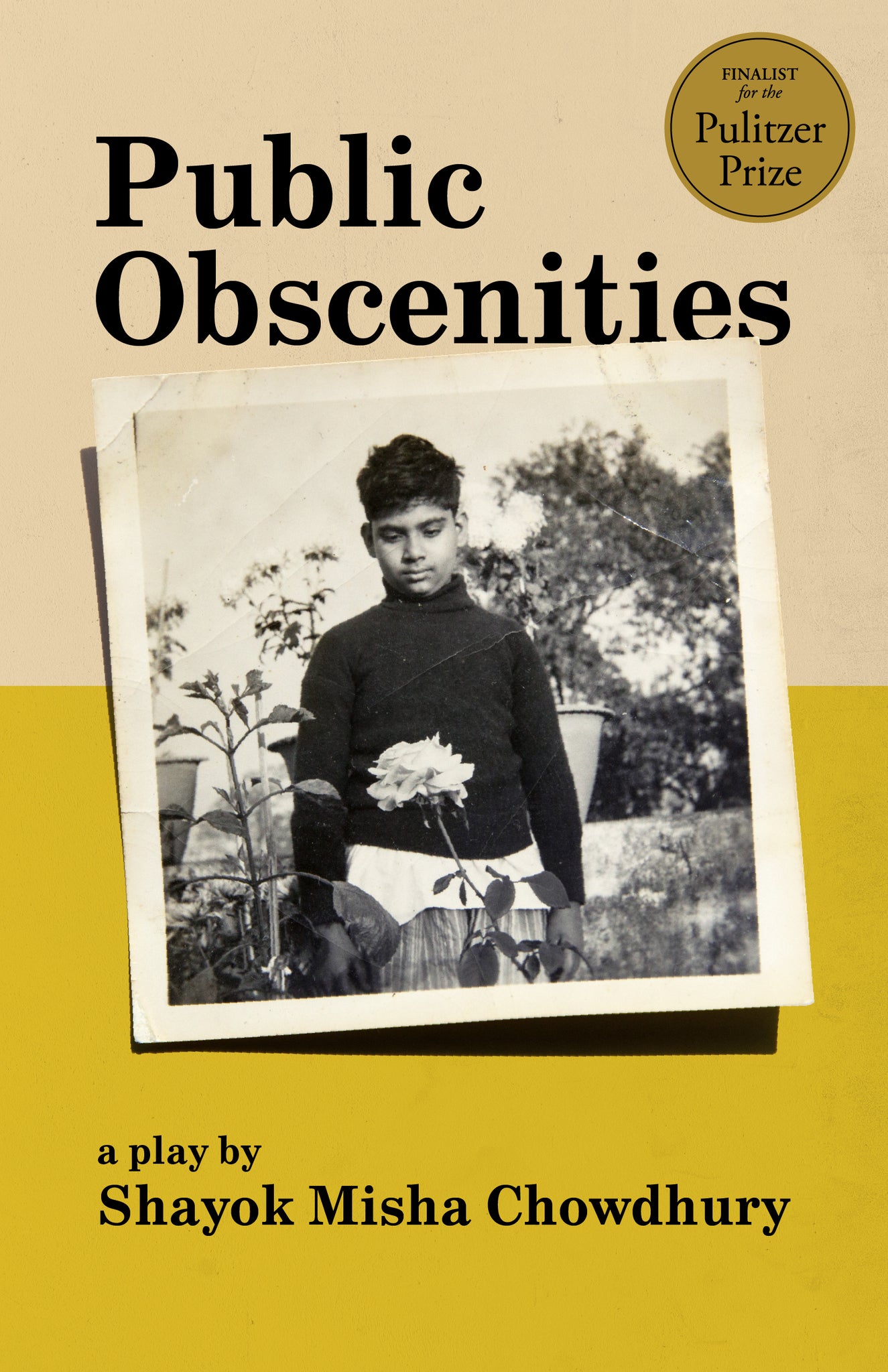
Finalist for the 2024 Pulitzer Prize for Drama
A complex and compelling bilingual play that examines the intersections of queerness and Indian-American identity.
When Indian-American graduate student Choton travels from the U.S. to his family’s home city of Kolkata to film interviews with the local queer community, he relishes acting as the local expert, especially in his role as interpreter between Bangla and English for his filmmaker boyfriend. Soon, though, Choton starts to question not only what he thinks he knows about queerness in India, but what both queerness and his Indian heritage mean for him. When a rediscovered roll of film reveals surprisingly intimate photographs of Choton’s austere grandfather (taken by whom?), Choton’s understanding of his family, both living and dead, starts to unravel. What follows is a mesmerizing examination of intercultural identity, asking audiences to reconsider what we mean when we call a place home.

It is a testament to Shayok Misha Chowdhury’s gifts as a writer that he is able to evoke as many themes, histories and possibilities as he does in Public Obscenities and leave his audience not dazed or frustrated, but longing for even more…Chowdhury is a writer with great promise who, with Public Obscenities, may have found himself on the brink of greatness.
—Juan A. Ramírez,New York Times
An absolute stunner.
—The Wrap
A stately, naturalistic, complexly layered masterwork…As a writer, Chowdhury interweaves humor, allusion, gravity, and extended metaphor as if each quality were a musical line, making an integrated, symphonic whole.
—Helen Shaw, New Yorker
One can walk away from Public Obscenities having experienced it not as a story but as the everyday texture of the characters’ lives, and the thick tapestry of themes that Chowdhury weaves around them—about the difficulty of communicating and of love, about the struggles to overcome strictures of caste and gender and sexuality, about memory and loss, longing and belonging.
—New York Theater
Gripping and enthralling…Through the act of filmmaking, the play asks the viewer to interrogate their relationships between what is hidden and what is shown, the lens with which we view ourselves and our families, and how the act of translation can bring us together, even as they seemingly keep us apart.
—Anjor Khadilkar, Asian American Arts Alliance
In this meticulously rendered middle-class Bengali home, the characters of Public Obscenities won’t howl and grandstand. They won’t soliloquize or strut or be shattered by a devastating third-act reveal. They will simply live. The play’s great poignancy lies in its restraint, in the moments that could lead to shouting and instead lead to silence and space, the insufficiency—especially in a world of constant translation—of language.
—Sara Holdren, Vulture
Shayok Misha Chowdhury is a writer and director based in Brooklyn. His play Public Obscenities, which he also directed, premiered in the spring of 2023 at Soho Rep in a co-commission with NAATCO. Misha was also awarded a Jonathan Larson Grant for his body of work writing musicals with composer Laura Grill Jaye; their most recent collaboration, How the White Girl Got Her Spots and Other 90s Trivia was awarded the 2022 Relentless Award.
Chowdhury is the creator of VICHITRA, a series of sound-driven, cinematic experiments, including Englandbashi, The Other Other, An Anthology of Queer Dreams, and In Order to Become, which he is developing into a live Carnatic opera.
Chowdhury is also a poet whose work has been published in The Cincinnati Review, Hayden’s Ferry Review, Asian American Literary Review, Lantern Review and elsewhere. He has taught and directed at Stanford University, Brown University, New York University, California Institute of the Arts, Fordham University, Syracuse University, University of the Arts, Hunter College, Carnegie-Mellon University, and Williams College.