Skip to product information
1 of 1

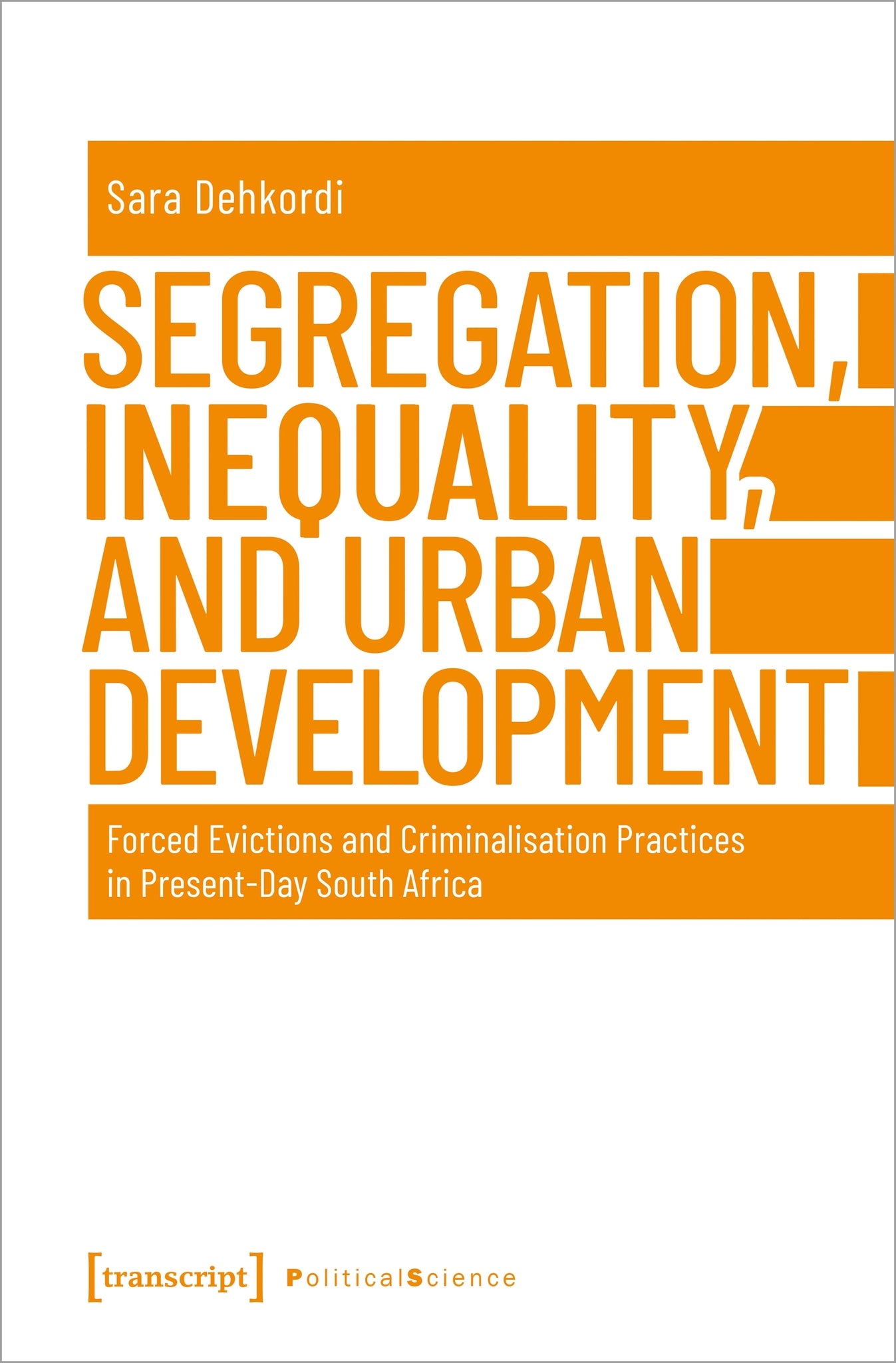
Segregation, Inequality, and Urban Development

Regular price $40.00
Sale price $40.00 Regular price $40.00
Sale Sold out
In present-day South Africa, urban development agendas have inscribed doctrines of desirable and undesirable life in city spaces and the public that uses the space. This book studies the ways in wh...
Read More
  • Format:
  • 27 July 2020
View Product Details
In present-day South Africa, urban development agendas have inscribed doctrines of desirable and undesirable life in city spaces and the public that uses the space. This book studies the ways in which segregated city spaces, displacement of people from their homes, and criminalization practices are structured and executed. Sara Dehkordi shows that these doctrines are being legitimized and legalized as part of a discursive practice and that the criminalization of lower-class members are part of that practice, not as random policing techniques of individual security forces, but as a technology of power that attends to the body, zooms in on it, screens it, and interrogates it.
files/i.png Icon
Price: $40.00
Pages: 262
Publisher: transcript publishing
Imprint: transcript publishing
Publication Date: 27 July 2020
Trim Size: 8.86 X 5.83 in
ISBN: 9783837653106
Format: Paperback
BISACs:

POLITICAL SCIENCE / Colonialism & Post-Colonialism, SOCIAL SCIENCE / Discrimination, SOCIAL SCIENCE / Social Classes & Economic Disparity

Sara Dehkordi is a lecturer at the Department of Political and Social Sciences at the Freie Universität Berlin. She teaches postcolonial and decolonial theories, on colonial genocide, the Negritude and Black Consciousness Movement, neoliberal urbanism, and critical peace and conflict studies.
She has received the German Tiburtius Prize for outstanding research for her work leading to the book »Segregation, Inequality, and Urban Development«.

Frontmatter 1
Contents 5
Acknowledgements 9
Introduction 13
Chapter one. The colonial archives repertoire 29
Chapter two. Policies of Displacement - Forced Evictions and their Discursive Framing 67
Chapter three. "Cleaning" the streets - Urban Development Discourse and criminalisation practices 97
Chapter four. Architectures of Division 161
Chapter five. Intervention through art - Performing is making visible 209
Conclusions 241
Epilogue 247
Bibliography 251