


Some error occured while loading the Quick View. Please close the Quick View and try reloading the page.
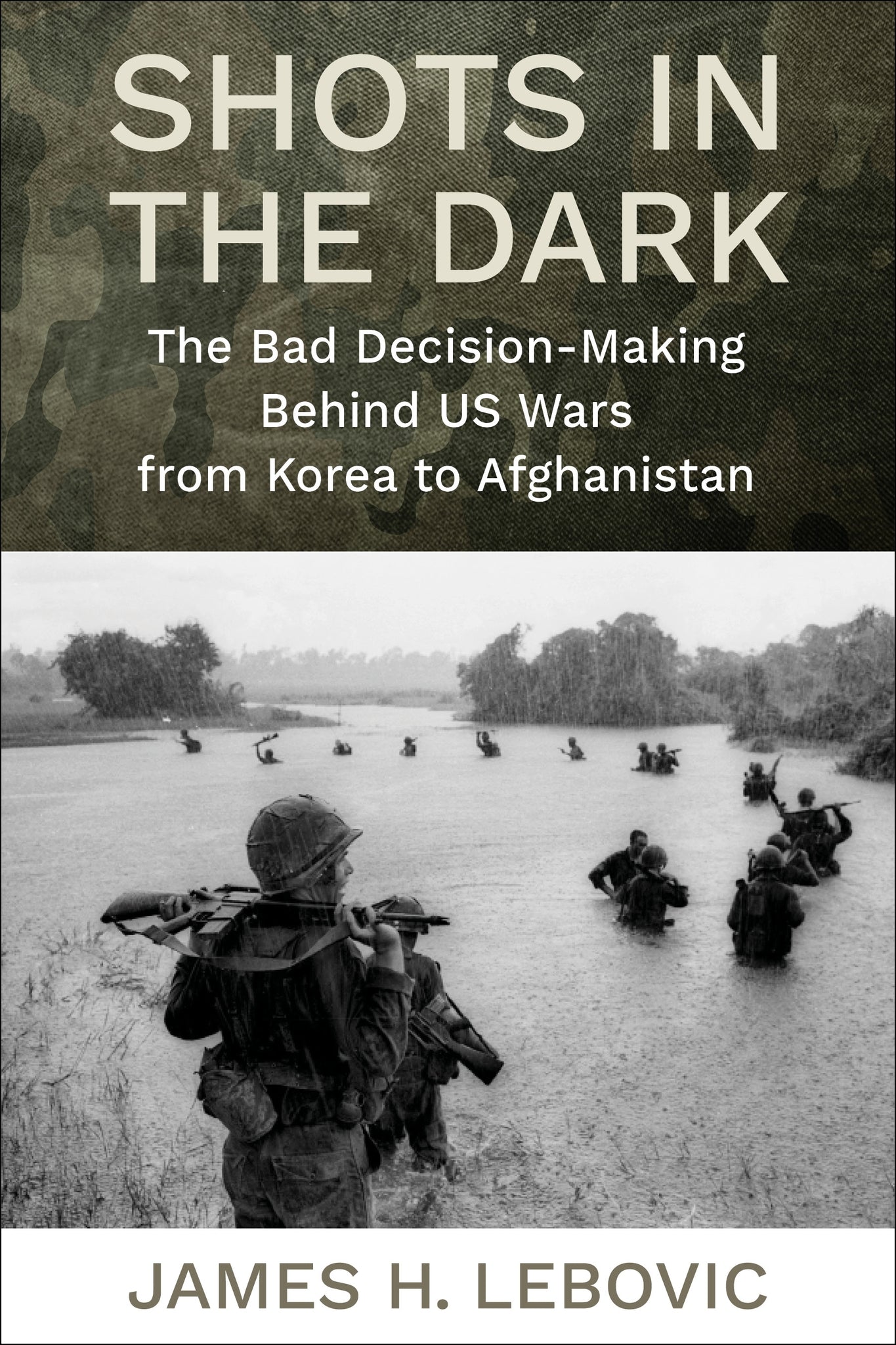
Why have US wars so often failed to go as planned? Four of the major conflicts in the post–World War II era—Korea, Vietnam, Iraq, and Afghanistan—lasted far longer, cost far more, and yielded far poorer results than what prewar predictions anticipated.
Shots in the Dark offers a new analysis of the pervasive biases that have afflicted decision-making in the lead-up to and early days of US military interventions. James H. Lebovic shows that leaders repeatedly made choices marred by short-term thinking and cognitive blind spots, lacking a clear sense of how particular policies would accomplish broader strategic objectives. Policymakers fixated on achieving immediate results through force of arms without interrogating buried assumptions, mapping out the potential consequences, reconciling conflicting priorities, or considering tradeoffs. Such flawed reasoning eventually made military force appear to be the only viable option.
To account for this persistent pattern, Lebovic develops an original theory of “instrumental bias,” reveals its telltale tendencies, and uncovers its results in the Korean, Vietnam, Iraq, and Afghanistan wars. Meticulously assessing the documentary evidence, he provides detailed reconstructions of top-level decision-making at key stages of these conflicts. Engagingly written and richly detailed, Shots in the Dark illuminates the biased thinking that has long undermined US foreign policy.

— Bruce W. Jentleson, author of Sanctions: What Everyone Needs to Know
Acknowledgments
1. Myopia in US Wartime Decision-Making
2. The Korean War
3. The Vietnam War in the Kennedy Administration
4. The Vietnam War in the Johnson Administration
5. The Lead-Up to the 2003 Iraq War, with Parallels to the War in Afghanistan
6. Final Thoughts: Bias in the US Approach to War
Notes
Bibliography
Index