


Some error occured while loading the Quick View. Please close the Quick View and try reloading the page.
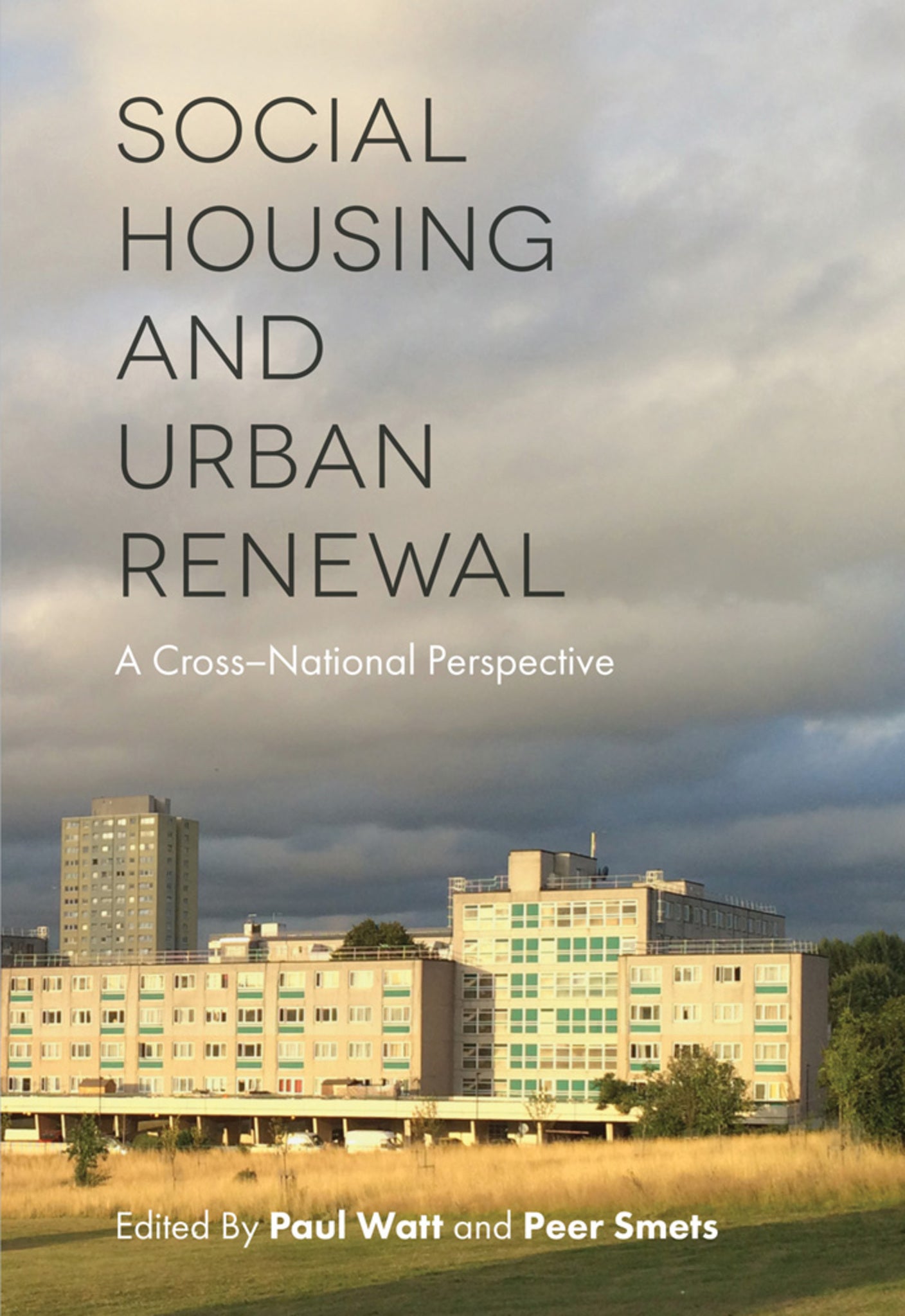
This book offers a cross-national perspective on contemporary urban renewal in relation to
social rental housing. Social housing estates – as developed either by governments (public
housing) or not-for-profit agencies – became a prominent feature of the 20th century urban
landscape in Northern European cities, but also in North America and Australia. Many
estates were built as part of earlier urban renewal, ‘slum clearance’ programs especially in
the post-World War 2 heyday of the Keynesian welfare state. During the last three decades,
however, Western governments have launched high-profile ‘new urban renewal’ programs
whose aim has been to change the image and status of social housing estates away from
being zones of concentrated poverty, crime and other social problems. This latest phase
of urban renewal – often called ‘regeneration’ – has involved widespread demolition of
social housing estates and their replacement with mixed-tenure housing developments in
which poverty deconcentration, reduced territorial stigmatization, and social mixing of poor
tenants and wealthy homeowners are explicit policy goals.
Academic critical urbanists, as well as housing activists, have however queried this dominant
policy narrative regarding contemporary urban renewal, preferring instead to regard it as
a key part of neoliberal urban restructuring and state-led gentrification which generate new
socio-spatial inequalities and insecurities through displacement and exclusion processes. This
book examines this debate through original, in-depth case study research on the processes and
impacts of urban renewal on social housing in European, U.S. and Australian cities. The book
also looks beyond the Western urban heartlands of social housing to consider how renewal is
occurring, and with what effects, in countries with historically limited social housing sectors such
as Japan, Chile, Turkey and South Africa.

Price: $61.99
Pages: 512
Publisher: Emerald Publishing Limited
Imprint: Emerald Publishing Limited
Publication Date:
04 November 2019
ISBN: 9781838679330
Format: Paperback
The 12 essays in this volume consider the impact of urban renewal on social housing in European, American, and Australian cities, as well as in Japan, Chile, and South Africa. Anthropologists, sociologists, urban studies specialists, and other researchers from these countries concentrate on the social processes and impacts of contemporary social housing renewal, particularly the themes of neighborhood and community, poverty and social exclusion, social mixing, mixed-tenure developments, neighborhood effects, territorial stigmatization, demolition, displacement, urban governance, state-led gentrification, and neoliberal urbanism. They examine how and why renewal occurs in different urban spatial contexts and how residents view and experience urban renewal, as well as the views of urban renewal officials and politicians. The book is based on a conference session, “Public/Social Rental Housing and Urban Renewal: New Inequalities and Insecurities?”, at the XVIII ISA World Congress of Sociology, held in July 2014 in Yokohama, Japan. Seven chapters are based on papers from the session.
— Annotation ©2017
— Annotation ©2017
Paul Watt is Reader in Urban Studies at the Department of Geography, Birkbeck, University of London, UK. Recent publications include, Mobilities and Neighbourhood Belonging in Cities and Suburbs, co-edited with Peer Smets (Palgrave Macmillan, 2014); and London 2012 and the Post-Olympics City: A Hollow Legacy?, co-edited with Phil Cohen
(Palgrave Macmillan, 2017).
Peer Smets is Assistant Professor at the Department of Sociology, Vrije Universiteit Amsterdam, the Netherlands. Recent publications include, Affordable Housing in the Urban Global South, co-edited with Jan Bredenoord and Paul Van Lindert (Earthscan/Routledge, 2014)
1. Introduction: Social Housing and Urban Renewal; Paul Watt
2. Holding on to HOPE: Assessing Redevelopment of Boston’s Orchard Park Public Housing Project; Shomon Shamsuddin and Lawrence J. Vale
3. “The Blue Bit, that was my Bedroom”: Rubble, Displacement and Regeneration in Inner-City London; Luna Glucksberg
4. Gentrification as Policy Goal or Unintended Outcome? Contested Meanings of Urban Renewal and Social Housing Reform in an Australian City; Lynda Cheshire
5. Are Social Mix and Participation Compatible? Conflicts and Claims in Urban Renewal in France and England; Agnès Deboulet and Simone Abram
6. Promoting Social Mix through Tenure Mix: Social Housing and Mega-Event Regeneration in Turin; Manuela Olanero and Irene Ponzo
7. Tenure Mix against the Background of Social Polarization: Social Mixing of Moroccan-Dutch and Native-Born Dutch in Amsterdam East; Peer Smets
8. Phased Out, Demolished and Privatized: Social Housing in an East German ‘Shrinking City’; Matthias Bernt
9. Social Housing and Urban Renewal in Tokyo: From Post-War Reconstruction to the 2020 Olympic Games; Chikako Mori
10. Territorial Stigmatization in Socially-Mixed Neighborhoods in Chicago and Santiago: A Comparison of Global-North and Global-South Urban Renewal Problems; Javier Ruiz-Tagle
11. Caught Between the Market and Transformation: Urban Regeneration and the Provision of Low-Income Housing in Inner-City Johannesburg; Aidan Mosselson
12. Social Housing, Urban Renewal, and Shifting Meanings of ‘Welfare State’ in Turkey:
A Study of the Karapınar Renewal Project, Eskişehir; Cansu Civelek
13. The Inbetweeners: Living with Abandonment, Gentrification and Endless Urban ‘Renewal’ in Salford, UK; Andrew Wallace
14. Conclusion; Peer Smets and Paul Watt