


Some error occured while loading the Quick View. Please close the Quick View and try reloading the page.
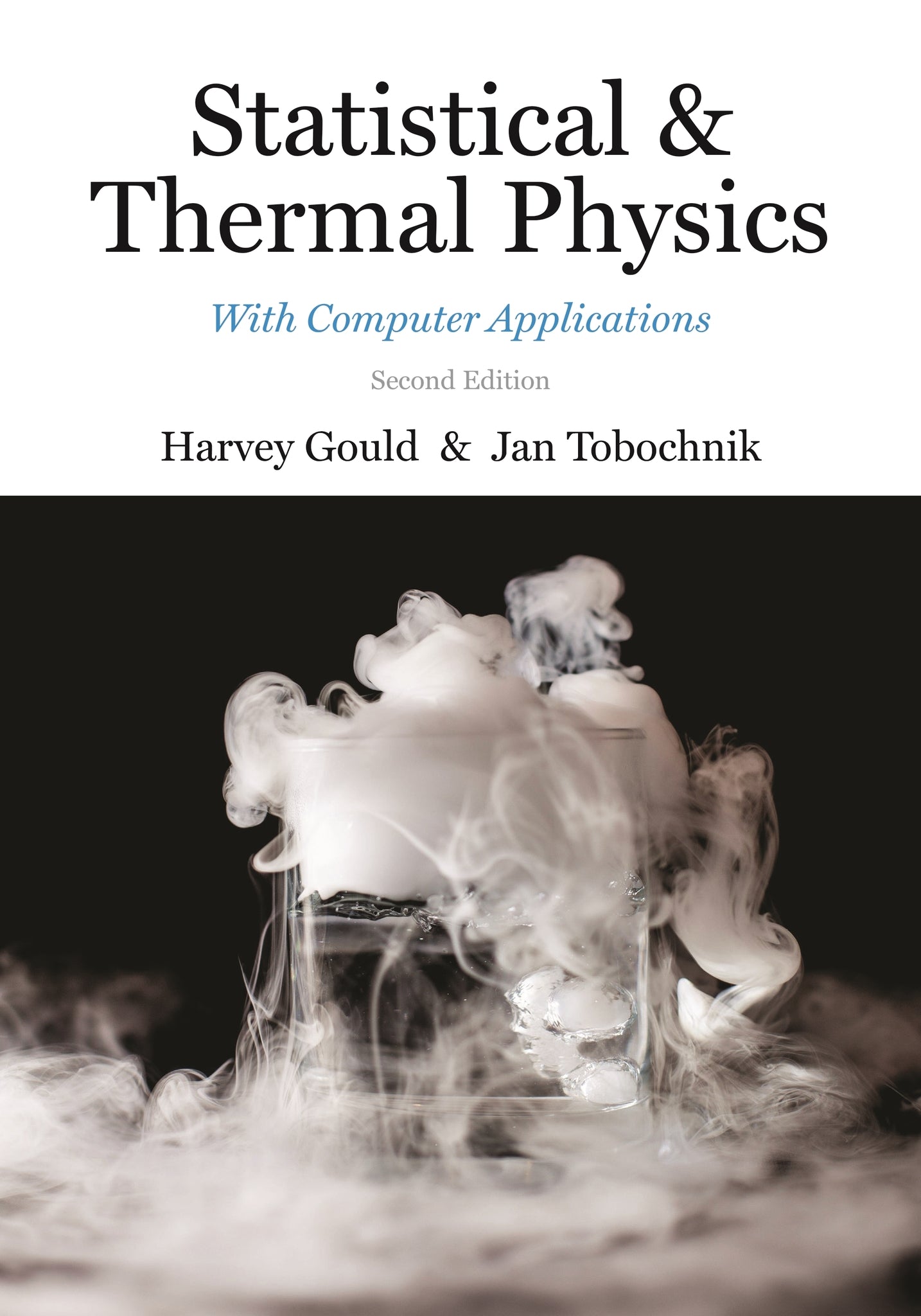
A completely revised edition that combines a comprehensive coverage of statistical and thermal physics with enhanced computational tools, accessibility, and active learning activities to meet the needs of today's students and educators
This revised and expanded edition of Statistical and Thermal Physics introduces students to the essential ideas and techniques used in many areas of contemporary physics. Ready-to-run programs help make the many abstract concepts concrete. The text requires only a background in introductory mechanics and some basic ideas of quantum theory, discussing material typically found in undergraduate texts as well as topics such as fluids, critical phenomena, and computational techniques, which serve as a natural bridge to graduate study.
- Completely revised to be more accessible to students
- Encourages active reading with guided problems tied to the text
- Updated open source programs available in Java, Python, and JavaScript
- Integrates Monte Carlo and molecular dynamics simulations and other numerical techniques
- Self-contained introductions to thermodynamics and probability, including Bayes' theorem
- A fuller discussion of magnetism and the Ising model than other undergraduate texts
- Treats ideal classical and quantum gases within a uniform framework
- Features a new chapter on transport coefficients and linear response theory
- Draws on findings from contemporary research
- Solutions manual (available only to instructors)

- Preface
- Updated Preface to the First Edition
- Links to Programs
- 1 From Microscopic to Macroscopic Behavior
- 1.1 Introduction
- 1.2 Some Qualitative Observations
- 1.3 Doing Work and the Quality of Energy
- 1.4 Thermal Equilibrium
- 1.4.1 A probabilistic model
- 1.4.2 Counting states
- 1.4.3 Some qualitative observations
- 1.5 Measuring the Pressure and Temperature
- 1.6 Work, Heating, and the First Law of Thermodynamics
- 1.7 *The Fundamental Need for a Statistical Approach
- 1.8 *Time and Ensemble Averages
- 1.9 Phase Changes and Cooperative Effects
- 1.10 Models of Matter
- 1.10.1 The ideal gas
- 1.10.2 Interparticle potentials
- 1.10.3 Lattice models
- 1.11 Importance of Simulations
- 1.12 Dimensionless Quantities
- 1.13 Summary
- 1.14 Supplementary Notes
- 1.14.1 Approach to equilibrium
- 1.14.2 Mathematics refresher
- Vocabulary
- Additional Problems
- Suggestions for Further Reading
- 2 Thermodynamic Concepts and Processes
- 2.1 Introduction
- 2.2 The System
- 2.3 Thermodynamic Equilibrium
- 2.4 Temperature
- 2.5 Pressure Equation of State
- 2.6 Some Thermodynamic Processes
- 2.7 Work
- 2.8 The First Law of Thermodynamics
- 2.9 Energy Equation of State
- 2.10 Heat Capacities and Enthalpy
- 2.11 Quasistatic Adiabatic Processes
- 2.12 The Second Law of Thermodynamics
- 2.13 The Thermodynamic Temperature
- 2.14 The Second Law and Heat Engines
- 2.15 Entropy Changes
- 2.16 Equivalence of Thermodynamic and Ideal Gas Scale Temperatures
- 2.17 The Thermodynamic Pressure
- 2.18 The Fundamental Thermodynamic Relation
- 2.19 The Entropy of an Ideal Classical Gas
- 2.20 The Third Law of Thermodynamics
- 2.21 Thermodynamic Potentials
- 2.22 Thermodynamic Derivatives
- 2.23 Applications to Irreversible Processes
- 2.23.1 Joule or free expansion process
- 2.23.2 Joule-Thomson process
- 2.24 Supplementary Notes
- 2.24.1 The mathematics of thermodynamics
- 2.24.2 Thermodynamic potentials and Legendre transforms
- Vocabulary
- Additional Problems
- Suggestions for Further Reading
- 3 Concepts of Probability
- 3.1 Probability in Everyday Life
- 3.2 The Rules of Probability
- 3.3 Mean Values
- 3.4 The Meaning of Probability
- 3.4.1 Information and uncertainty
- 3.4.2 *Bayesian inference
- 3.5 Bernoulli Processes and the Binomial Distribution
- 3.6 Continuous Probability Distributions
- 3.7 The Central Limit Theorem (or Why Thermodynamics Is Possible)
- 3.8 *The Poisson Distribution
- 3.9 *Are All Probability Distributions Gaussian?
- 3.10 Supplementary Notes
- 3.10.1 Method of undetermined multipliers
- 3.10.2 Derivation of the central limit theorem
- Vocabulary
- Additional Problems
- Suggestions for Further Reading
- 4 Methodology of Statistical Mechanics
- 4.1 Introduction
- 4.2 A Simple Example of a Thermal Interaction
- 4.3 Counting Microstates
- 4.3.1 Noninteracting spins
- 4.3.2 Harmonic oscillator
- 4.3.3 One particle in a one-dimensional box
- 4.3.4 One particle in a two-dimensional box
- 4.3.5 One particle in a three-dimensional box
- 4.3.6 Two noninteracting identical particles and the semiclassical limit
- 4.4 The Number of States of Many Noninteracting Particles: Semiclassical Limit
- 4.5 The Microcanonical Ensemble (Fixed E, V, and N)
- 4.6 The Canonical Ensemble (Fixed T, V, and N)
- 4.7 Simple Applications of the Canonical Ensemble
- 4.8 Grand Canonical Ensemble (Fixed T, V, and µ)
- 4.9 The Demon and the Boltzmann Distribution
- 4.10 Simulation of the Microcanonical Ensemble
- 4.11 Simulation of the Canonical Ensemble
- 4.12 *Entropy Is Not a Measure of Disorder
- 4.13 Supplementary Notes
- 4.13.1 Number of microstates of the Einstein solid
- 4.13.2 The volume of a hypersphere
- 4.13.3 Fluctuations in the canonical ensemble
- Vocabulary
- Additional Problems
- Suggestions for Further Reading
- 5 Magnetic Systems
- 5.1 Introduction
- 5.2 Thermodynamics of Magnetism
- 5.3 Noninteracting Magnetic Moments
- 5.4 The Ising Model
- 5.5 The Ising Chain
- 5.5.1 Exact enumeration
- 5.5.2 Spin-spin correlation function
- 5.5.3 Simulation of the Ising chain
- 5.5.4 Transfer matrix
- 5.5.5 Absence of a phase transition in one dimension
- 5.6 The Two-Dimensional Ising Model
- 5.6.1 Onsager solution
- 5.6.2 Computer simulation of the two-dimensional Ising model
- 5.7 Mean-Field Theory
- 5.7.1 *Phase diagram of the Ising model
- 5.8 *Simulation of the Number of States
- 5.9 Metastability and Nucleation
- 5.10 Supplementary Notes
- 5.10.1 Derivation of C(r) in one dimension
- 5.10.2 Lattice gas
- 5.10.3 The Heisenberg model of magnetism
- 5.10.4 Low temperature expansion
- 5.10.5 High temperature expansion
- Vocabulary
- Additional Problems
- Suggestions for Further Reading
- 6 Many-Particle Systems
- 6.1 The Ideal Gas in the Semiclassical Limit
- 6.2 Classical Statistical Mechanics
- 6.2.1 The equipartition theorem
- 6.2.2 The Maxwell velocity distribution
- 6.3 Occupation Numbers and Bose and Fermi Statistics
- 6.4 Quantum Ideal Gases in the Grand Canonical Ensemble
- 6.5 Distribution Functions of Ideal Bose and Fermi Gases
- 6.6 Single Particle Density of States
- 6.6.1 Photons
- 6.6.2 Nonrelativistic particles
- 6.7 The Equation of State of an Ideal Classical Gas: Application of the Grand Canonical Ensemble
- 6.8 Blackbody Radiation
- 6.9 The Ideal Fermi Gas
- 6.9.1 Ground state properties
- 6.9.2 Low temperature properties
- 6.10 The Heat Capacity of a Crystalline Solid
- 6.10.1 The Einstein solid
- 6.10.2 Debye model
- 6.11 The Ideal Bose Gas and Bose-Einstein Condensation
- 6.12 Supplementary Notes
- 6.12.1 Fluctuations in the number of particles
- 6.12.2 Low temperature expansion of an ideal Fermi gas
- Vocabulary
- Additional Problems
- Suggestions for Further Reading
- 7 The Chemical Potential and Phase Equilibria
- 7.1 Meaning of the Chemical Potential
- 7.2 Measuring the Chemical Potential in Simulations
- 7.3 Phase Equilibria
- 7.3.1 Equilibrium conditions
- 7.3.2 Simple phase diagrams
- 7.3.3 Clausius-Clapeyron equation
- 7.4 The van der Waals Equation of State
- 7.4.1 Maxwell construction
- 7.4.2 *Mean-field exponents and the van der Waals critical point
- 7.5 Chemical Reactions
- 7.6 Supplementary Notes: A demon with two sacks
- Vocabulary
- Additional Problems
- Suggestions for Further Reading
- 8 Classical Gases and Liquids
- 8.1 Density Expansion
- 8.2 The Second Virial Coefficient
- 8.3 *Diagrammatic Expansions
- 8.3.1 Cumulants
- 8.3.2 High temperature expansion
- 8.3.3 Density expansion
- 8.3.4 Higher order virial coefficients for hard spheres
- 8.4 The Radial Distribution Function
- 8.5 Perturbation Theory of Liquids
- 8.5.1 The van der Waals equation
- 8.6 *The Ornstein-Zernike Equation and Integral Equations for g(r)
- 8.7 *One-Component Plasma
- 8.8 Supplementary Notes
- 8.8.1 The third virial coefficient for hard spheres
- 8.8.2 Definition of g(r) in terms of the local particle density
- 8.8.3 X-ray scattering and the static structure function
- 8.8.4 Compressibility equation
- Vocabulary
- Additional Problems
- Suggestions for Further Reading
- 9 Critical Phenomena: Landau Theory and the Renormalization Group Method
- 9.1 Landau Theory of Phase Transitions
- 9.2 Universality and Scaling Relations
- 9.3 A Geometrical Phase Transition
- 9.4 Renormalization Group Method for Percolation
- 9.5 The Renormalization Group and the Ising Model in One Dimension
- 9.6 *The Renormalization Group and the Ising Model in Two Dimensions
- 9.7 Supplementary Notes: Decimation
- Vocabulary
- Additional Problems
- Suggestions for Further Reading
- 10 It Is About Time: Time-Dependent Phenomena
- 10.1 Random Walks and Self-Diffusion
- 10.2 The Diffusion Equation
- 10.3 The Velocity Autocorrelation Function
- 10.4 Kinetic Theory of a Dilute Gas
- 10.5 Thermal Conductivity
- 10.6 Viscosity
- 10.7 The Langevin Equation and the Fluctuation-Dissipation Theorem
- 10.8 Linear Response
- 10.9 What If We Had More Time?
- Supplementary Notes
- 10.9.1 Solution of the diffusion equation
- 10.9.2 Relation of the self-diffusion coefficient to the velocity autocorrelation function
- 10.9.3 The Boltzmann equation
- 10.9.4 More on linear response theory
- Vocabulary
- Additional Problems
- Suggestions for Further Reading
- Appendix: Physical Constants and Mathematical Relations
- A.1 Physical Constants and Conversion Factors
- A.2 Hyperbolic Functions
- A.3 Approximations
- A.4 Euler-Maclaurin Formula
- A.5 Gaussian Integrals
- A.6 Stirling’s Approximation
- A.7 Bernoulli Numbers
- A.8 Probability Distributions
- A.9 Fourier Transforms
- A.10 The Delta Function
- A.11 Convolution Integrals
- A.12 Fermi and Bose Integrals
- Index